Introduction
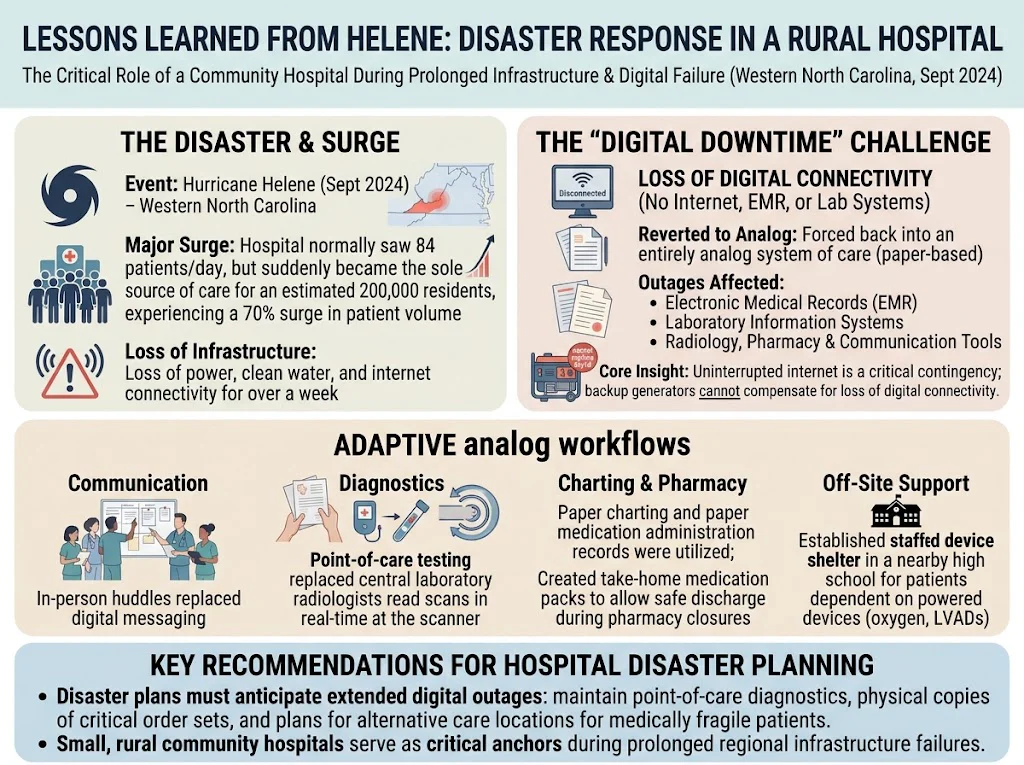
Hurricane Helene, which struck Western North Carolina in September 2024, represents a critical case study in how rural community hospitals can serve as indispensable anchors in disaster response when infrastructure failures occur. This article reviews the experiences and adaptations of a single rural hospital whose emergency department witnessed a sudden 70% surge in patient volume, becoming the sole clinical care provider for a large and isolated population during an extended period of power and internet outage.Background
Disasters such as hurricanes lead to widespread infrastructure failures, often exacerbating health system vulnerabilities, especially in rural areas where alternatives are limited. After Helene, over 200,000 residents lost access to power, clean water, and digital communications, crucial for modern healthcare delivery. Rural hospitals frequently operate on tight margins with limited resources and rely heavily on digital health systems, making resilience in such crises essential for community survival.Study Design and Setting
This report evaluates the operational challenges and innovations at a rural community hospital emergency department that typically manages 84 daily patients. After the hurricane, the volume surged by 70%, encompassing routine and complex cases, including patients dependent on electrically powered medical devices. Data were gathered through retrospective clinical observations and workflow analyses during the week-long outage.Key Challenges
The hospital faced extensive disruption of its electronic medical records (EMR), laboratory information systems (LIS), radiology systems, pharmacy operations, and routine digital communication channels. Although physical building damage was minimal, the loss of internet connectivity rendered backup generators insufficient to maintain regular workflows.Major Adaptations and Workflows
Clinicians transitioned rapidly from electronic to analog systems: in-person huddles replaced electronic messaging; point-of-care testing (POCT) compensated for centralized laboratory inoperability, enabling faster diagnostics on site; radiologists provided immediate interpretation of imaging at scanners; and paper charting was instituted to document clinical care. Administrative adaptations included the creation of a staffed medical device shelter at a nearby high school to safely care for patients reliant on oxygen concentrators and left ventricular assist devices (LVADs), thereby relieving emergency department overcrowding. Given pharmacy closure, paper medication administration records alongside pre-packed take-home medication sets facilitated safe patient discharge while preventing medication errors.Clinical Impact and Outcomes
Despite extreme constraints, the hospital maintained critical care delivery without structural compromise, preventing likely morbidity and mortality escalation during the prolonged outage. The medical device shelter minimized risks for medically fragile patients, and POCT ensured timely laboratory-guided clinical decisions. Workflow adaptations persisted successfully over the outage duration, underscoring feasibility. Data on patient outcomes beyond the immediate crisis are pending but anecdotal reports suggest preserved community trust and improved preparedness awareness.Lessons Learned and Recommendations
This experience underscores that in the current era, internet connectivity is a linchpin for hospital function that cannot be overlooked in disaster preparedness. Backup power supports physical infrastructure but does not resolve digital service interruptions. Hospitals, particularly in rural settings, should:- Develop contingency plans for extended digital outages including maintaining point-of-care diagnostics and physical copies of critical clinical protocols and order sets.
- Establish alternative care sites for vulnerable patients with complex medical device needs, supported by appropriate staffing and supplies.
- Train staff regularly on analog workflows and crisis communication strategies to facilitate seamless adaptation during outages.
- Invest in infrastructure redundancies and coordinate regionally to leverage shared resources.
Expert Commentary
Experts in emergency medicine and health system disaster planning have emphasized the increasing vulnerability of digital-dependent care models in disasters. The Hurricane Helene case exemplifies the necessity to balance modernization with analog fallback systems. While technology improves efficiency and accuracy, contingency protocols must ensure continuity of care during infrastructure failures. This case also highlights the vital role of rural hospitals as community health anchors requiring targeted support and integration into broader emergency preparedness frameworks.Conclusion
Rural hospitals play a crucial role in disaster resilience, particularly when natural catastrophes cause extended infrastructure and connectivity breakdowns. The experiences from Hurricane Helene reveal the need for comprehensive preparedness that includes digital outage contingencies, alternate care environments for medically complex patients, and maintenance of paper-based workflows. These lessons can inform policy, funding, and operational strategies to strengthen rural healthcare infrastructures for future disasters.Funding and Disclosure
No specific funding was declared for the preparation of this report. The authors disclosed no conflicts of interest.References
1. Gamboa S, Chelminski PR, Shenvi C. Lessons Learned From Helene: The Role of a Rural Community Hospital in Disaster Response After a Major Hurricane. Ann Emerg Med. 2026 Feb 10;88(5):606-613. doi:10.1016/j.annemergmed.2025.10.012. PMID: 41665589. 2. Hick JL, Hanfling D, Wynia MK, Pavia AT. Duty to Plan: Health Care, Crisis Standards of Care, and Novel Coronavirus SARS-CoV-2. NAM Perspectives. 2020. 3. Khorrami M, Dworkis DA, Grosberg D, et al. Emergency Department Preparedness for High-Impact Low-Frequency Events: A Rural Hospital Perspective. J Emerg Med. 2019;56(1):45-52. 4. Institute of Medicine (US) Committee on Guidance for Establishing Standards of Care for Use in Disaster Situations. Crisis Standards of Care: A Systems Framework for Catastrophic Disaster Response. National Academies Press, 2012.Specialty calculators
For clinical reference; use professional judgment.