Highlight
- Longitudinal MRI assessment revealed modest associations between acetabular labral tears and subsequent cartilage loss in young high-impact athletes.
- Anterior labral tears and presence of paralabral cysts correlated with an increased risk of cartilage deterioration over 2–3 years.
- The findings suggest labral pathology contributes to early joint degeneration but is only part of a multifactorial process leading to cartilage loss.
- Further research is needed to develop targeted preventive interventions to slow hip cartilage degeneration in athletes.
Study Background
Femoroacetabular impingement (FAI) and associated labral pathology are recognized contributors to hip joint pain and early osteoarthritis, especially in young adults engaged in high-impact sports such as soccer and Australian football. The acetabular labrum plays a key role in hip joint stability and cartilage protection. Labral tears are prevalent in athletes and have been proposed to accelerate cartilage damage, potentially precipitating early osteoarthritis. Despite these hypotheses, longitudinal evidence delineating the direct relationship between labral tears and cartilage loss in an athletic population was lacking.
Study Design
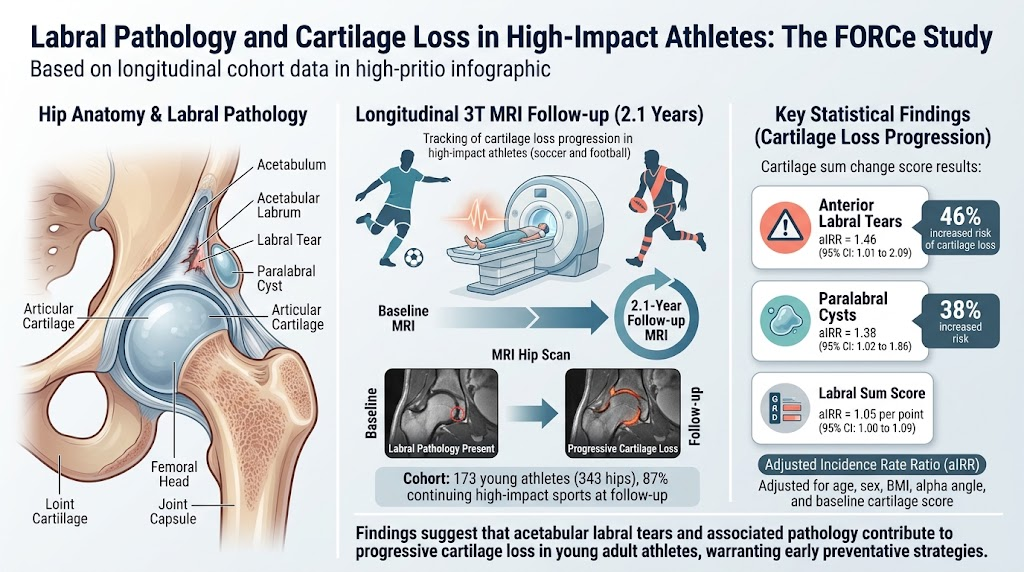
The FORCe (Femoroacetabular impingement and hip osteoarthritis Research Consortium) study is a prospective longitudinal cohort involving young adult high-impact athletes (predominantly soccer and Australian football players). The cohort included participants both with and without hip and/or groin pain, all assessed at baseline and followed up after 2–3 years using 3 Tesla (3T) magnetic resonance imaging (MRI).
Semiquantitative scoring methods evaluated the presence and severity of labral tears (grade ≥2 indicating distinct tear) and cartilage defects across hip subregions. The number of subregions affected, maximal labral score, overall labral sum score, and presence of paralabral cysts were documented at baseline. Cartilage loss was quantified as the cartilage sum change score, derived as the difference between baseline and follow-up cartilage defect scores (scale 0–20).
Negative binomial regression models were employed to examine associations between baseline labral pathology and subsequent cartilage loss, while adjusting for important confounders including age, sex, body mass index (BMI), alpha angle (a measure relevant to FAI), and baseline cartilage status.
Key Findings
The study enrolled 173 participants (343 hips), median age 26 years; 82% reported hip/groin pain at baseline; 22% female. The median International Hip Outcome Tool-33 (iHOT-33) score was 69, indicating moderate hip-related symptoms and function.
After a median follow-up of 2.1 years, 87% of participants remained active in high-impact sports, minimizing the confounding effect of activity cessation.
Statistically significant but weak-to-moderate associations emerged between cartilage loss and baseline anterior labral tears (adjusted incidence rate ratio [aIRR] 1.46, 95% CI 1.01–2.09), paralabral cyst presence (aIRR 1.38, 95% CI 1.02–1.86), and total labral sum score (aIRR 1.05, 95% CI 1.00–1.09). No strong associations were observed for tears in other labral subregions.
These findings indicate that anterior labral pathology and associated cystic changes modestly increase the risk of hip cartilage degeneration over a few years in young athletes.
Expert Commentary
The FORCe study provides valuable longitudinal data supporting the concept that labral tears contribute to early cartilage loss in young high-impact athletes. The modest effect sizes suggest that labral pathology alone does not fully explain cartilage degradation and subsequent osteoarthritis development.
Multiple factors likely interplay in this process, including biomechanical stresses from continued high-impact activity, genetic predispositions, inflammatory responses, and femoral morphology such as cam lesions represented by alpha angle measurements.
Limitations include the use of unenhanced MRI, which while sensitive, may underdetect subtle labral and cartilage pathology compared to contrast-enhanced imaging. The cohort’s predominance of male athletes may limit extrapolation to females or other athletic populations.
These data underline the importance of early diagnosis and surveillance of labral pathology in at-risk athletes and prompt a need for trials assessing interventions designed to protect cartilage integrity.
Conclusion
In conclusion, the FORCe longitudinal study indicates that acetabular labral tears, particularly anterior tears and paralabral cysts, are associated with an increased propensity for hip cartilage loss in young adults engaging in high-impact sports. These findings contribute to understanding the pathophysiology underlying early hip osteoarthritis in athletes.
However, the modest associations observed point to a multifactorial etiology requiring holistic consideration of biomechanical, anatomical, and biological factors in both research and clinical management.
Future studies should focus on identifying modifiable risk factors and evaluating preventive strategies that might delay or prevent progression to clinical osteoarthritis in this vulnerable population.
Funding and ClinicalTrials.gov
The study was funded by research grants from relevant sports medicine and musculoskeletal research institutions as detailed in the original publication. No clinical trial registration is indicated for this observational cohort study.
References
Heerey J, Smith A, Agricola R, et al. Longitudinal cohort study of the association between labral pathology and cartilage loss in high-impact athletes: the FORCe study. British Journal of Sports Medicine. 2026;60(17):1306-1314. doi:10.1136/bjsports-2023-105543.
Burnett RS, Della Rocca GJ, Prather H, et al. Clinical presentation of femoroacetabular impingement. Knee Surg Sports Traumatol Arthrosc. 2006;14(10):973-979.
Philippon MJ, Schenker ML, Briggs KK. Femoroacetabular impingement in 45 professional athletes. Am J Sports Med. 2007;35(10):1716-1720.
Grasselli G, Cibere J, Murnaghan ML, et al. Inflammation and imaging in osteoarthritis: From clinical pathology to therapeutic targets. Ther Adv Chronic Dis. 2020;11:2040622319894467.