Highlight
– A single ultrasound-guided dextrose prolotherapy injection combined with therapeutic exercise produced better longitudinal improvements in shoulder pain and function compared to saline plus exercise in subacromial-subdeltoid bursitis.
– Significant benefits were observed in Shoulder Pain and Disability Index total and subscale scores, pain visual analog scales, and specific shoulder range of motion measures.
– The treatment was well tolerated with only mild transient postinjection soreness reported, and no serious adverse events.
– The between-group difference, while statistically significant, was below the prespecified minimal clinically important difference, underscoring the need for larger trials.
Study Background
Subacromial-subdeltoid (SASD) bursitis is a common inflammatory condition of the shoulder bursa that contributes significantly to shoulder pain and functional limitations. It is frequently encountered in clinical practice and leads to reduced quality of life and impairments in daily activities. Conventional management includes physical therapy and pharmacologic interventions, but persistent symptoms often challenge clinicians. Dextrose prolotherapy (DPT), an injection-based regenerative therapy aimed at stimulating fibroblast proliferation and tissue healing via hyperosmolar dextrose, has been proposed as an adjunct to conservative treatment modalities. Evidence remains limited regarding the efficacy of a single ultrasound-guided DPT injection combined with therapeutic exercise in recent SASD bursitis.
Study Design
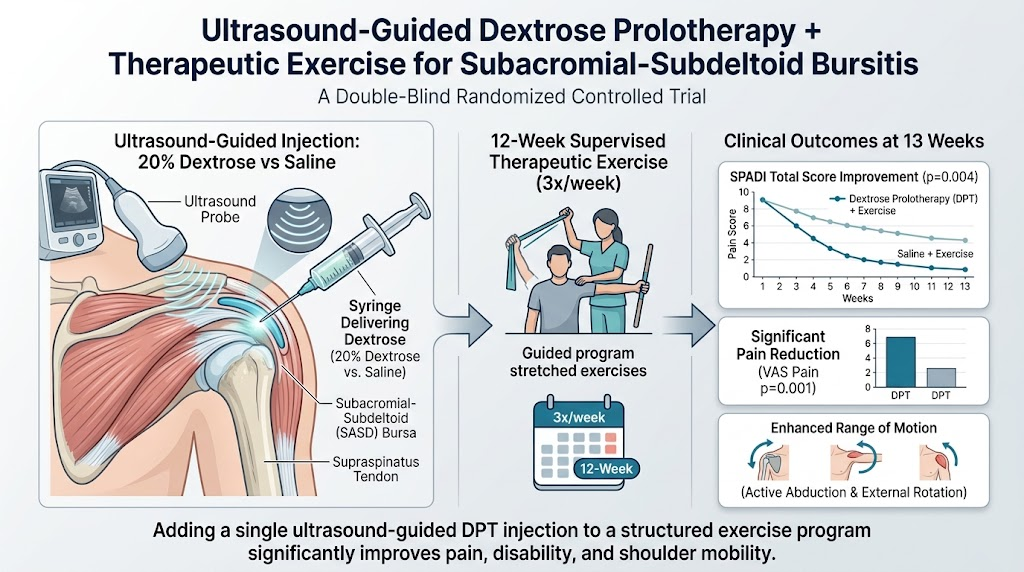
This investigation was a pilot double-blind randomized controlled trial conducted at a tertiary referral hospital in XXXXX, enrolling adults aged 20 years or older presenting with ultrasound-confirmed SASD bursitis and shoulder pain of three months or less duration. A total of 46 participants were randomized into two groups: one receiving a single ultrasound-guided injection of 10 mL 20% dextrose into the SASD bursa plus a standardized 12-week supervised therapeutic exercise program thrice weekly; the other group received identical exercise plus 10 mL normal saline injection. Forty-two participants completed the 13-week follow-up period. The primary outcome measure was the Shoulder Pain and Disability Index (SPADI) total score. Secondary outcomes included SPADI pain and disability subscales, Disabilities of the Arm, Shoulder and Hand (DASH) score, visual analog scale (VAS) pain score, shoulder range of motion (ROM) for various movements, and the World Health Organization Quality of Life-Brief version (WHOQOL-BREF). The analysis used sex- and baseline-adjusted repeated-measures analysis of covariance, focusing on group by time interactions.
Key Findings
The trial demonstrated that participants receiving the DPT injection combined with exercise experienced significantly more favorable improvements over time in SPADI total score compared to the saline plus exercise group (group × time interaction p=0.004). At the 13-week endpoint, the unadjusted between-group difference was -6.40 points (95% confidence interval [CI], -8.72 to -4.08). While statistically significant, this difference was below the study’s predefined minimal clinically important difference (MCID) of 8 points, indicating that the degree of benefit, although real, may be modest.
Secondary outcomes corroborated these findings with significant group × time interaction effects favoring DPT plus exercise for SPADI pain (p=0.002) and disability (p=0.017) subscales, active shoulder abduction (p <0.001) and external rotation (p=0.012), passive external rotation (p=0.002) and internal rotation (p=0.016), and VAS pain scores (p=0.001). No significant differential effects were evidenced in DASH or WHOQOL-BREF scores, suggesting limited impact on broader disability measures and quality of life within the follow-up period.
Safety assessments revealed that four participants in the DPT group reported mild, transient postinjection soreness, with no serious adverse events documented, indicating a favorable safety profile for this intervention.
Expert Commentary
The study is noteworthy for its rigorous double-blind randomized design and the pragmatic addition of supervised exercise, reflecting current clinical practice. The statistically significant improvements in shoulder pain, function, and specific range of motion metrics suggest that ultrasound-guided DPT could enhance recovery trajectories in subacute SASD bursitis. However, the observed between-group difference falling short of the MCID raises clinical interpretative caution about the magnitude of benefit. This pilot nature and relatively short follow-up highlight the need for larger, adequately powered trials with longer monitoring to assess durability of effect and broader functional and quality of life outcomes.
Mechanistically, dextrose prolotherapy may promote local proliferative responses and collagen synthesis, facilitating repair of inflamed bursal tissues. Combined with therapeutic exercise—which addresses muscle strength and joint mechanics—this multimodal approach could synergistically restore shoulder function more effectively than exercise alone. Future investigations should explore dosing strategies, injection frequency, patient selection criteria, and comparison with other interventions such as corticosteroid injections.
Conclusion
The pilot trial supports that a single ultrasound-guided 20% dextrose prolotherapy injection added to a standardized therapeutic exercise regimen yields statistically superior improvements in shoulder pain and disability, as well as certain range of motion parameters, compared to saline injection plus exercise in adults with recent subacromial-subdeltoid bursitis. The intervention appears safe and well tolerated. These preliminary findings warrant confirmation in larger randomized controlled studies with extended follow-up to establish clinical significance and guide treatment recommendations.
Funding and Trial Registration
The source article did not specify funding details or ClinicalTrials.gov registration information.
References
1. Hsieh RL, Lee WC, Chiu WM. Single Ultrasound-Guided Dextrose Prolotherapy Plus Therapeutic Exercise for Subacromial-Subdeltoid Bursitis: A Pilot Double-Blind Randomized Controlled Trial. Arch Phys Med Rehabil. 2026 Oct 2. PMID: 42826813.
2. Lyftogt J. Dextrose prolotherapy: A narrative review of basic science, clinical research, and practice. Pain Ther. 2017;6(1):41-52.
3. Lewis J. Rotator cuff related shoulder pain: Assessment, management and uncertainties. Man Ther. 2016;23:57-68.
4. Hegedus EJ, Goode A, Campbell S, et al. Physical examination tests of the shoulder: a systematic review with meta-analysis of individual tests. Br J Sports Med. 2008 Mar;42(2):80-92.