Introduction
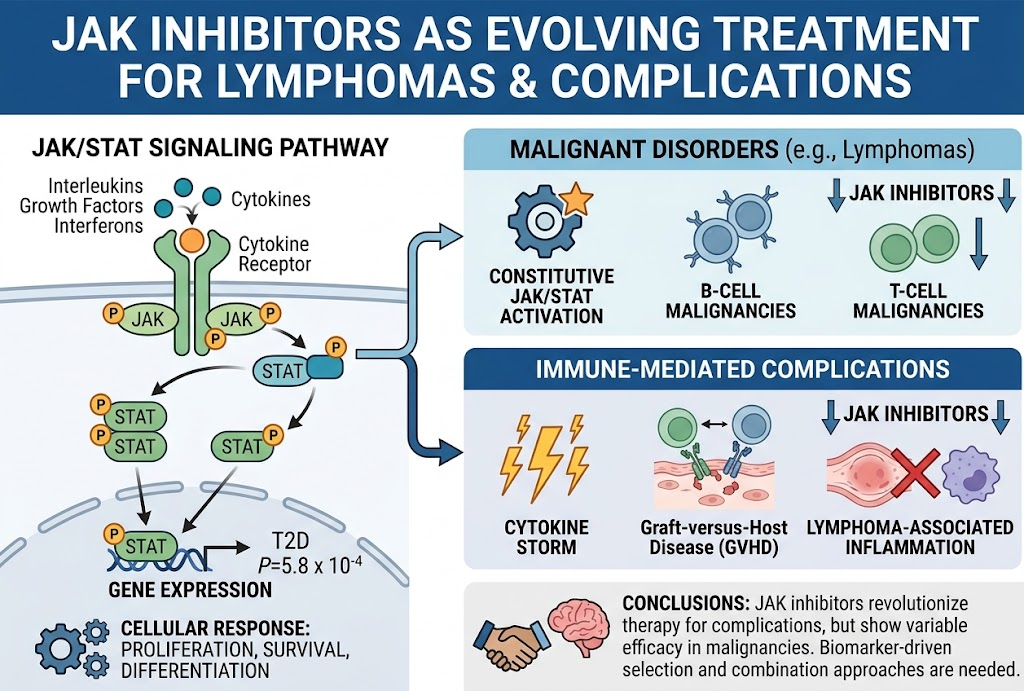
The Janus kinase (JAK) family and the Signal Transducer and Activator of Transcription (STAT) proteins comprise a critical signaling axis that mediates the cellular response to diverse cytokines, including interleukins, interferons, and hematopoietic growth factors. Dysregulation of the JAK/STAT pathway underlies a spectrum of hematologic diseases, from primary inflammatory conditions to hematopoietic malignancies. This article reviews the evolving role of JAK inhibitors in the treatment of lymphomas and immune-mediated complications, highlighting current clinical evidence, mechanistic insights, and future directions.
Highlight
- Constitutive activation of the JAK/STAT pathway through mutations is implicated in the pathogenesis of both myeloproliferative and lymphoid malignancies.
- JAK inhibitors, initially developed for inflammatory diseases, have shown promise in malignancies and related immune complications, including graft-versus-host disease (GVHD).
- Clinical efficacy of JAK inhibition varies among B- and T-cell lymphomas, suggesting a need for biomarker-driven treatment strategies and combination therapies.
Disease Burden and Clinical Context
Lymphomas represent a heterogeneous group of hematologic malignancies characterized by malignant transformation of lymphoid cells. The clinical course can be variable, with some subtypes responsive to conventional therapies, while others remain refractory or relapse. Additionally, immune-mediated complications such as GVHD lead to significant morbidity and mortality, especially post-hematopoietic stem cell transplantation (HSCT). Despite advancements, therapeutic options for both lymphomas and their immune complications remain limited, contributing to an unmet clinical need for targeted, effective, and safer treatments.
The JAK/STAT Pathway in Lymphoid Malignancies and Immune Disorders
The JAK/STAT pathway is essential for transmitting signals from numerous cytokines influencing immune cell proliferation, differentiation, and survival. Mutations and aberrant activation of this pathway have been identified in various lymphoid malignancies, including certain subtypes of non-Hodgkin lymphoma and T-cell lymphomas.
In myeloproliferative neoplasms (MPNs), gain-of-function mutations in JAK2 are well established. Similarly, studies reveal activating mutations or overexpression of JAKs and STATs in lymphoid cancers contributing to uncontrolled cell growth and evasion of immune regulation. Moreover, the pathway’s role extends to mediating inflammatory responses after HSCT, where dysregulated cytokine signaling drives GVHD pathology.
Development and Mechanisms of JAK Inhibitors
JAK inhibitors (Jakinibs) are small molecules designed to block the kinase activity of JAKs, thereby modulating downstream STAT phosphorylation and cytokine signaling. The first generation of JAK inhibitors, such as ruxolitinib and tofacitinib, showed efficacy in myelofibrosis and rheumatoid arthritis, respectively. These agents act by targeting ATP-binding sites of JAKs, effectively attenuating cytokine-driven inflammation and cellular proliferation.
Mechanistically, JAK inhibitors interfere with multiple cytokine pathways (e.g., IL-2, IL-6, IFN-γ), which reduces both malignant clone survival and pathogenic immune responses. This dual action underpins their utility in lymphoid malignancies and immune complications like GVHD, where immune dysregulation contributes to disease severity.
Study Design and Clinical Evidence
Clinical trials and observational studies have explored JAK inhibitors across various lymphomas and GVHD settings. Populations studied include patients with relapsed or refractory B- and T-cell lymphomas, as well as individuals experiencing steroid-refractory acute and chronic GVHD post-HSCT.
Key endpoints in these studies often encompass overall response rates (ORR), progression-free survival (PFS), overall survival (OS), and safety profiles. Comparators typically include standard chemotherapy regimens, immunosuppressive treatments, or placebo controls.
Key Findings
1. Lymphoid Malignancies: Clinical efficacy of JAK inhibitors varies significantly across lymphoma subtypes. For example, ruxolitinib demonstrated modest activity in relapsed/refractory peripheral T-cell lymphoma but limited efficacy in diffuse large B-cell lymphoma. These disparate outcomes are attributed to heterogeneity in JAK/STAT pathway activation and genetic contexts.
2. Immune-Mediated Complications (GVHD): JAK inhibitors have revolutionized management of GVHD, particularly steroid-refractory forms. Ruxolitinib is FDA-approved for acute and chronic GVHD, based on randomized trials showing improved durable responses and survival compared to best available therapy. Safety data indicate manageable adverse effects, with close monitoring for infections and cytopenias warranted.
3. Biomarker-Driven Insights: Emerging data underscore the importance of biomarkers—such as JAK mutations, phospho-STAT expression, and cytokine profiles—to select patients most likely to benefit from JAK inhibition and avoid unnecessary toxicity.
4. Combination Therapies: Rational combinations of JAK inhibitors with chemotherapeutics, immunomodulators, or novel agents (e.g., checkpoint inhibitors) are under investigation to potentiate anti-lymphoma effects and overcome resistance mechanisms.
Expert Commentary
Experts emphasize that while JAK inhibitors have significantly advanced treatment in select lymphomas and immune complications, the variable responses necessitate precision medicine approaches. Biomarker-driven patient selection and integration of JAK inhibitors into multimodal regimens represent critical next steps to maximize clinical benefit. Additionally, long-term safety data remain an area of active research, particularly regarding immune suppression and secondary malignancies.
The mechanistic rationale is supported by translational studies demonstrating pathway blockade reverses malignant phenotypes and inhibits pathogenic inflammation. Hence, future research should aim to clarify which lymphoma subsets harbor actionable JAK/STAT alterations and identify predictive biomarkers.
Conclusion and Future Perspectives
JAK inhibitors have emerged as transformative agents in the treatment landscape of lymphomas and immune-mediated complications, notably GVHD. Their dual role in targeting malignant signaling and modulating immune responses offers unique therapeutic leverage. Yet, the variability in clinical efficacy highlights the necessity for personalized approaches employing molecular diagnostics and combination regimens tailored to disease biology.
Ongoing clinical trials and translational research will further delineate optimal use scenarios, define resistance mechanisms, and expand indications. Ultimately, integrating JAK inhibitors with other targeted therapies holds promise to improve outcomes for patients with challenging lymphoid malignancies and associated immune complications.
Funding and Clinical Trial Registry
The studies reviewed are supported by various academic and industry sponsors; specific grants and clinical trial registrations are detailed in the original literature sources such as the clinicaltrials.gov database.
References
Unkenholz C, Huerga S, Moskowitz A, Vardhana S. Janus kinase inhibitors as an evolving treatment for lymphomas and immune-mediated complications. Haematologica. 2026 Aug 13. doi: 10.3324/haematol.2026.301214. Epub ahead of print. PMID: 42610416.