Highlight
- Intravenous albumin after outpatient paracentesis reduces the risk of hospitalization due to acute kidney injury (AKI) in patients with cirrhosis.
- Albumin use was more common in patients with higher disease severity (MELD-Na), hepatic encephalopathy, and lower baseline renal function.
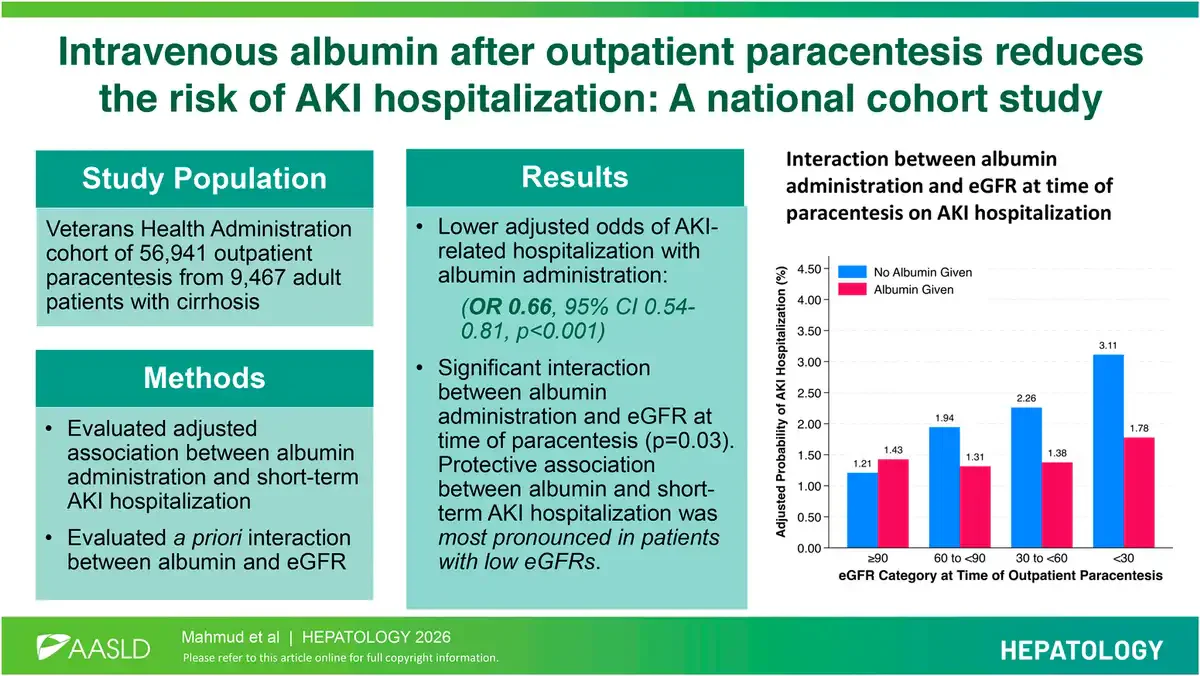
- The protective effect of albumin was notably greater in patients with significantly reduced estimated glomerular filtration rate (eGFR).
- Higher albumin dosing (≥6-8 g per liter of ascitic fluid removed) further decreased AKI hospitalization risk regardless of the volume of fluid extracted.
Study Background
Paracentesis is commonly performed in patients with cirrhosis to remove ascitic fluid, and large-volume paracentesis may lead to postparacentesis circulatory dysfunction (PPCD), which predisposes patients to complications such as acute kidney injury (AKI). Intravenous (i.v.) albumin is traditionally recommended post-large-volume paracentesis to mitigate these risks by expanding plasma volume and maintaining circulatory stability. However, while guidelines advocate for albumin use primarily after large-volume procedures usually performed inpatient, the real-world effectiveness of albumin administration for outpatient paracentesis cases remains less well characterized, especially across diverse patient populations and paracentesis volumes. Understanding these effects has considerable clinical relevance given the frequency of outpatient paracentesis, the burden of AKI in cirrhosis, and the rising healthcare costs associated with hospitalizations.Study Design
This retrospective national cohort study analyzed data from the Veterans Health Administration, encompassing 9467 patients with cirrhosis who underwent a total of 56,941 outpatient paracentesis procedures. Data collected included albumin administration, paracentesis volume, Model for End-Stage Liver Disease-Sodium (MELD-Na) scores, estimated glomerular filtration rate (eGFR), presence of hepatic encephalopathy (HE), and hospitalization for AKI within 7 days post-procedure. Mixed-effects logistic regression models were applied to identify predictors of albumin use and its association with AKI-related hospitalizations. A subcohort of 48,401 procedures with detailed albumin dosing data was analyzed to explore the dose-response relationship between albumin amount and AKI hospitalization risk.Key Findings
The key findings highlight substantial underutilization of albumin, with only 17% of outpatient paracentesis procedures accompanied by albumin infusion. Albumin administration was more frequently observed in patients with higher MELD-Na scores (OR 1.02 per unit increase, 95% CI 1.02-1.03, p <0.001), lower kidney function (eGFR <30 mL/min/1.73 m2 vs. ≥90 mL/min/1.73 m2, OR 3.06, 95% CI 2.64-3.54, p <0.001), and presence of HE (OR 1.22, 95% CI 1.13-1.33, p <0.001), reflecting clinical recognition of increased risk in these patients. Critically, albumin administration correlated with a significant reduction in odds of hospitalization for AKI within 7 days following outpatient paracentesis (OR 0.66, 95% CI 0.54-0.81, p <0.001). The protective effect was more pronounced in patients with lower eGFR (interaction p=0.03), suggesting that those with compromised renal function benefit the most from albumin supplementation. The dose-response analysis revealed that higher doses of albumin, defined as ≥6-8 g per liter of ascitic fluid removed, were associated with further reduced odds of AKI hospitalization (OR 0.36, 95% CI 0.20-0.64, p=0.001). Notably, this association was consistent irrespective of the volume of fluid removed during paracentesis, challenging the conventional focus on absolute paracentesis volume thresholds for albumin use.Expert Commentary
The study by Mahmud et al. offers compelling real-world evidence supporting intravenous albumin use after outpatient paracentesis in patients with cirrhosis to reduce AKI-related hospitalizations. This expands upon established guidelines that prioritize albumin administration primarily in inpatient large-volume paracentesis cases. Importantly, the finding that patients with lower eGFR experience a greater benefit underscores the need to individualize albumin dosing based on baseline renal function and hemodynamic status. While the retrospective design precludes definitive causal inference, the large sample size, adjustment for key confounders, and clinically plausible mechanism lend credibility to these observations. The study identifies an important gap between guideline recommendations and clinical practice, with albumin underutilized in significant proportions of patients who might benefit. This suggests potential barriers such as costs, logistical challenges, or clinician uncertainty. The dose-related findings raise the question of whether albumin administration protocols should shift from a fixed threshold of volume removed to a more nuanced approach considering patient-specific variables and fluid shifts. Prospective interventional trials are warranted to confirm optimal dosing strategies and to evaluate clinical outcomes such as survival, renal replacement therapy, and healthcare resource use.Conclusion
This national cohort study demonstrates that intravenous albumin administration following outpatient paracentesis is associated with a marked reduction in AKI-related hospitalizations among patients with cirrhosis. The benefit is especially pronounced in those with impaired baseline renal function, and higher dosing of albumin correlates with greater risk reduction. These findings highlight the importance of tailoring albumin use not solely on paracentesis volume but also on patient-specific risk factors such as eGFR and clinical status. Implementation strategies to increase appropriate albumin use in outpatient paracentesis settings should be prioritized, alongside prospective trials to establish evidence-based dosing frameworks. Ultimately, optimizing albumin supplementation may reduce AKI incidence, decrease hospitalizations, and improve outcomes in this vulnerable patient population.Funding and ClinicalTrials.gov
The study was conducted within the Veterans Health Administration system and funded by institutional research grants. No specific clinical trial registration was reported.References
1. Mahmud N, Schechter MS, Zhang S, Mezzacappa C, Ochoa-Allemant P, Kaplan DE, Serper M. Intravenous albumin after outpatient paracentesis reduces the risk of AKI hospitalization: A national cohort study. Hepatology. 2026 Mar;84(5):1415-1425. PMID: 41918411. 2. European Association for the Study of the Liver. EASL Clinical Practice Guidelines on the management of ascites, spontaneous bacterial peritonitis, and hepatorenal syndrome in cirrhosis. J Hepatol. 2021;74(3):569-603. 3. Ginès P, Arroyo V. Albumin treatment of cirrhosis and its complications: Good, but probably not perfect. Hepatology. 2019;69:1828-1836. 4. Angeli P, Wong F, Watson H, Ginès P. Acute kidney injury in cirrhosis. J Hepatol. 2015;62(4):1150-1161.Specialty calculators
For clinical reference; use professional judgment.