Introduction
Status epilepticus (SE) is a neurological emergency characterized by prolonged or recurrent seizures without recovery between them. When seizures persist despite appropriate antiseizure medications (ASMs), the condition is termed refractory status epilepticus (RSE). If seizures continue or reoccur after 24 hours of anesthetic treatment, it is categorized as super-refractory status epilepticus (SRSE). Both conditions carry high morbidity and mortality risks and pose significant therapeutic challenges.
Cenobamate (CNB) is a novel antiseizure medication approved for focal epilepsy, demonstrating robust efficacy in drug-resistant cases. Its role in controlling SE, particularly RSE and SRSE, has not been fully elucidated. Preliminary data suggest CNB might provide rapid and meaningful seizure control at relatively low doses, with a tolerable safety profile, potentially making it a valuable adjunct in urgent treatment settings.
Study Objectives
The study aimed to evaluate the clinical effectiveness and safety of CNB in adult patients with focal-onset RSE and SRSE treated in real-world clinical practice. It sought to determine whether CNB improves sustained seizure termination rates and overall outcomes compared to standard care.
Methods
A multicenter retrospective cohort design was employed using a prospectively maintained registry of adult patients. Eligible participants had focal-onset RSE or SRSE and were treated between January 2022 and October 2025. Detailed clinical data, including EEG findings and treatment regimens, were collected. The primary endpoint was sustained cessation of SE lasting over 24 hours, confirmed both clinically and electrographically, attributed to CNB administration.
To strengthen the analysis, a secondary observational comparative study was conducted using propensity score matching (1:2 ratio) between CNB-exposed patients and matched controls who did not receive CNB, drawn from the same registry over 2011–2025. This approach emulated a target trial to account for confounding factors.
Results
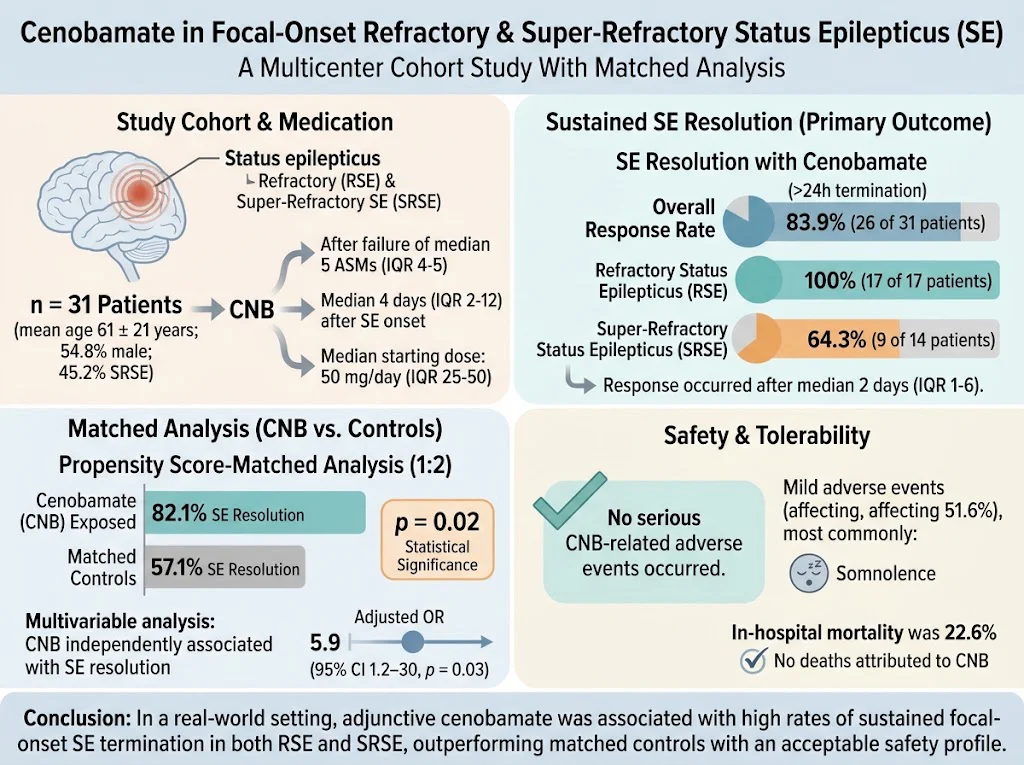
Thirty-one patients received CNB therapy (mean age 61 ± 21 years, 54.8% male). Nearly half (45.2%) met criteria for SRSE. CNB was introduced a median of 4 days after SE onset, following failure of about five different ASMs. The median initial dose was 50 mg per day.
Sustained SE termination was achieved in 83.9% (26/31) of patients, including 100% (17/17) with RSE and 64.3% (9/14) with SRSE. The median time to response was two days. In the matched comparison (28 CNB patients vs. 56 controls), seizure resolution rates were significantly higher with CNB (82.1% vs. 57.1%, p = 0.02).
Multivariable logistic regression adjusting for confounders confirmed CNB exposure was independently associated with improved SE outcome (adjusted odds ratio 5.9; 95% CI 1.2–30; p = 0.03). There were no serious adverse events directly related to CNB. Mild side effects were common (51.6%), mostly somnolence. Hospital mortality was 22.6%; no deaths were attributed to CNB treatment.
Discussion
This multicenter real-world study demonstrates that CNB is an effective adjunctive therapy for adults with focal-onset RSE and SRSE, achieving high rates of sustained seizure termination. CNB-treated patients had better outcomes compared to matched controls without encountering significant safety issues.
The findings align with existing knowledge of CNB’s efficacy in focal epilepsy and extend its potential therapeutic role into acute severe seizure management. Given CNB’s relatively rapid onset of action and favorable tolerability, it stands out as a promising option in the often refractory and critically challenging context of status epilepticus.
Despite encouraging results, limitations include the retrospective design and relatively small cohort size, which call for larger prospective controlled trials to confirm optimal dosing, timing, and long-term outcomes.
Conclusion
Cenobamate shows strong potential as an adjunctive treatment for focal-onset refractory and super-refractory status epilepticus, significantly improving sustained seizure control without serious safety concerns. This study provides Class IV evidence supporting CNB’s use in this critical clinical scenario and encourages further investigation to refine its role in emergency epilepsy care.
Clinical Implications and Future Directions
Given the high morbidity associated with prolonged SE, adding CNB to the treatment arsenal may enhance seizure control where standard therapies fail. Clinicians should consider CNB initiation after failure of multiple ASMs, guided by EEG and clinical monitoring. Further studies should evaluate optimal dosing schedules, interactions with anesthetic agents, and long-term neurocognitive outcomes.
Development of clinical guidelines integrating CNB for refractory SE could improve standardized care and patient prognosis. Meanwhile, vigilance on adverse effects and drug interactions remains crucial.
Specialty calculators
For clinical reference; use professional judgment.