Highlight
Thrombosis remains a leading cause of morbidity and mortality worldwide, with current anticoagulants often increasing bleeding risk due to broad pathway inhibition. Amrecibart (REGN9933A2) and cenvacibart (REGN7508Cat) are two novel monoclonal antibodies targeting Factor XI (FXI) with distinct mechanisms, offering focused inhibition of the intrinsic coagulation pathway. Both antibodies demonstrate effective anticoagulation in preclinical and early human studies, with potential for tailored therapy balancing efficacy and bleeding safety.Study Background
Thrombosis causes a significant global health burden, manifesting as deep vein thrombosis, pulmonary embolism, myocardial infarction, and stroke. Anticoagulant therapies traditionally target the extrinsic and common pathways of the coagulation cascade. While efficacious at reducing thrombosis, these treatments elevate bleeding risk, a major limitation in clinical use. Factor XI (FXI), part of the intrinsic coagulation pathway, represents a promising therapeutic target. Genetic FXI deficiency correlates with reduced thrombosis incidence and minimal spontaneous bleeding, suggesting that selective FXI inhibition may uncouple anticoagulation from hemorrhage risk. This paradigm challenges existing anticoagulant strategies and motivates development of novel FXI-directed agents.Study Design
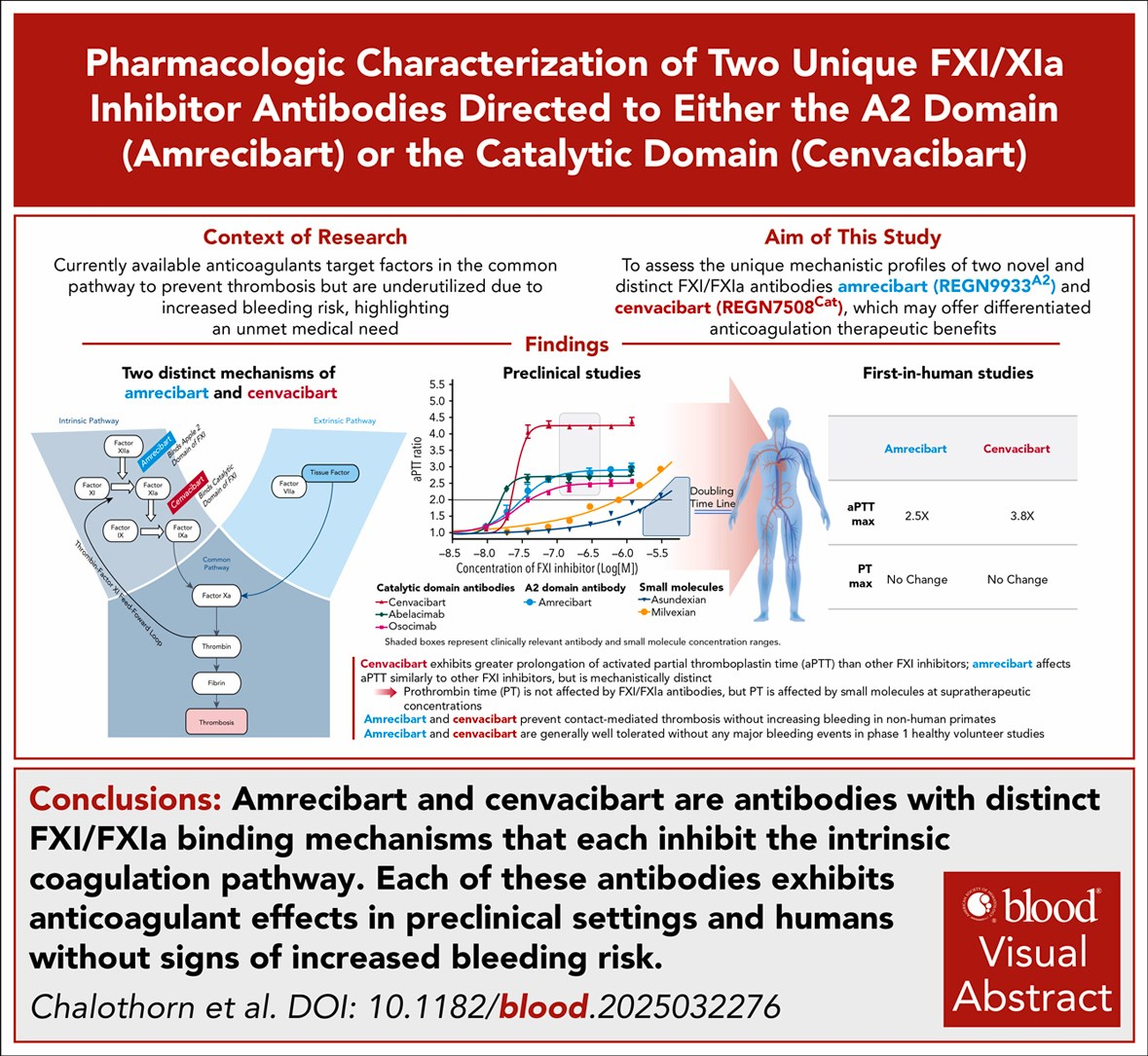
The study developed two distinct monoclonal antibodies targeting FXI: amrecibart (REGN9933A2) and cenvacibart (REGN7508Cat), each designed to inhibit FXI through different mechanisms. Cenvacibart binds the catalytic domain of FXI/FXIa, completely blocking FXI enzymatic activity induced by FXIIa, FXIa, or thrombin, thus maximizing anticoagulant effect. Amrecibart binds the apple 2 domain of FXI/FXIa, selectively inhibiting activation by FXIIa only, potentially providing a safer bleeding profile. These antibodies were tested in vitro using human and nonhuman primate plasma, in vivo in nonhuman primate thrombosis models, and in phase 1 first-in-human studies evaluating safety, pharmacodynamics, and coagulation parameters.Key Findings
In vitro and preclinical results: Both antibodies effectively prolonged activated partial thromboplastin time (aPTT), an established marker of intrinsic pathway coagulation. Cenvacibart caused a greater aPTT prolongation compared with amrecibart, reflecting its broader inhibitory mechanism. Neither antibody affected prothrombin time (PT), indicating sparing of the extrinsic pathway. In nonhuman primate thrombosis models, both antibodies inhibited thrombus formation effectively without increasing bleeding risk, a critical preclinical safety signal. First-in-human studies: Both amrecibart and cenvacibart showed dose-dependent intrinsic pathway inhibition consistent with preclinical data, with sustained aPTT prolongation and no significant effect on PT. Both agents were generally well tolerated without serious adverse events or clinically relevant bleeding episodes during the study periods. Mechanistic distinctions: Cenvacibart’s catalytic domain targeting produces powerful anticoagulation by completely suppressing FXI/FXIa enzymatic activity regardless of activation source. Amrecibart’s selectivity for FXIIa-induced FXI activation may yield a more focused inhibition, offering customizable anticoagulation that could reduce bleeding risk in patients at higher hemorrhagic risk.Expert Commentary
The introduction of FXI-targeted therapies marks a significant advance in thrombosis prevention. As noted by hematology experts, the intrinsic pathway’s lesser role in hemostasis compared to the extrinsic pathway supports the rationale that FXI inhibition might mitigate thrombotic risk while preserving physiological clotting mechanisms. The differentiated mechanisms of amrecibart and cenvacibart allow clinicians to consider either a robust or more nuanced anticoagulant effect depending on patient bleeding risk and clinical context. However, longer-term studies and larger populations are necessary to confirm safety, particularly relating to bleeding events in real-world settings. Additionally, the impact on diverse thrombotic conditions and interactions with other anticoagulants remains to be delineated. Mechanistically, understanding the balance between thrombin feedback amplification and FXI activation pathways may further refine patient selection and optimize treatment strategies.Conclusion
Amrecibart and cenvacibart represent promising new anticoagulant modalities by specifically targeting FXI with distinct mechanisms. The preclinical and early human data indicate effective thrombosis prevention coupled with favorable bleeding profiles, addressing a critical unmet need in anticoagulation therapy. This tailored approach may expand therapeutic options to patients vulnerable to bleeding, advancing precision medicine in hemostasis management. Ongoing clinical trials and future investigations will elucidate their roles across thrombotic disorders and inform integration into clinical practice, potentially redefining anticoagulant paradigms.Funding and Trial Registration
This research was supported by Regeneron Pharmaceuticals. The associated clinical trials were registered at ClinicalTrials.gov under identifiers NCT05102136 and NCT05603195.References
- Chalothorn D, et al. Anticoagulation with the mechanistically distinct FXI/FXIa antibodies amrecibart (REGN9933A2) and cenvacibart (REGN7508Cat). Blood. 2026 Oct 8;148(15):1867-1879. PMID:42275249.
- Weitz JI, et al. Targeting factor XI to prevent thrombosis: hype or hope? Blood. 2016;128(13):1703-1707.
- Rasmussen MT, et al. Pharmacological targeting of factor XI and factor XII: novel approaches to anticoagulation and inflammation. Thromb Haemost. 2020;120(5):724-736.
- Butenas S, et al. Factor XI and thrombotic risk: opportunities for safer anticoagulants. Trends Cardiovasc Med. 2017;27(7):511-516.