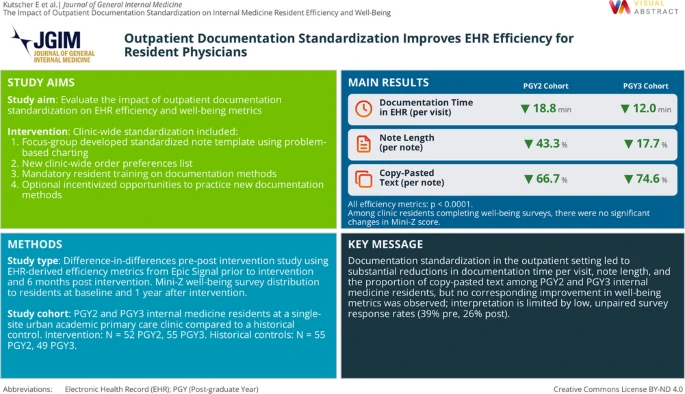
Standardized outpatient documentation reduces electronic health record (EHR) time per patient for internal medicine residents by approximately 13-19 minutes per visit.
Note length and the volume of copied-pasted text decrease substantially with documentation template standardization, improving note quality and concise information capture.
No significant change observed in overall well-being metrics, although a specific burnout question showed a modest but statistically significant improvement post-intervention.
Study Background
Physician burnout is a pressing concern in clinical medicine, closely linked to the administrative burden of EHR documentation. Internal medicine residents, who manage complex outpatient caseloads, often cite documentation tasks as a major contributor to time pressures and emotional exhaustion. Excessively detailed and copied notes not only lengthen documentation time but may also degrade note quality, impacting care efficiency and patient safety. Interventions targeting EHR workflow efficiency hold promise to mitigate these issues, but high-quality evidence examining impacts on resident efficiency and wellness remains limited. The study by Kutscher et al. focuses on standardizing outpatient documentation practices to address these challenges within an academic internal medicine residency program.
Study Design
This investigation employed a pre-post difference-in-differences study design at an urban academic internal medicine clinic. The participants consisted of 52 PGY-2 and 55 PGY-3 internal medicine residents in the intervention group, compared against historical controls of 55 PGY-2 and 49 PGY-3 residents. The intervention comprised the introduction of standardized documentation templates and medication ordering procedures, paired with mandatory training sessions and incentivized documentation practice opportunities.
Primary endpoints involved objective EHR efficiency metrics: time spent per appointment on chart review, note writing, and order entry. Secondary metrics included the length of clinical notes quantified by character count and the amount of text copied and pasted from previous notes. Resident well-being was assessed using the validated Mini-Z survey, administered before and after intervention implementation.
Key Findings
The documentation standardization intervention significantly improved efficiency metrics among residents at both PGY-2 and PGY-3 levels:
– Time dedicated to documentation per patient encounter decreased by an average of 18.8 minutes (p < 0.0001) for PGY-2 residents and 12.0 minutes (p < 0.0001) for PGY-3 residents.
– Note length was markedly reduced by approximately 3,650 characters, equating to a 43.3% reduction for PGY-2 residents (p < 0.0001) and by 1,608 characters or 17.7% for PGY-3 residents (p < 0.0001).
– The amount of copied and pasted text decreased substantially, by 66.7% for PGY-2 and 74.6% for PGY-3 residents (both p < 0.0001), indicating reduced reliance on repetitive text recycling.
Regarding well-being, among 42 residents who completed pre-intervention surveys and 28 residents post-intervention, no significant change was observed in overall Mini-Z composite scores. However, the single burnout-related item on the Mini-Z survey showed improvement from a mean score of 3.2 pre-intervention to 3.7 post-intervention (p = 0.01), suggesting some reduction in self-reported burnout symptoms.
Expert Commentary
This study underscores the potential of structured EHR documentation standardization to enhance clinical workflow efficiency for internal medicine trainees. The substantial reductions in documentation time and note length may translate into increased clinical capacity and reduced clerical burden. The decrease in copy-paste text is particularly notable, considering the risks of inaccuracies and note bloat associated with such practices. Although the overall wellness survey scores did not change significantly, the burnout item improvement intimates a preliminary positive trend warranting further investigation with larger and longitudinally followed resident cohorts.
Limitations include the use of a historical control group, which may not account for secular trends or other confounding factors. Additionally, lower response rates on post-intervention well-being surveys limit robust conclusions about wellness impacts. Future research might explore the integration of standardized documentation across different specialties and incorporate qualitative assessments to better capture resident perceptions and experiences.
Conclusion
Standardization of outpatient documentation practices in internal medicine residency markedly enhances EHR efficiency by reducing documentation time, note length, and copy-paste text volume. These workflow improvements have the potential to alleviate documentation-related burdens, a recognized contributor to resident burnout. Although measurable improvements in overall resident well-being were not demonstrated, a meaningful reduction in burnout perception was observed. Implementing documentation standardization strategies appears to be a pragmatic approach to improving resident efficiency and potentially mitigating burnout, supporting broader adoption and further evaluation in graduate medical education settings.
Funding and ClinicalTrials.gov
The original study did not specify funding sources or clinical trial registration details in the abstract. Further details may be available in the full publication.
References
1. Kutscher E, Halket D, Feinberg A, et al. The Impact of Outpatient Documentation Standardization on Internal Medicine Resident Efficiency and Well-Being. J Gen Intern Med. 2026 Oct; PMID: 42834286.
2. Shanafelt TD, et al. Relationship Between Clerical Burden and Physician Burnout. Mayo Clin Proc. 2016;91(7):836-848.
3. West CP, Dyrbye LN, Shanafelt TD. Physician burnout: contributors, consequences and solutions. J Intern Med. 2018;283(6):516-529.
4. O’Donnell HC, et al. Use of electronic health record templates to improve outpatient documentation accuracy and efficiency. J Am Board Fam Med. 2013;26(4):418-423.