Highlight
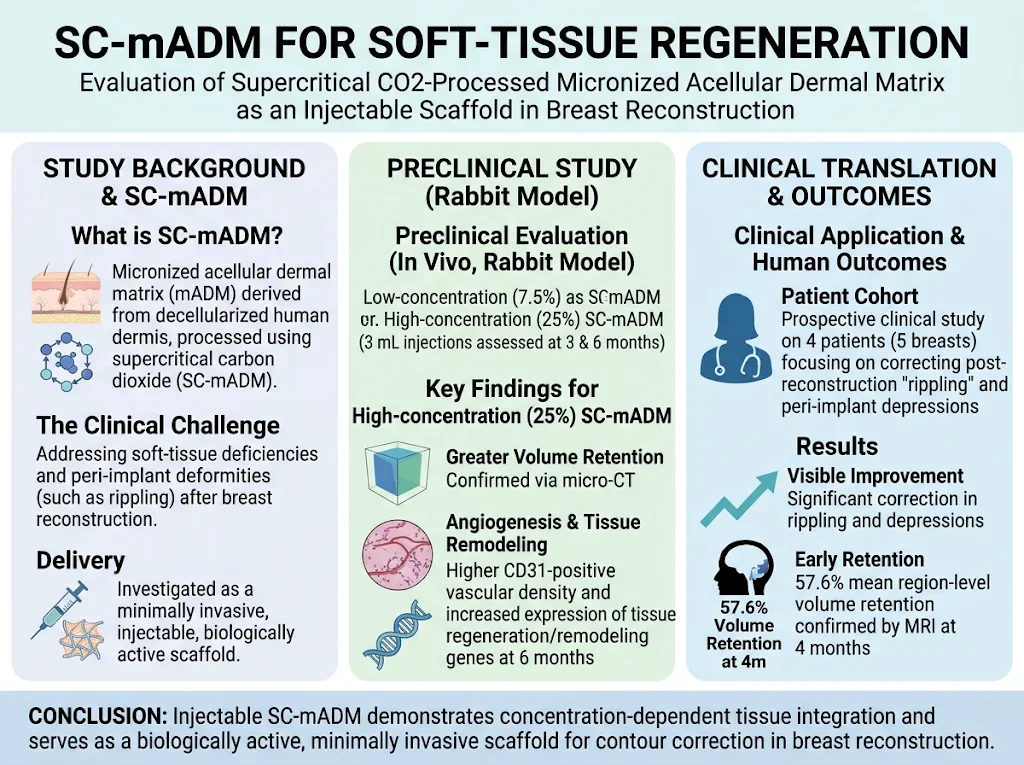
- Supercritical CO2-processed micronized acellular dermal matrix (SC-mADM) enhances soft-tissue regeneration by supporting volume retention and increased vascularization.
- Preclinical rabbit models demonstrated concentration-dependent tissue integration with improved angiogenesis and gene expression related to remodeling.
- Preliminary clinical outcomes indicate effective correction of post-reconstruction breast rippling with sustained volume retention at 4 months post-injection.
- SC-mADM represents a promising minimally invasive injectable scaffold for breast contour correction with potential applications in soft-tissue augmentation.
Study Background
Breast reconstruction following mastectomy or other breast surgeries frequently encounters challenges such as soft-tissue deficiencies and peri-implant deformities, including skin rippling and contour irregularities. Acellular dermal matrices (ADMs) have been increasingly used to support implant coverage and soft-tissue support. However, traditional ADM materials may require invasive placement and exhibit limited integration or volume retention. The micronized form of ADM (mADM), prepared from decellularized human dermis, offers injectable potential but had not been optimized or fully studied clinically. Supercritical carbon dioxide (SC-CO2) processing, an innovative technique, has been applied to produce SC-mADM, purportedly enhancing its biocompatibility and scaffold properties. Prior studies established fabrication and basic biocompatibility, yet clinical application data were lacking. This study aimed to address this gap by evaluating biological responses and preliminary clinical efficacy of SC-mADM as an injectable scaffold for soft-tissue regeneration and contour correction in breast reconstruction.Study Design
This investigation encompassed two phases: a preclinical animal study and a preliminary clinical trial. Preclinical Phase: Using a rabbit model, 3 mL of SC-mADM at two concentrations—low (7.5%) and high (25%)—was subcutaneously injected. Assessments were conducted at 3 and 6 months post-injection. Volume retention was quantified via micro-computed tomography (micro-CT). Histologic examination included immunohistochemical staining for CD31 to evaluate vascular density. Additionally, quantitative reverse transcription polymerase chain reaction (qRT-PCR) analyses measured mRNA expression related to angiogenesis and tissue remodeling. Clinical Phase: Following encouraging preclinical results, a prospective clinical study was conducted involving four patients undergoing breast reconstruction who exhibited postoperative rippling and contour irregularities. Five breasts were treated with injections of high-concentration SC-mADM. Clinical outcomes included aesthetic improvement and volumetric retention measured by magnetic resonance imaging (MRI) at 4 months.Key Findings
Preclinical Outcomes: The high-concentration SC-mADM group displayed significantly greater volume retention compared to the low-concentration group at both 3 and 6 months, indicating a dose-dependent effect on scaffold persistence. Histologic analysis revealed increased CD31-positive vascular density in the high-concentration cohort at 6 months, highlighting enhanced angiogenesis within the regenerated tissue. Correspondingly, qRT-PCR demonstrated upregulated gene expression of key angiogenic markers such as VEGF (vascular endothelial growth factor) and remodeling-related genes including MMPs (matrix metalloproteinases), supporting active matrix integration and extracellular remodeling. Clinical Outcomes: Patients receiving high-concentration SC-mADM injections experienced notable improvement in visible rippling and peri-implant depressions. MRI volumetric analysis at 4 months showed an average volume retention rate of 57.6%, suggesting sustained scaffold presence and integration in human soft tissue. No significant adverse events related to injection or material compatibility were reported during the preliminary follow-up. These findings collectively suggest that SC-mADM exhibits robust tissue integration characterized by vascular ingrowth and extracellular matrix remodeling, which translates clinically into meaningful contour correction and volume preservation in breast reconstruction settings.Expert Commentary
The application of supercritical CO2 processing introduces a novel dimension in ADM fabrication, potentially enhancing the preservation of collagen architecture and removal of residual cellular components, resulting in enhanced biocompatibility and scaffold function. The concentration-dependent retention and angiogenic response observed underscore the importance of optimizing formulation parameters to achieve maximal clinical benefit. While the preclinical data provide compelling mechanistic insight, the clinical component remains limited by small sample size and short follow-up duration. Longitudinal studies with larger patient cohorts are necessary to ascertain long-term durability, immunogenicity risks, and comparative effectiveness versus existing fillers or ADM products. Mechanistically, improved neovascularization is vital as it promotes sustained cell viability, tissue integration, and remodeling. The upregulation of matrix metalloproteinases indicates active extracellular turnover, which may support scaffold remodeling into functional host tissue rather than inert filler material. Collectively, these biological activities align with advanced regenerative objectives in reconstructive surgery.Conclusion
Supercritical CO2-processed micronized acellular dermal matrix represents a promising injectable scaffold for soft-tissue regeneration in breast reconstruction. Its concentration-dependent biological integration fosters angiogenesis and remodeling, enabling improved volume retention and correction of peri-implant deformities such as rippling. Early clinical data indicate favorable safety and efficacy profiles, warranting further validation through expansive, long-term clinical trials. Such advances could facilitate minimally invasive interventions that enhance reconstructive outcomes and patient satisfaction.Funding and Clinical Trials Information
The original study does not specify funding sources or registration on clinicaltrials.gov. Future research transparency should ensure declaration of funding and trial registry to uphold clinical research standards.References
1. Yang H, Ha EH, Yoon S, et al. Supercritical CO2-Processed Micronized Acellular Dermal Matrix Enhances Soft-Tissue Regeneration: A Preclinical and Clinical Study. Plast Reconstr Surg. 2026 Nov 16. PMID: 43037578. 2. Salzberg CA. Acellular dermal matrices in primary breast reconstruction: A critical review and best practices. Plast Reconstr Surg. 2017;140(6S):59S-66S. 3. Crapo PM, Gilbert TW, Badylak SF. An overview of tissue and whole organ decellularization processes. Biomaterials. 2011 Apr;32(12):3233-43. 4. Bonomi S, et al. Supercritical CO2-based cleaning processes and applications in advanced medical materials. J Supercrit Fluids. 2020;157:104686. 5. He T, et al. Injectable acellular dermal matrix and fat grafting for soft tissue augmentation: A systematic review. Plast Reconstr Surg Glob Open. 2019;7(10):e2461.Specialty calculators
For clinical reference; use professional judgment.