Highlight
- Implementation of structured, multidisciplinary ICU rounding including family members is associated with increased family confidence in staff compassion.
- Family perceptions of honesty, consistency, and quality of information shared during rounds significantly improved, especially in the medical ICU setting.
- Clinician attitudes toward family inclusion on rounds were generally positive, suggesting feasibility and acceptance of this patient- and family-centered care approach.
- The study highlights benefits of structured communication templates in enhancing family engagement and satisfaction without compromising clinical workflow.
Study Background
Family involvement in the care of critically ill patients is increasingly recognized as vital to holistic, patient- and family-centered care in the intensive care unit (ICU). Critical illness often imposes significant emotional and informational burdens on family members, with communication gaps and inconsistent information contributing to anxiety, poor satisfaction, and distrust. Despite recommendations from various professional societies, family inclusion during ICU rounds is not uniformly practiced, and approaches to optimize multidisciplinary communication remain variable.
This study seeks to address the unmet clinical need for standardized, structured rounding processes that formally incorporate families and bedside nurses in daily ICU discussions, hypothesizing that such interventions may improve family confidence in information shared, perceived compassion of staff, and provider attitudes toward family participation.
Study Design
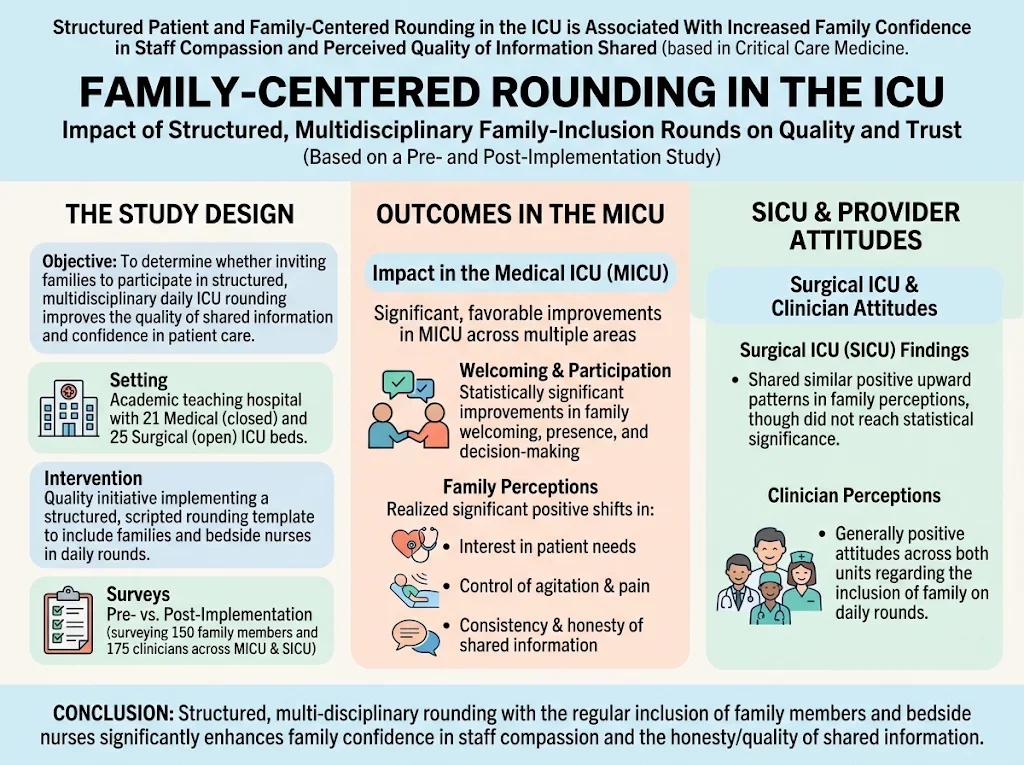
This was a pre- and post-implementation observational study conducted at a single academic teaching hospital operating both medical (closed unit) and surgical (open unit) ICUs with 21 and 25 beds, respectively. The patient population comprised family members of critically ill adults aged ≥18 years and ICU clinicians.
The intervention consisted of a quality initiative implementing structured, scripted, multidisciplinary rounding templates prioritizing patient- and family-centered communication. Families and clinicians were surveyed before and after the implementation using validated instruments provided by the Society of Critical Care Medicine–Patient-Centered Outcomes Research Institute initiative.
Surveys assessed dimensions including family perceptions of interest in patient needs, pain/agitation control, consistency and honesty of communication, and clinician attitudes toward family inclusion and participation in decision-making.
Key Findings
The study surveyed 36 families pre- and 28 families post-intervention in the medical ICU (MICU), and 44 and 42 families respectively in the surgical ICU (SICU). Clinician surveys included 53 and 48 respondents in the MICU, and 46 and 28 in the SICU for pre- and post-intervention periods respectively.
Family Perceptions: In the MICU, family members reported statistically significant improvements post-intervention in:
- Perceived staff interest in patient needs
- Control of agitation and pain in patients
- Consistency and honesty of information shared
Trends toward improvement were also observed in the SICU but did not reach statistical significance, possibly reflecting differences in ICU structure or patient population.
Clinician Perceptions: Post-intervention clinician attitudes in the MICU were significantly more favorable regarding family welcoming, presence during rounds, and participation in decision-making. Although positive trends were seen in the SICU, these did not achieve statistical significance.
Clinical Implications: The findings suggest that structured, patient- and family-centered rounding protocols enhance the quality and transparency of communication in critical care, thereby increasing family trust and confidence in the care team. Importantly, clinicians largely supported this family inclusion, highlighting its acceptability and potential for broader adoption.
Expert Commentary
These results align with emerging evidence underscoring the critical role of family engagement in ICU outcomes. Structured rounding protocols with scripted communication may mitigate variability in information delivery, fostering honesty and empathy, which are pivotal for family satisfaction and psychological well-being.
However, differences in results between medical and surgical ICUs highlight the need for tailored implementation strategies sensitive to unit-specific workflows and cultures. Further large-scale, multicenter studies are required to assess long-term impacts on clinical outcomes such as conflict resolution, length of stay, and psychological sequelae for families.
Potential limitations include the single-center design and survey-based methodology, which may be influenced by response bias and limited generalizability. Nonetheless, this study contributes valuable insights into operationalizing family-centered care in high-acuity settings.
Conclusion
Structured, multidisciplinary, patient- and family-centered rounding in the ICU is associated with increased family confidence in staff compassion and the quality and honesty of information shared. Clinician support for family involvement is generally positive, reinforcing the practicality of this approach.
Incorporating families using a scripted structured template during routine ICU rounds can enhance family satisfaction and engagement, potentially improving communication outcomes in critical care settings. Moving forward, healthcare systems should consider adopting such models to promote transparency, empathy, and patient- and family-centeredness in ICU practices.
Funding and ClinicalTrials.gov
No specific funding source or clinical trial registration information was provided with the study.
References
- Clouser RD, et al. Structured Patient and Family-Centered Rounding in the ICU is Associated With Increased Family Confidence in Staff Compassion and Perceived Quality of Information Shared. Crit Care Med. 2026 Nov 12; PMID: 43018411.
- Davidson JE, et al. Guidelines for family-centered care in the ICU: development and rationale. Crit Care Med. 2017;45(2):219-225.
- Kynoch K, et al. Family satisfaction with care and decision-making in ICU: a systematic review. J Intensive Care Soc. 2016;17(1):45–54.
Specialty calculators
For clinical reference; use professional judgment.