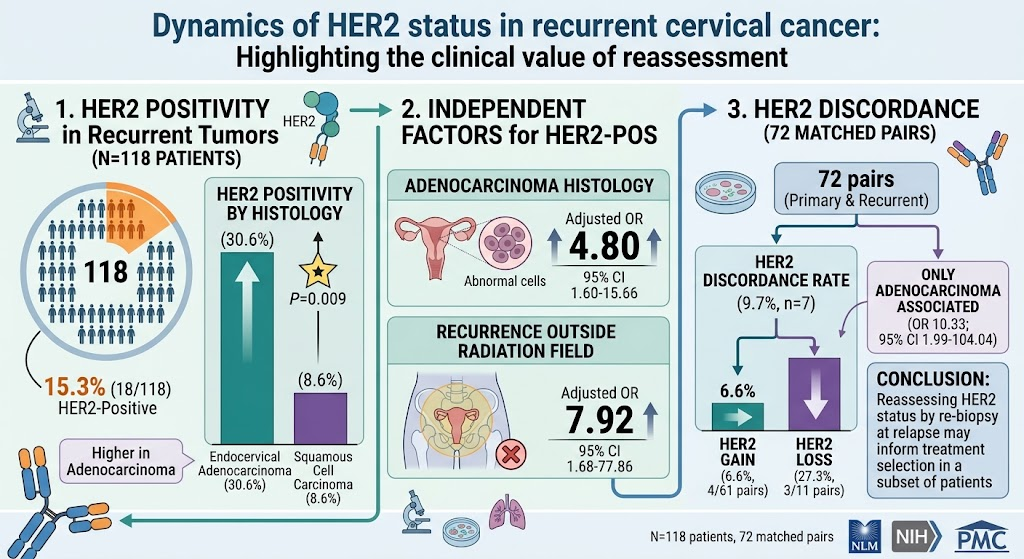
Highlight
- HER2 positivity in recurrent cervical cancer occurs in approximately 15% of cases, with a higher prevalence in endocervical adenocarcinoma than squamous cell carcinoma.
- Recurrent tumors manifesting outside previously irradiated fields show increased likelihood of HER2 positivity, suggesting tumor evolution or selection pressures affect HER2 status.
- Significant HER2 discordance exists between primary and recurrent tumors, emphasizing the clinical value of re-biopsy and reassessment at relapse.
Study Background
Cervical cancer remains a significant global health challenge despite advances in screening and vaccination strategies. Recurrence after initial treatment confers a poor prognosis, and therapeutic options are often limited. The emergence of human epidermal growth factor receptor 2 (HER2)-directed antibody-drug conjugates offers a promising targeted therapy for cervical cancer subsets demonstrating HER2 overexpression. However, the dynamic nature of HER2 expression during disease progression and recurrence is incompletely understood, complicating treatment decisions. Accurate HER2 assessment at recurrence is critical for identifying candidates for HER2-targeted therapies and improving outcomes.
Study Design
This retrospective cohort study identified 118 patients with recurrent cervical cancer treated at a single tertiary center from 2013 to 2024. Formalin-fixed paraffin-embedded specimens of recurrent tumors and available matched primary tumors (72 pairs) underwent HER2 immunohistochemistry (IHC) analysis, using the 2017 ASCO/CAP guideline for gastroesophageal adenocarcinoma scoring. Tumors with IHC scores of 2+ or 3+ were classified as HER2-positive. Logistic regression assessed associations between clinicopathological factors and HER2 positivity in recurrent tumors, as well as HER2 status discordance between matched pairs.
Key Findings
The HER2-positive rate in recurrent cervical tumors was 15.3% (18/118), with a significantly higher prevalence among endocervical adenocarcinomas compared to squamous cell carcinomas (30.6% vs. 8.6%, P = 0.009). Multivariate logistic regression revealed that adenocarcinoma histology conferred a 4.8-fold increased odds of HER2 positivity (95% CI, 1.60-15.66), while recurrence outside prior radiotherapy fields was independently associated with nearly eightfold higher odds (adjusted OR 7.92; 95% CI, 1.68-77.86).
Within the 72 matched primary-recurrence tumor pairs, 7 cases (9.7%) exhibited HER2 discordance. Notably, 6.6% (4/61) showed gain in HER2 expression at recurrence, and 27.3% (3/11) displayed loss of HER2 compared to the primary tumor. Adenocarcinoma histology was strongly associated with HER2 discordance (OR 10.33; 95% CI, 1.99-104.04).
Expert Commentary
These findings highlight the dynamic biology of cervical cancer, where tumor heterogeneity and selection pressures, such as prior treatments and microenvironmental changes, may alter HER2 expression over time. The higher HER2 positivity in adenocarcinoma and in tumors recurring outside radiotherapy fields suggests distinct molecular trajectories and potentially differential susceptibility to targeted agents. The observed discordance rate underscores the clinical imperative of re-biopsy and reassessment at relapse rather than relying on historical HER2 status from the primary tumor.
Clinicians should consider routine HER2 evaluation in recurrent cervical cancer, particularly in adenocarcinoma histology and non-irradiated recurrence sites, to optimize patient selection for HER2-targeted therapies. This approach aligns with precision oncology principles and may enhance therapeutic efficacy while minimizing unnecessary exposure to ineffective treatments.
Limitations include the retrospective design and single-center setting, which may limit generalizability. Prospective multicenter studies are warranted to validate these results and to explore the clinical benefit of incorporating HER2 reassessment into standard recurrent cervical cancer management algorithms.
Conclusion
HER2 expression in recurrent cervical cancer is heterogeneous and influenced by histologic subtype and recurrence localization relative to prior radiotherapy. Approximately 10% of cases demonstrate HER2 status changes at recurrence compared with their primary tumors. These data advocate for HER2 reassessment through re-biopsy during relapse evaluation to better guide the use of HER2-directed therapies. Incorporating dynamic biomarker evaluation may improve personalized treatment strategies and ultimately affect patient outcomes in recurrent cervical cancer.
Funding and ClinicalTrials.gov
The study was supported by institutional research funds; no specific clinical trial registration was reported.
References
1. Seo JH, Lee Y, Lim S, et al. Dynamics of HER2 status in recurrent cervical cancer: Highlighting the clinical value of reassessment. Gynecol Oncol. 2026 Aug 11;212:125-133. PMID: 42579944.
2. ASCO/CAP Guideline Update for HER2 Testing in Gastroesophageal Adenocarcinoma. J Clin Oncol. 2017.
3. Liang Y, et al. Targeting HER2 in cervical cancer: therapeutic potential and challenges. Am J Cancer Res. 2021.
4. National Comprehensive Cancer Network (NCCN) Guidelines: Cervical Cancer. Version 1.2025.