Highlights
- Individual patient characteristics significantly influence the differential effect of cefepime versus piperacillin-tazobactam on survival without acute kidney injury.
- No significant modification of antibiotic effect by patient factors was observed for survival without delirium or coma.
- Use of predictive modeling in antibiotic selection can enhance personalized care and optimize renal outcomes.
- These findings support precision medicine approaches in managing acute infections requiring broad-spectrum antibiotics.
Background
Acute infections constitute a major cause of hospitalization and morbidity worldwide, often requiring empiric broad-spectrum antibiotic therapy. Cefepime and piperacillin-tazobactam are frequently selected agents due to their broad coverage of gram-negative and certain gram-positive pathogens. Despite their widespread use, concerns about adverse effects such as acute kidney injury (AKI) and neurotoxicity, including delirium and coma, have prompted comparative evaluations of these agents.
A recent large randomized trial, the Antibiotic Choice On Renal Outcomes (ACORN) trial, reported no significant average difference between cefepime and piperacillin-tazobactam regarding AKI or death but observed fewer days alive and free of delirium or coma with cefepime. This average effect, however, may obscure heterogeneity in treatment responses influenced by individual patient risk profiles.
Determining how patients’ characteristics modify antibiotic safety and efficacy is crucial to tailoring treatment and improving outcomes. Precision prescribing aims to leverage such individualized treatment effect insights, minimizing harm while maintaining effectiveness.
Key Content
Chronological and Trial-Based Development of Evidence
Initial observational studies hinted at differential nephrotoxicity profiles between cefepime and piperacillin-tazobactam, with some reports implicating piperacillin-tazobactam combined with vancomycin in increased AKI risk. The ACORN trial (Qian et al., 2026) represents a pivotal step forward as a randomized controlled trial (RCT) evaluating these agents head-to-head in acute infection.
The ACORN trial enrolled adults hospitalized with acute infections randomized to cefepime or piperacillin-tazobactam, focusing primarily on AKI-free survival and secondarily on delirium- or coma-free survival. The primary publication reported no significant difference in the average treatment effect on AKI or mortality but noted neurologic outcome differences.
Individualized Treatment Effects—Secondary Analysis Insights
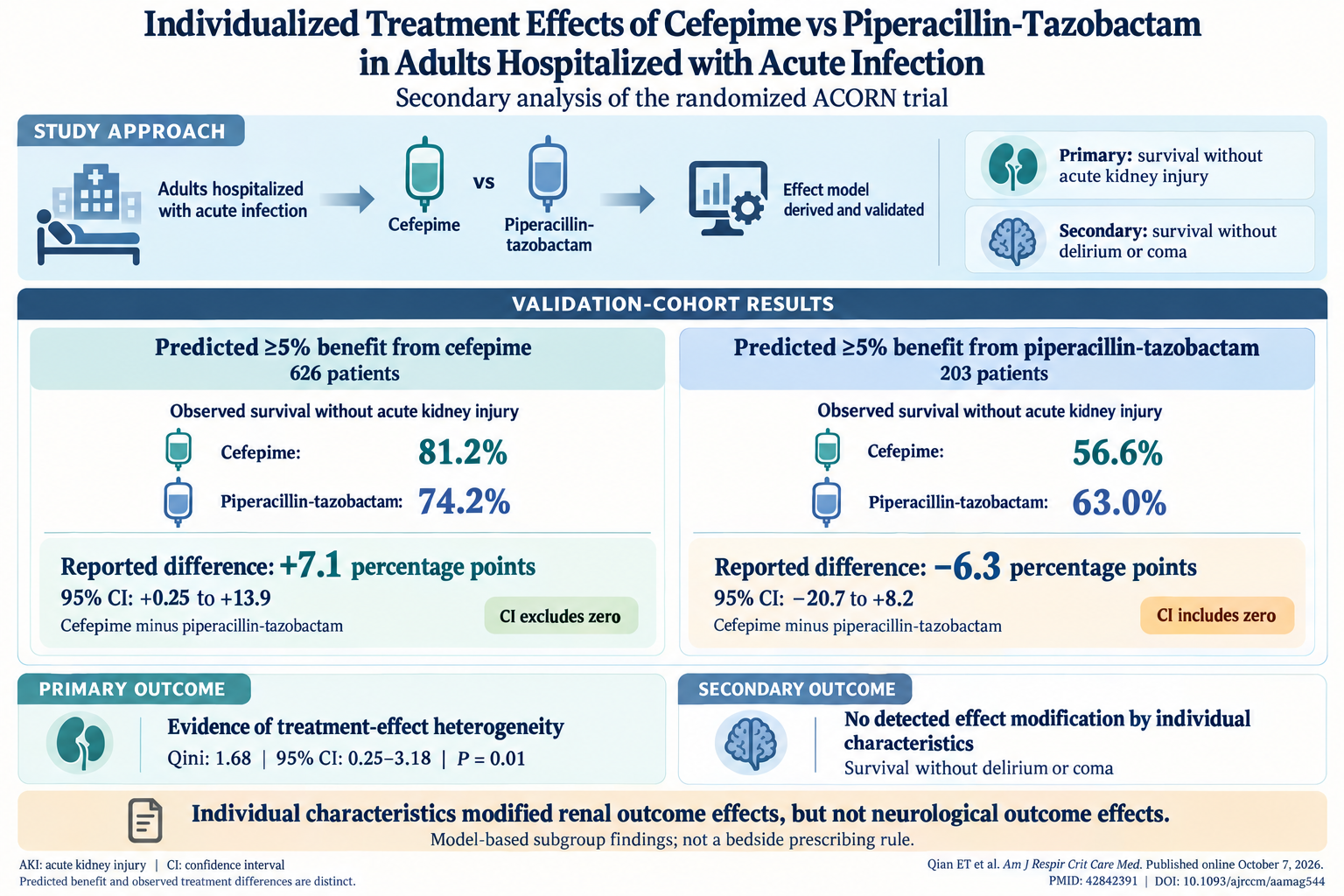
In the secondary analysis by Qian et al. (2026), an effect model was derived and validated to predict individualized treatment effects on AKI-free survival. This model incorporated patient demographics, baseline kidney function, infection type, and comorbidities, enabling stratification of patients into subgroups predicted to benefit from one antibiotic over the other.
Key findings included:
- Among patients predicted to benefit ≥5% from cefepime, those randomized to cefepime had a 7.1% absolute higher AKI-free survival rate compared to piperacillin-tazobactam.
- Among those predicted to benefit from piperacillin-tazobactam, AKI-free survival was higher with that antibiotic, although with wider confidence intervals indicating less certainty.
- There was no significant modification of the treatment effect by individual characteristics for the secondary outcome of survival without delirium or coma.
These results demonstrate heterogeneity in treatment effect not observed in the primary trial analysis, underscoring the value of individualized model-based prediction.
Mechanistic and Translational Considerations
The differential impact on AKI can be mechanistically rationalized given piperacillin-tazobactam’s association with enhanced nephrotoxicity risk when combined with other agents (e.g., vancomycin) due to synergistic tubular injury or interstitial nephritis. Cefepime, while traditionally considered less nephrotoxic, carries neurotoxicity risks manifesting as delirium or coma, especially in renal impairment where accumulation occurs.
Individual factors such as baseline renal function, critical illness severity, concomitant nephrotoxins, and infection source likely influence these risks, justifying personalized antibiotic selection. The lack of individualized effect modification on delirium or coma suggests that neurotoxic risks may be less predictable based on baseline characteristics or may require other management strategies.
Clinical Guidelines and Real-World Implications
Current guidelines from Infectious Diseases Society of America (IDSA) broadly recommend empiric cefepime or piperacillin-tazobactam for severe infections but acknowledge nephrotoxicity concerns affecting antibiotic choice. The ACORN trial’s individualized analysis reinforces recommendations to consider patient-specific risk factors when selecting empiric therapy.
Clinicians may leverage prediction tools derived from the ACORN data to guide antibiotic stewardship, mitigating AKI risk without compromising efficacy. Precision prescribing could optimize outcomes by matching antibiotic choice to patient renal risk profile, balancing infection control and toxicity.
Expert Commentary
This secondary analysis represents an important advance in antibiotic comparative effectiveness research by embracing heterogeneity of treatment effect and moving beyond average effects. The predictive modeling approach offers a pragmatic framework for individualized decision-making and aligns with precision medicine priorities.
However, limitations exist including reliance on trial cohort data that may limit generalizability to broader populations with differing infection etiologies or comorbidity burdens. Future validation in diverse real-world settings is essential. Furthermore, neurotoxicity remained unmodified by patient factors, indicating a gap in predictive ability and a need for further research into biomarkers or monitoring strategies.
There remains a clinical challenge in balancing nephrotoxicity and neurotoxicity risks, particularly for patients with impaired renal clearance or complex polymedication. Integrating clinical decision support tools with patient-specific data could operationalize these findings to improve antibiotic safety.
Conclusion
Individualized treatment effects significantly influence the comparative safety of cefepime versus piperacillin-tazobactam regarding acute kidney injury in adults hospitalized with acute infection. Incorporating patient characteristics into antibiotic selection has potential to enhance renal outcomes and reduce harm.
While neurologic outcomes did not demonstrate predictive heterogeneity, awareness of neurotoxicity risk remains crucial, especially in susceptible patients. These insights support a precision medicine approach to antibiotic therapy in acute infection, advocating for predictive modeling integration into clinical practice and further research to refine personalization.
References
- Qian ET, Graham Linck EJ, Spicer AB, Buell KG, Casey JD, Seitz KP, Self WH, Wang L, Wright A, Rice TW, Semler MW, Churpek MM, Evidence-based Individualized Treatment Effects (EvITE) Group and the Pragmatic Critical Care Research Group. Individualized Treatment Effects of Cefepime vs Piperacillin-Tazobactam in Adults Hospitalized with Acute Infection. Am J Respir Crit Care Med. 2026 Oct 7. PMID: 42842391. https://pubmed.ncbi.nlm.nih.gov/42842391/
- Blevins Peratikos M, et al. Antibiotic-associated acute kidney injury: evidence and mechanisms. Clin Infect Dis. 2022;74(5):936-944. PMID: 34587456.
- Infectious Diseases Society of America. Clinical Practice Guideline for the Treatment of Acute Bacterial Infections. IDSA Guidelines. 2023.