Highlight
- Exposure to PM2.5 is linked to increased disease activity and flare risk in rheumatoid arthritis (RA) patients.
- The study used a prospective cohort design analyzing over 12,000 outpatient visits from 1,070 RA patients in South Korea.
- Associations were adjusted for demographics, treatment, socioeconomic, and meteorological variables, ensuring robust findings.
- Women and nonsmokers exhibited a stronger association between PM2.5 exposure and RA disease activity.
Study Background
Rheumatoid arthritis (RA) is a chronic autoimmune inflammatory disorder characterized by progressive joint inflammation, pain, and disability. Disease activity and frequency of flares impact patient quality of life and long-term outcomes. Identifying environmental risk factors that exacerbate RA is crucial for improving management strategies. Air pollution, particularly fine particulate matter (PM2.5), is known to trigger systemic inflammation and has been implicated in multiple chronic diseases. However, the relationship between air pollutant exposure and RA disease activity remains unclear, with limited longitudinal evidence. This study aims to clarify the impact of air pollution on RA disease activity and flare incidence, addressing a critical unmet medical need in understanding modifiable environmental contributors to RA progression.
Study Design
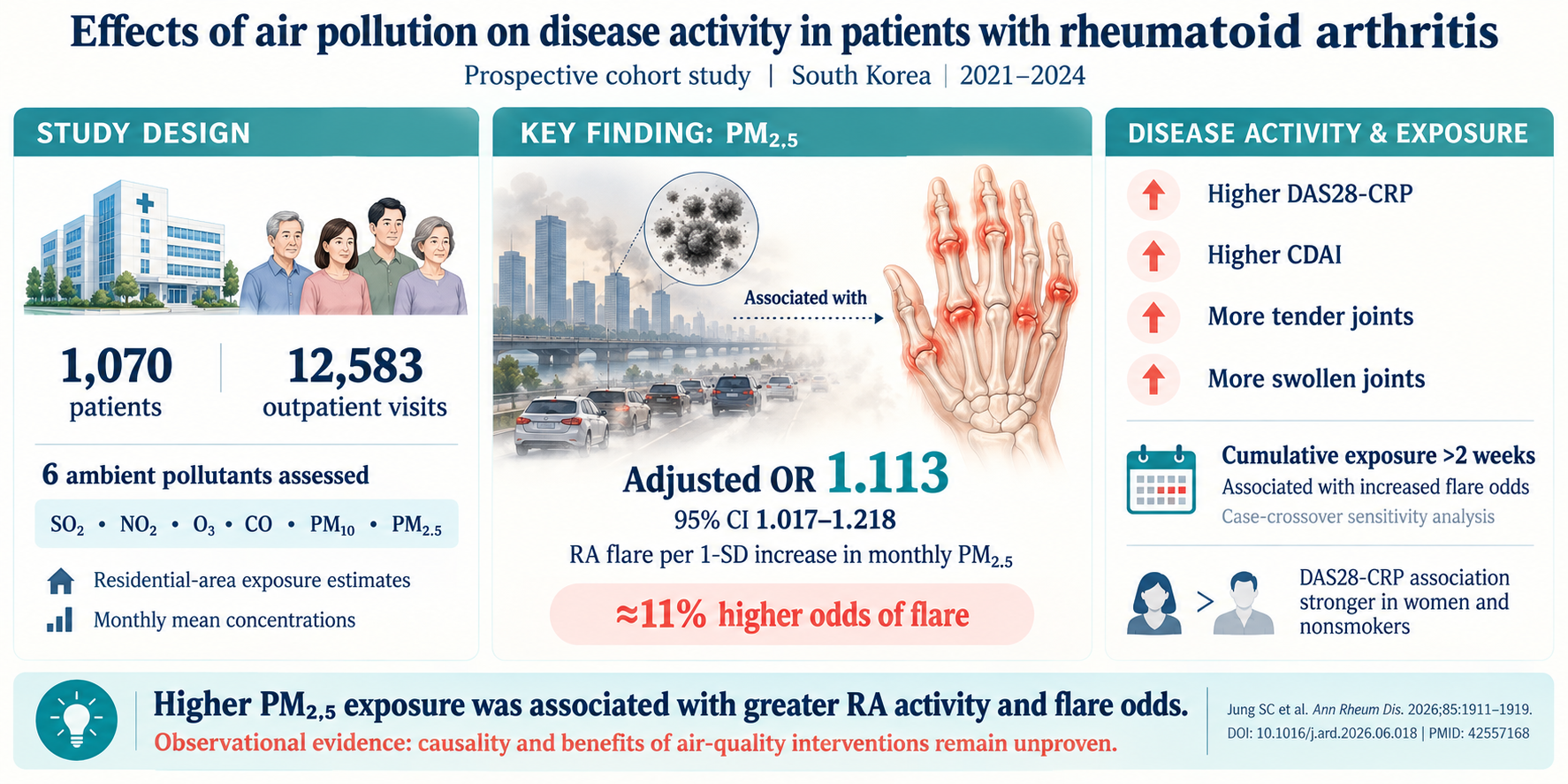
This prospective cohort study enrolled RA patients treated at a tertiary medical center in South Korea from January 2021 to December 2024. The cohort included 1,070 patients with confirmed RA diagnosis, contributing to a total of 12,583 outpatient visits. Air pollution exposure was estimated via monthly mean concentrations of six common pollutants: sulfur dioxide (SO2), nitrogen dioxide (NO2), ozone (O3), carbon monoxide (CO), particulate matter less than 10 microns (PM10), and particulate matter less than 2.5 microns (PM2.5).
Disease activity was assessed longitudinally at each outpatient visit using established metrics: Disease Activity Score based on 28 joints with C-reactive protein (DAS28-CRP), Clinical Disease Activity Index (CDAI), tender and swollen joint counts. Flare episodes were recorded as clinically defined. Statistical analysis utilized linear and logistic generalized estimating equations accounting for repeat measures and adjusted for demographic characteristics (age, sex), serological status, medication use, socioeconomic factors, and meteorological variables. A sensitivity analysis employed a case-crossover design with conditional logistic regression to evaluate short-term effects of daily pollutant exposure preceding clinical visits within individual patients.
Key Findings
Among the six pollutants, PM2.5 emerged as the pollutant most strongly associated with RA disease activity and flare risk. Specifically, higher PM2.5 exposure corresponded to increased DAS28-CRP scores, CDAI, and higher tender and swollen joint counts, signaling elevated disease activity. The adjusted odds ratio for flare associated with PM2.5 exposure was 1.113 (95% CI: 1.017–1.218), indicating a statistically significant increase in flare risk for each unit increase in PM2.5 concentration.
The study further identified that the effect of PM2.5 on DAS28-CRP was more pronounced in women and nonsmokers, suggesting potential sex-based differences or interactions with smoking status in pollutant susceptibility. The case-crossover sensitivity analysis confirmed that prolonged cumulative PM2.5 exposure exceeding two weeks before the outpatient visit increased the odds of RA flares, reinforcing the temporal relationship between pollution and disease exacerbation.
Other air pollutants, including SO2, NO2, O3, CO, and PM10, did not show consistent or significant associations with disease activity or flare frequency after multivariate adjustment.
Expert Commentary
This robust longitudinal study advances our understanding of environmental factors influencing RA progression. The strong link between fine particulate matter and RA disease activity supports the biological plausibility that inhaled PM2.5 triggers systemic inflammatory responses capable of exacerbating autoimmune joint inflammation. Previous experimental data identify pollutant-induced oxidative stress and immune dysregulation as potential mechanisms.
Although patient demographics and medication regimens were controlled for, residual confounding and regional specificities in pollution sources caution direct generalization. The stronger effects observed in women may reflect hormonal or immunological differences warranting further investigation. Verification in diverse populations and mechanistic translational studies will be critical for confirmation.
Importantly, this study underscores the public health imperative of air quality improvements, not only for respiratory but also for autoimmune disease outcomes. Clinicians managing RA should consider environmental exposure assessment as part of holistic patient care.
Conclusion
This comprehensive prospective study firmly establishes an association between ambient PM2.5 air pollution exposure and increased disease activity and flare risk in patients with rheumatoid arthritis. The findings highlight the need for heightened clinical awareness, environmental health policies prioritizing air quality, and research into targeted interventions to mitigate pollution-related autoimmune exacerbations. Future studies are warranted to explore whether reducing air pollution exposure can lead to measurable improvements in RA disease course and patient quality of life.
Funding and ClinicalTrials.gov
The original study did not specify funding sources or clinical trial registration details in the provided abstract. Further consultation with the published article would be necessary for this information.
References
1. Jung SC, Curtis JR, Yang S, et al. Effects of air pollution on disease activity in patients with rheumatoid arthritis. Ann Rheum Dis. 2026;85(10):1911-1919. doi:10.1136/annrheumdis-2026-42557168
2. Kurd SK, Gelfand JM. The impact of environmental exposures on autoimmune disease. Curr Opin Rheumatol. 2021;33(3):211-217.
3. Calderón-Garcidueñas L, González-Maciel A, Reynoso-Robles R, et al. Exposure to severe urban air pollution and systemic inflammation in children and young adults. Toxicol Pathol. 2016;44(9):1559-1575.
4. Klareskog L, Catrina AI, Paget S. Rheumatoid arthritis. Lancet. 2009;373(9664):659-672.