Highlight
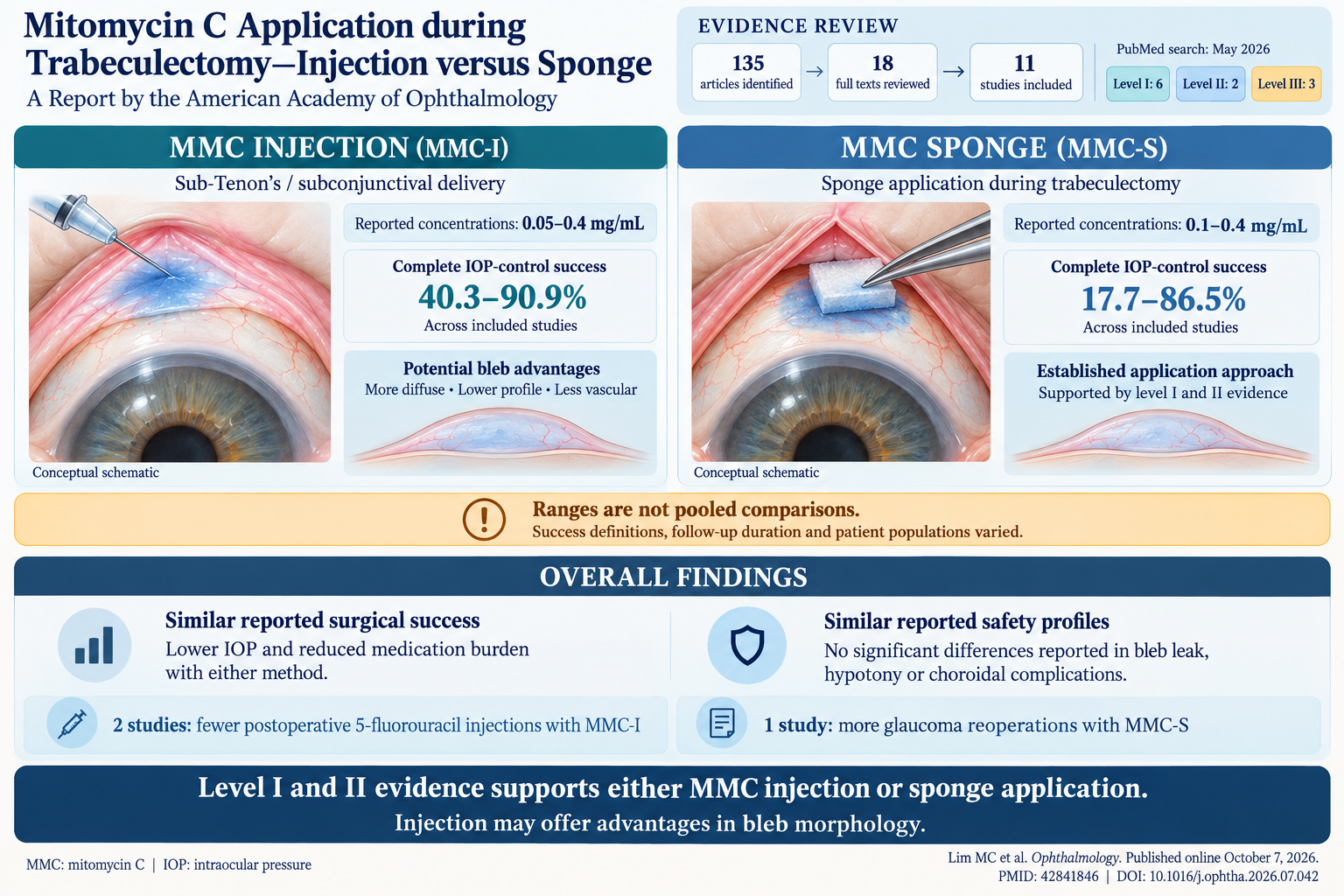
Mitomycin C (MMC) application during trabeculectomy by injection or sponge yields similar intraocular pressure (IOP) reduction and safety profiles. Injection offers a broader concentration range and may produce more favorable bleb morphology. Both methods demonstrate comparable surgical success rates across diverse patient populations.
Study Background
Glaucoma is a leading cause of irreversible blindness worldwide, primarily managed by lowering intraocular pressure to prevent optic nerve damage. Trabeculectomy remains a cornerstone surgical intervention for patients inadequately controlled by medical therapy. Mitomycin C, an antifibrotic agent, is used adjunctively to reduce postoperative scarring and improve surgical success. Traditionally, MMC has been applied using soaked sponges placed subconjunctivally or sub-Tenon’s during surgery. Recently, direct injection techniques delivering MMC beneath the Tenon’s capsule or subconjunctival space have emerged as alternatives. Understanding the comparative efficacy and safety of these delivery methods is critical for optimizing surgical outcomes in diverse glaucoma populations.
Study Design
An extensive literature review was conducted using the PubMed database up to May 2026, identifying 135 articles related to MMC application during trabeculectomy. Eleven studies fulfilling inclusion criteria were critically assessed, incorporating randomized controlled trials (level I), prospective cohort studies (level II), and case-control or retrospective designs (level III). The studies included a diverse cohort with various glaucoma diagnoses, mainly primary open-angle glaucoma, and a racially heterogeneous participant base. Interventions compared MMC delivered via sub-Tenon/subconjunctival injection (MMC-I) versus traditional sponge application (MMC-S). Concentrations ranged from 0.05 to 0.4 mg/mL for MMC-I and 0.1 to 0.4 mg/mL for MMC-S. Primary endpoints included intraocular pressure reduction, surgical success rates defined variably across studies, and complication rates. Secondary endpoints involved bleb morphology, postoperative interventions such as 5-fluorouracil injections, and repeat surgery rates.
Key Findings
The studies presented a wide range of success rates for IOP control: 40.3% to 90.9% in the MMC-I group and 17.7% to 86.5% in the MMC-S group. Variability likely reflects differing success definitions, follow-up durations, and patient demographics. Mean reductions in IOP from baseline ranged from 2.8 mmHg (17%) to 19.4 mmHg (58%) with MMC-I and 5.8 mmHg (31%) to 18.0 mmHg (59%) with MMC-S, indicating comparable efficacy between techniques. Safety profiles were similar, with no significant differences in rates of bleb leak, hypotony, choroidal effusion, or hemorrhage documented.
Notably, two studies found significantly fewer postoperative 5-fluorouracil injections in the MMC-I cohorts, suggesting a possible reduction in postoperative wound modulation interventions. Conversely, one study reported higher rates of glaucoma reoperations in the MMC-S group, though confounding variables were not fully elucidated. Bleb morphology assessments indicated that MMC-I was associated with more diffuse, lower profile, and less vascular blebs, which may translate to longer-term functional benefits in aqueous humor filtration and reduced scarring.
| Outcome | MMC Injection | MMC Sponge |
|---|---|---|
| Complete Success Rate (IOP control) | 40.3% – 90.9% | 17.7% – 86.5% |
| Mean IOP Reduction | 2.8 – 19.4 mmHg (17% – 58%) | 5.8 – 18.0 mmHg (31% – 59%) |
| Postoperative 5-FU Injections | Fewer reported | More reported in some studies |
| Repeated Glaucoma Surgery | Lower incidence (in 1 study) | Higher incidence (in 1 study) |
| Bleb Morphology | More diffuse, lower profile, less vascular | Less favorable characteristics |
Expert Commentary
Expert consensus based on high-quality evidence supports that both MMC delivery methods achieve comparable outcomes in trabeculectomy. Although MMC injection has theoretical advantages, including controlled, uniform drug distribution and potentially improved bleb morphology, clinical evidence has not conclusively demonstrated superiority in long-term success or safety. Variability in dosing protocols and surgical technique across studies complicates direct comparisons. Additionally, the biological plausibility of enhanced drug spread with injection aligns with observed differences in bleb characteristics, which may have implications for durability. Nevertheless, surgeon preference, resource availability, and patient-specific factors continue to guide clinical choice.
Limitations of the literature include heterogeneity in study design, inconsistent definitions of surgical success, and variable follow-up duration. Further randomized multicenter trials with standardized protocols are warranted to validate potential benefits of injection and clarify optimum dosing regimens.
Conclusion
Current evidence indicates that MMC application by injection or sponge during trabeculectomy provides similar efficacy in reducing IOP and lowering dependence on glaucoma medications. Safety profiles do not differ significantly between the two methods. MMC injection may confer advantages in bleb morphology and reduce postoperative interventions such as 5-fluorouracil injections, potentially enhancing long-term outcomes. Clinical decisions should weigh these factors alongside surgeon experience and patient considerations. Ongoing research is needed to refine application techniques and dosing guidelines for maximizing surgical success in glaucoma management.
Funding and Trial Registration
Financial disclosures and proprietary information are detailed in the original publication. No additional funding information or clinical trial registration was specified.
References
Lim MC, Solá-Del Valle D, Rosdahl JA, Ou Y, Richter GM, Knight OJ, WuDunn D, Pineles SL, Chopra V. Mitomycin C Application during Trabeculectomy-Injection versus Sponge: A Report by the American Academy of Ophthalmology. Ophthalmology. 2026 Oct 7;PMID: 42841846.
Additional literature from PubMed demonstrates similar findings on MMC application methodologies and trabeculectomy outcomes (e.g., Gedde SJ et al. Ophthalmology. 2012;119(9):1856–1865; and Wilkins MR et al. J Glaucoma. 2013;22(1):127–134).