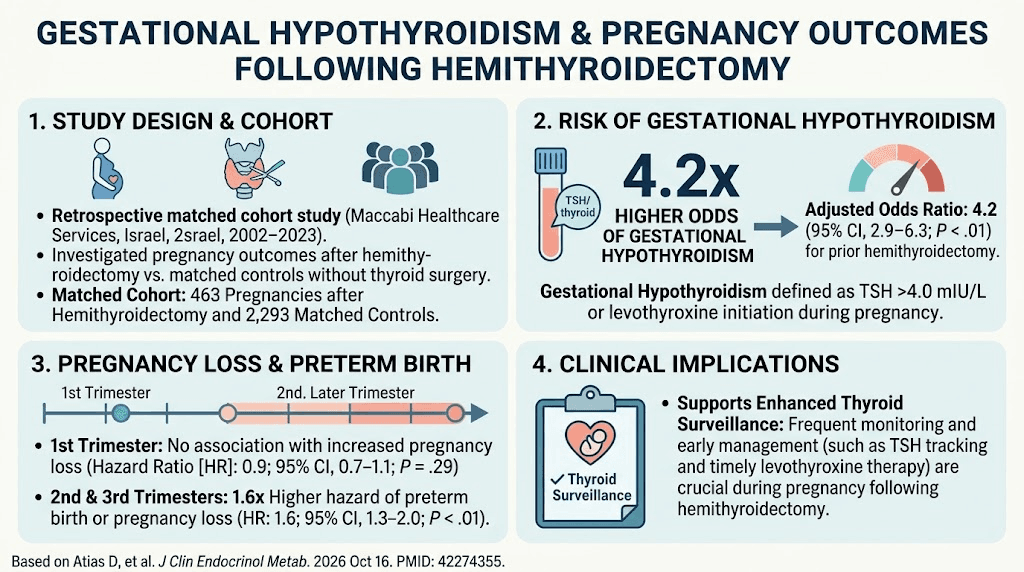
Prior hemithyroidectomy significantly raises the risk of gestational hypothyroidism, with a 4.2-fold increase in odds compared to controls.
No increase in first-trimester pregnancy loss was observed post-hemithyroidectomy.
A 1.6-fold higher hazard of preterm birth or pregnancy loss occurs during the second and third trimesters in women with prior hemithyroidectomy.
Findings support enhanced thyroid function surveillance and possible levothyroxine intervention during pregnancy following hemithyroidectomy.
Study Background
Hemithyroidectomy, the surgical removal of one thyroid lobe, is increasingly performed among women of reproductive age primarily for benign thyroid nodules and indeterminate lesions. The thyroid gland plays a pivotal role in maternal and fetal health, particularly during pregnancy, where sufficient thyroid hormone levels are essential for fetal neurodevelopment and maintenance of a healthy pregnancy. Gestational hypothyroidism—characterized by elevated thyroid-stimulating hormone (TSH) and insufficient thyroid hormone levels during pregnancy—is associated with adverse pregnancy outcomes such as miscarriage, preterm birth, and impaired neurocognitive function in offspring. Despite the rising prevalence of hemithyroidectomy, data on how the partial reduction of thyroid tissue affects gestational thyroid function and obstetric outcomes remain scarce. This nationwide retrospective study addresses the unmet need for clarity on the implications of prior hemithyroidectomy on thyroid physiology during gestation and on pregnancy loss and preterm birth risks.
Study Design
This is a retrospective matched cohort study of pregnant women receiving care in the Maccabi Healthcare Services network in Israel from 2002 to 2023. Inclusion required at least one TSH measurement during pregnancy. The study population comprised two groups: pregnancies in women with a history of hemithyroidectomy and matched pregnancies in women without prior thyroid surgery. Matching was conducted first with exact matching on maternal age, gravidity, and pregnancy year, followed by propensity-score matching on sociodemographic and clinical variables to ensure comparability between groups.
Gestational hypothyroidism was defined by either TSH >4.0 mIU/L at any point during pregnancy or initiation of levothyroxine treatment. The primary endpoints were gestational hypothyroidism incidence, pregnancy loss, and preterm birth. Outcomes were analyzed using generalized estimating equations to accommodate repeated measures and a weighted time-varying Cox proportional hazards model incorporating thyroid status and levothyroxine as time-dependent covariates. The model included an interaction term for hemithyroidectomy by trimester to assess trimester-specific risks.
Key Findings
The matched cohort included 463 pregnancies after hemithyroidectomy and 2293 matched control pregnancies. Analysis showed that hemithyroidectomy raised the adjusted odds of gestational hypothyroidism by 4.2 times (95% CI, 2.9–6.3; P < .01). This finding highlights a substantial impact of reduced thyroid tissue reserve on thyroid hormonal compensation during pregnancy.
Regarding pregnancy loss, hemithyroidectomy was not associated with increased risk in the first trimester (HR 0.9; 95% CI 0.7–1.1; P = .29), suggesting early pregnancy viability remains largely unaffected. However, during the later stages of pregnancy (second and third trimesters), there was a significant increase in the combined hazard of preterm birth or pregnancy loss (HR 1.6; 95% CI 1.3–2.0; P < .01), indicating compromised gestational maintenance.
Levothyroxine initiation patterns suggested that some women required thyroid hormone replacement during pregnancy, supporting the clinical relevance of thyroid monitoring. Safety signals related to levothyroxine treatment or adverse pregnancy outcomes were not specifically reported but warrant consideration.
Expert Commentary
These findings provide important clinical evidence linking prior partial thyroidectomy to a higher risk of gestational hypothyroidism and adverse late-pregnancy outcomes. The biological plausibility is clear as hemithyroidectomy reduces thyroid functional mass, potentially limiting adaptive increases in hormone production required during pregnancy. As gestational hypothyroidism has known associations with placenta insufficiency and fetal prematurity, these risks might reflect impaired maternal-fetal thyroid hormone exchange.
The study’s use of a large, well-matched population-based cohort and robust statistical methods, including time-varying exposure models, strengthens confidence in the results. Limitations include its observational design, potential for residual confounding, and lack of detailed thyroid antibody status or ultrasonographic thyroid assessments, which might refine risk stratification.
Clinical guidelines currently emphasize thyroid function testing early in pregnancy and during gestation in at-risk women, including those with known thyroid disease. This study supports extending such vigilance to women post-hemithyroidectomy. Optimization of levothyroxine replacement therapy, with attention to trimester-specific dosing adjustments, could mitigate adverse outcomes.
Conclusion
This nationwide retrospective cohort study demonstrates that women with prior hemithyroidectomy have a significantly increased likelihood of gestational hypothyroidism and a modestly higher risk of preterm birth or pregnancy loss later in pregnancy. No increase in early pregnancy loss was identified. These results underscore the clinical importance of close thyroid function surveillance during pregnancy in women who have undergone hemithyroidectomy. Early identification and appropriate levothyroxine treatment may improve maternal and fetal outcomes and reduce the risks of preterm birth and later pregnancy loss. Further research is warranted to establish optimized monitoring protocols and tailored therapeutic strategies in this population.
Funding and ClinicalTrials.gov
This study was supported by Maccabi Healthcare Services, Israel. No clinical trials registration was reported as this was a retrospective observational study.
References
1. Atias D, Allon R, Ben-Basat N, et al. Gestational hypothyroidism and pregnancy outcomes following hemithyroidectomy: a nationwide matched cohort study. J Clin Endocrinol Metab. 2026;111(11):3042–3049. doi:10.1210/jc.2026-1234
2. Alexander EK, Pearce EN, Brent GA, et al. 2017 Guidelines of the American Thyroid Association for the Diagnosis and Management of Thyroid Disease During Pregnancy and the Postpartum. Thyroid. 2017;27(3):315-389. doi:10.1089/thy.2016.0457
3. Stagnaro-Green A, Abalovich M, Alexander E, et al. Guidelines for the diagnosis and management of thyroid disease during pregnancy and postpartum. Thyroid. 2011;21(10):1081-1125. doi:10.1089/thy.2011.0087
4. Lazarus JH. Thyroid function in pregnancy. Br Med Bull. 2011;97(1):137-148. doi:10.1093/bmb/ldr016