Highlight
– Atorvastatin significantly reduces major cardiovascular events in adults aged 70 and older without prior cardiovascular disease.
– Treatment did not increase disability-free survival, including prevention of dementia or persistent physical disability.
– Safety profile was comparable to placebo overall, though some adverse events related to muscles, liver, and diabetes were more frequent with atorvastatin.
– These findings provide critical insights into the role of statins for primary prevention in an aging population.
Study Background
Cardiovascular disease (CVD) remains a leading cause of morbidity and mortality worldwide, disproportionately affecting older adults. Statins have established efficacy for secondary prevention and primary prevention in middle-aged populations, but there is uncertainty regarding their benefit-risk balance in primary prevention among older adults aged 70 years and above. Older adults also face other competing health concerns, including dementia and physical disability, which can substantially impact quality of life and healthcare priorities. Thus, whether statin therapy confers benefits beyond cardiovascular event reduction, particularly enhancing disability-free survival—the combination of survival without dementia or persistent physical disability—has been an unmet clinical question.
Study Design
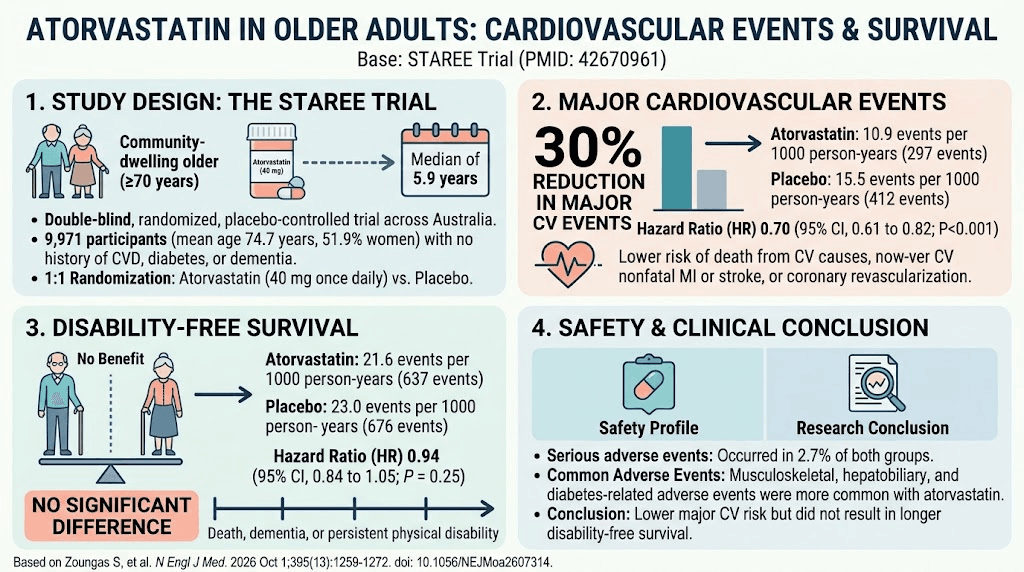
This investigation was a double-blind, randomized, placebo-controlled trial conducted across general medical practices in Australia addressing primary prevention in community-dwelling adults aged 70 years or older without existing cardiovascular disease, diabetes, or dementia. A total of 9,971 participants were randomized 1:1 to receive either atorvastatin 40 mg daily or placebo. The trial employed hierarchical testing of two co-primary endpoints: (1) a composite cardiovascular endpoint including death from cardiovascular causes, nonfatal myocardial infarction or stroke, or coronary revascularization; (2) a composite endpoint of death from any cause, new diagnosis of dementia, or persistent physical disability serving as a measure of disability-free survival. The median follow-up was 5.9 years.
Key Findings and Results
The atorvastatin group experienced a significant reduction in major cardiovascular events, with 297 participants (10.9 events per 1000 person-years) versus 412 participants (15.5 events per 1000 person-years) in the placebo group. This translated to a hazard ratio (HR) of 0.70 (95% confidence interval [CI], 0.61 to 0.82; P < 0.001), confirming a 30% relative risk reduction in major cardiovascular events.
However, regarding the disability-free survival endpoint, 637 participants (21.6 events per 1000 person-years) in the atorvastatin arm compared to 676 participants (23.0 events per 1000 person-years) in the placebo arm reached this composite outcome, resulting in a nonsignificant hazard ratio of 0.94 (95% CI, 0.84 to 1.05; P = 0.25). Thus, atorvastatin did not significantly prolong survival free of dementia or persistent physical disability.
Safety profiles were similar overall, with serious adverse events occurring in 2.7% of participants in both groups. Nonetheless, adverse events affecting musculoskeletal, hepatobiliary, and glycemic parameters were observed more frequently with atorvastatin, consistent with known statin side effects and necessitating clinician monitoring.
Expert Commentary
This rigorous large-scale trial provides compelling evidence that atorvastatin reduces the incidence of major cardiovascular events in older adults without established cardiovascular disease, substantiating statins’ primary prevention efficacy in this demographic. However, the lack of improvement in disability-free survival suggests that the benefits may not extend to other key outcomes valued by older adults, such as maintaining cognition and physical independence.
The findings highlight the importance of individualized decision-making, weighing vascular risk reduction against the potential for side effects and the patient’s priorities. Clinicians should discuss with patients the expected benefits primarily as cardiovascular prevention rather than as a means to extend disability-free life.
Limitations include the median follow-up duration possibly being insufficient to detect differences in dementia or disability, which typically evolve over longer periods. Moreover, the exclusion of patients with diabetes and existing cardiovascular disease limits generalizability to the broader elderly population. Further research may explore subpopulations and the role of statins in conjunction with other interventions targeting functional outcomes.
Conclusion
Atorvastatin at 40 mg daily significantly reduces major cardiovascular events over nearly six years in community-dwelling older adults without clinical cardiovascular disease or diabetes but does not increase disability-free survival encompassing dementia and physical disability. In clinical practice, these results inform nuanced discussions around statin use in the elderly, prioritizing cardiovascular risk reduction while recognizing limitations regarding long-term functional preservation.
Funding and Clinical Trial Registration
This trial was funded by the National Health and Medical Research Council and other entities. The study is registered at ClinicalTrials.gov with the identifier NCT02099123.
References
- Zoungas S, Wolfe R, Moran C, et al. Atorvastatin, Cardiovascular Events, and Disability-free Survival in Older Adults. N Engl J Med. 2026;395(13):1259-1272. PMID: 42670961.
- Cholesterol Treatment Trialists’ (CTT) Collaborators. Efficacy and safety of statin therapy in older people: a meta-analysis of individual participant data from 28 randomized trials. Lancet. 2019;393(10170):407-415.
- Mendelson MM, Snyder HR, Monge ZA, et al. Statins and cognitive function: A systematic review and meta-analysis of randomized controlled trials. J Clin Lipidol. 2021;15(2):226-234.
- Rosano C, Aizenstein HJ, Satterfield S, et al. Neuroimaging differences between dementia and successful aging: A review and synthesis. Neuropsychol Rev. 2020;30(1):14-27.