Higher baseline inflammation, as assessed by CRP, identifies older HF patients likely to benefit most from physical rehabilitation.
Cardiac biomarkers troponin I and T also associated with greater functional improvements with rehabilitation.
Biomarker profiling could guide personalized rehabilitation strategies post-acute HF hospitalization.
Study Background
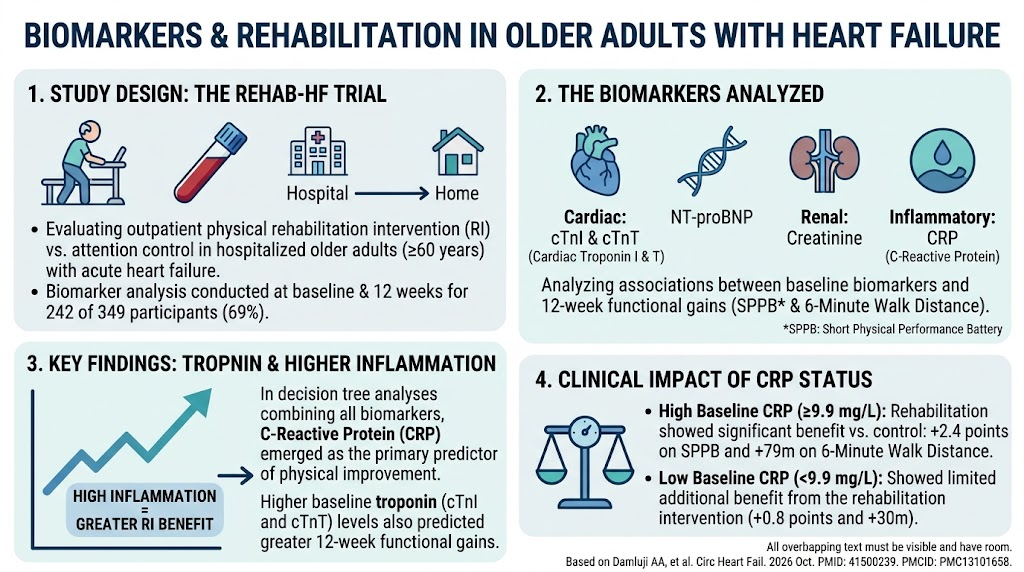
Heart failure (HF) in older adults is a prevalent condition with considerable morbidity, particularly following acute hospitalizations. Functional decline due to geriatric syndromes often complicates recovery, impeding return to baseline autonomy. Physical rehabilitation interventions have shown promise to improve functional outcomes post-HF hospitalization. However, heterogeneity in response to rehabilitation limits optimized allocation. Circulating biomarkers such as cardiac troponins and inflammatory markers like C-reactive protein (CRP) provide insights into underlying pathophysiology and prognosis in HF, but their utility to predict rehabilitation responsiveness remains underexplored. The REHAB-HF trial investigated whether baseline biomarker profiles could stratify functional improvement from a 12-week outpatient physical rehabilitation intervention in older hospitalized HF patients, addressing a critical gap in personalized rehabilitation approaches.
Study Design
REHAB-HF was a randomized controlled trial enrolling participants aged 60 years or older hospitalized with acute decompensated HF. Participants were randomized to either a 12-week structured physical rehabilitation intervention (RI) concentrating on progressive, multidomain exercise or to an attention control group receiving standard care without targeted rehabilitation. Biomarkers measured at baseline and 12 weeks included cardiac troponin I and T (cTnI, cTnT), NT-proBNP, creatinine, and CRP. Primary functional endpoints were changes from baseline to 12 weeks in the Short Physical Performance Battery (SPPB) score and 6-minute walk distance (6MWD). Adjusted linear regression and machine learning decision tree models assessed associations between baseline biomarker levels and functional gains by treatment group.
Key Findings
Biomarker data were available for 242 of 349 participants. Higher baseline cardiac troponins (cTnI and cTnT) were significantly associated with greater improvements in SPPB and 6MWD, respectively, in the rehabilitation group compared to controls (interaction P=0.040 for cTnI and 0.032 for cTnT).
Machine learning analyses integrating all biomarkers identified CRP as the primary discriminator:
– Participants with CRP ≥9.9 mg/L receiving RI had a mean +2.4 point increase in SPPB (95% CI: 1.8-3.1) and +79 m improvement in 6MWD (95% CI: 50-109) compared to controls.
– Those with CRP <9.9 mg/L showed attenuated treatment effects (+0.8 points SPPB, 95% CI: 0.1-1.6; +30 m 6MWD, 95% CI: -1.0 to 61).
Biomarker levels (except creatinine) decreased by 12 weeks post-hospitalization regardless of treatment arm, indicating general clinical improvement, but these changes did not differ between RI and control groups.
These data suggest that a high-inflammatory biomarker profile identifies older HF patients most likely to gain substantial physical function improvements from rehabilitation.
Expert Commentary
This study advances personalized medicine approaches in geriatric heart failure rehabilitation by integrating biomarker profiling to predict treatment responsiveness. The prominence of CRP underscores the role of systemic inflammation in functional impairment and recovery capacity in older HF patients. Elevated troponins, markers of myocardial injury, also associate with rehabilitation gains, perhaps reflecting a subgroup with more active cardiovascular remodeling where exercise elicits greater benefit.
Limitations include the intermediate sample size and the focus on short-term (12 weeks) outcomes. The attenuation of biomarker levels over time irrespective of rehabilitation suggests that biomarker changes are more reflective of overall convalescence than specific intervention effects. Future studies should validate these findings in larger cohorts and examine long-term functional and clinical outcomes.
From a practical standpoint, incorporating baseline CRP measurements could enable clinicians to prioritize rehabilitation resources toward individuals with highest likelihood of functional recovery, optimizing patient-centered care pathways.
Conclusion
The REHAB-HF trial substantiates that circulating biomarkers, particularly CRP, can stratify older adults hospitalized with heart failure by their potential for physical function improvement following rehabilitation. Elevated inflammatory status identifies patients who derive the most pronounced benefit from a structured rehabilitation intervention. Biomarker-guided rehabilitation strategies hold promise to enhance recovery and quality of life in this vulnerable population.
Funding and ClinicalTrials.gov
The REHAB-HF trial was registered on ClinicalTrials.gov (NCT02196038). Funding sources were not detailed in the summary but can be referenced via the primary publication.
References
Damluji AA, Bruce SA, Reeves G, et al. Circulating Biomarkers as Predictors of Improvement in Physical Function in Hospitalized Older Adults With Geriatric Syndromes: Findings From the REHAB-HF Trial. Circulation. Heart failure. 2026;19(10):e013251. PMID: 41500239. https://pubmed.ncbi.nlm.nih.gov/41500239/