Highlight
- COVID-19 pandemic led to a significant immediate reduction in otitis media with effusion (OME) surgeries among the general pediatric population in Japan.
- Surgical volumes among high-risk children with Down syndrome and cleft palate remained largely stable, indicating persistent anatomical need.
- Concomitant procedures such as adenoidectomy and tonsillectomy during OME surgery declined notably during the pandemic.
- Findings emphasize the influence of environmental factors on OME in the general population and highlight the necessity of tailored surgical prioritization in public health emergencies.
Study Background
Otitis media with effusion (OME) is a common pediatric condition characterized by fluid accumulation in the middle ear without signs of acute infection, often leading to hearing loss and potential developmental delays. Tympanostomy tube insertion and myringotomy are established surgical interventions for persistent cases, improving hearing and quality of life. The COVID-19 pandemic drastically altered healthcare delivery globally, including elective surgeries and infectious disease incidence.
Reduced exposure to community-acquired respiratory infections during social distancing and lockdowns was hypothesized to influence the incidence and surgical demand for OME. High-risk pediatric groups—for example, children with Down syndrome or cleft palate—possess anatomical susceptibilities that predispose them to middle ear pathologies. Understanding how pandemic-related environmental changes differentially affected surgical trends can inform healthcare resource allocation and prioritization strategies during public health crises.
Study Design
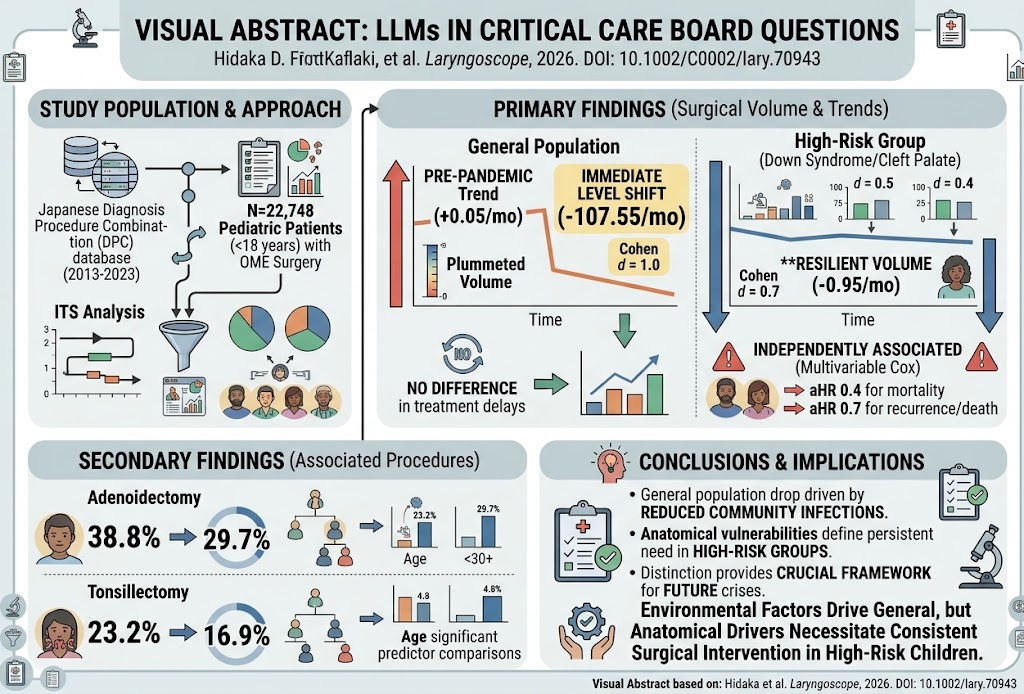
This retrospective cohort study utilized the Japanese Diagnosis Procedure Combination database spanning ten years (April 2013 to March 2023) to analyze pediatric patients under 18 years undergoing tympanostomy tube insertion or myringotomy. The study deployed interrupted time-series (ITS) analysis—an advanced statistical technique to detect immediate changes (level shifts) and evolution of trends (slope changes) while accounting for pre-existing secular trends.
The study compared surgical trends in the general pediatric population with those in two high-risk subgroups: children with Down syndrome and those with cleft palate, to distinguish environmental versus anatomical factors influencing surgical need.
Key Findings
Out of 22,748 recorded pediatric OME surgical cases over the decade, there was no significant pre-pandemic growth trend in surgical volume, indicating a relatively stable baseline.
Following the onset of the COVID-19 pandemic, the general pediatric population experienced an immediate and significant drop of approximately 108 surgeries per month (p<0.05), demonstrating a notable level shift likely linked to decreased viral upper respiratory infections and widespread public health measures. The slope post-pandemic showed a non-significant modest increase, suggesting gradual recovery or adaptation.
Conversely, high-risk groups with Down syndrome and cleft palate did not show statistically significant immediate changes in surgery volume, suggesting persistent anatomical disease burden necessitating ongoing surgical intervention regardless of environmental shifts.
Additionally, the frequency of simultaneous adenoidectomy and tonsillectomy performed with OME surgery decreased significantly—from 38.8% to 29.7% for adenoidectomy and from 23.2% to 16.9% for tonsillectomy (both p<0.001). This trend possibly reflects surgical prioritization or procedural caution during the pandemic.
Expert Commentary
This time-series analysis offers robust evidence that environmental factors—primarily respiratory infection incidence—strongly modulate the demand for OME surgery in the general pediatric population. The preservation of surgical volumes among children with Down syndrome or cleft palate highlights that their middle ear disease is fundamentally driven by intrinsic anatomical and physiological vulnerabilities rather than external infection rates alone.
The observed reduction in concomitant adenoidectomy and tonsillectomy may relate to modified clinical guidelines or risk-benefit assessments in the context of infection control and resource conservation during the pandemic. Future guidelines might consider stratified surgical approaches based on patient risk profiles during health crises.
Limitations include retrospective design and reliance on administrative coding, which may omit nuances of clinical severity or outpatient management strategies. Also, generalizability outside Japan may be limited by differences in healthcare systems and pandemic response measures.
Conclusion
This comprehensive study elucidates distinct patterns in pediatric OME surgical trends during the COVID-19 pandemic, underscoring divergent disease drivers between the general population and high-risk anatomical subgroups. Clinicians and policymakers should incorporate these insights for dynamic surgical prioritization during future public health emergencies, ensuring continued care for vulnerable children while optimizing resource allocation.
Moreover, the findings reinforce the complex interplay between environmental exposures and anatomical predispositions in pediatric OME, highlighting areas for further research in preventative strategies and tailored therapeutic interventions.
Reference
Hidaka H, Tarasawa K, Fujimori K, Kitawaki T, Fushimi K, Ikeda R, Nakano A, Yoshida H, Kamide Y, Hashimoto K, Kakuta R, Tochigi K, Kasai M, Kuroki H, Iino Y, Kobayashi H, Horii A, Ito M. Pediatric Otitis Media With Effusion Surgical Trends During COVID-19: A Time-Series Study. Laryngoscope. 2026 Sep 21. doi: 10.1002/lary.70943. Epub ahead of print. PMID: 42768420.