Highlights
- Younger age at type 1 diabetes onset is associated with markedly increased risk of all-cause mortality, cardiovascular mortality, and kidney complications.
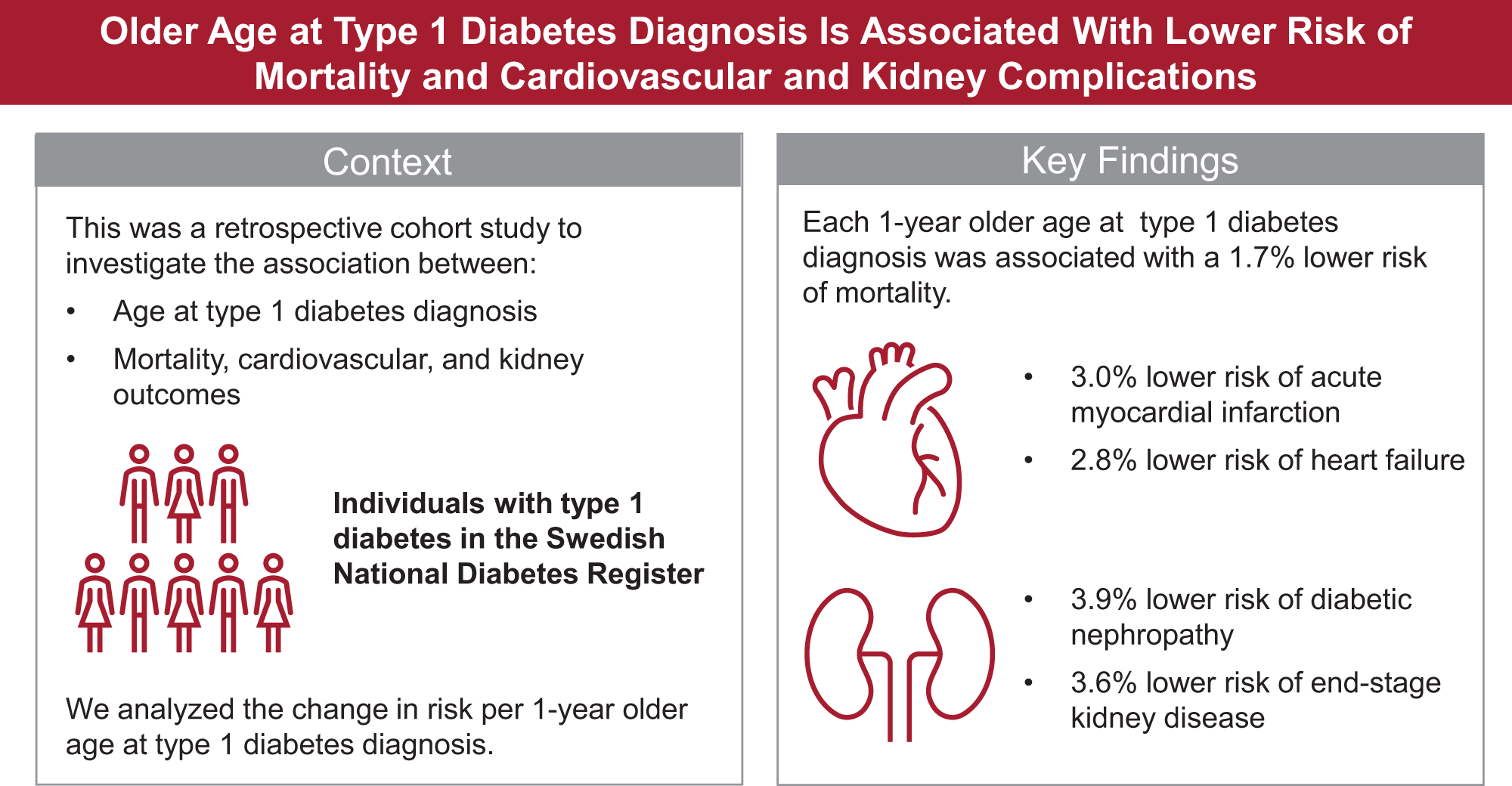
- Each additional year delay in diabetes onset correlates with a 1.7% relative reduction in all-cause mortality risk, underscoring the prognostic importance of age at diagnosis.
- Excess risks compared to matched population controls are highest in those diagnosed before 10 years of age, particularly for cardiovascular outcomes.
- Understanding age-related risk stratification aids in tailored clinical management and prioritizing early preventive interventions.
Background
Type 1 diabetes (T1D) is a chronic autoimmune condition characterized by pancreatic beta-cell destruction resulting in lifelong insulin deficiency. Globally, the incidence peaks in childhood but spans all ages. Despite advances in insulin therapy and glucose monitoring, T1D remains associated with significant long-term morbidity and mortality, largely due to cardiovascular disease (CVD) and chronic kidney disease (CKD). The disease burden is accentuated by early-onset cases, where the longer disease duration may predispose to more complications.
The differential impact of age at diagnosis on survival and organ-specific outcomes remains an area of active investigation. Prior studies have revealed that earlier onset of T1D correlates with worse cardiovascular and renal prognosis, but few large-scale, population-based cohorts have quantified this risk robustly using longitudinal data. Elucidating these associations holds clinical importance for risk stratification, surveillance, and therapeutic intensification.
Key Content
Nationwide Cohort Evidence from Sweden (Rawshani et al., 2026)
A large retrospective cohort study using the Swedish National Diabetes Register (NDR) included 34,155 individuals aged ≥18 with T1D and 150,026 matched comparators, followed from 1998–2019 with outcomes assessed through 2020. Using Cox proportional hazards modeling, the study examined the association of age at T1D diagnosis (modeled continuously per year) with all-cause mortality, cardiovascular mortality, and noncardiovascular mortality.
Key findings included:
- A hazard ratio (HR) per 1-year increase in diagnosis age of 0.98 (95%CI 0.98–0.99) for all-cause mortality, translating to an 8.2% risk reduction per 5-year age delay.
- Similar effect sizes for cardiovascular mortality (HR 0.97 per year increase) and modest effects for noncardiovascular mortality (HR 0.99).
- Maximum excess mortality risk relative to population controls was observed in individuals diagnosed before 10 years of age, with HRs >3 for all-cause mortality and >5 for cardiovascular mortality.
These findings underscore a robust inverse relationship between age at diagnosis and mortality risk, largely driven by cardiovascular complications.
Contextual Literature
Several prior studies and meta-analyses have documented elevated cardiovascular and renal risks in T1D but often categorize age at onset as childhood versus adulthood rather than a continuous metric. For example, the DCCT/EDIC study delineated that early-onset T1D is associated with prolonged exposure to hyperglycemia and early nephropathy, accelerating cardiovascular disease progression. Similarly, international registry data (e.g., EURODIAB, T1D Exchange) support increased microvascular complication risks in younger-onset cohorts.
Mechanistic insights attribute these findings to longer cumulative metabolic insults, early endothelial dysfunction, and accelerated atherosclerosis. Moreover, younger patients face challenges in glycemic control adherence and may thus experience wider glycemic variability, potentiating tissue damage.
Kidney Outcomes and Age at Onset
Chronic kidney disease remains a critical complication in T1D, often motivated by diabetic nephropathy. While Rawshani et al. focus on mortality outcomes, earlier research highlights that earlier diagnosis links with increased incidence of albuminuria and declining glomerular filtration rate (GFR). The protracted duration of diabetes after early onset facilitates progression to end-stage renal disease (ESRD), corroborating the urgency for early nephroprotective strategies.
Methodological Advances
The Swedish registry-based approach offers powerful strengths: large sample size, national representativeness, and linkage to comprehensive mortality data, enabling accurately adjusted hazard models. The use of continuous age at diagnosis avoids limitations of arbitrary categorical groupings, increasing clinical interpretability. Nonetheless, residual confounding and inability to fully account for temporal changes in diabetes management (e.g., insulin analogs, glucose monitoring technologies) over two decades remain limitations.
Expert Commentary
The evidence that younger age at T1D onset portends worse survival and organ outcomes has important clinical ramifications. First, it emphasizes the need for aggressive cardiovascular risk factor modification and renal surveillance in younger-onset patients, who represent a high-risk group for premature complications. Current guidelines from ADA and ISPAD echo this principle, recommending early optimization of glycemic control and blood pressure management.
Biologically, the findings align with cumulative hyperglycemic burden leading to endothelial injury and microvascular dysfunction. Yet, the modest risk reduction per year delay suggests that even small postponements in disease onset can yield meaningful survival benefits, potentially correlated with differences in beta-cell reserve and immune milieu.
In pediatric and adolescent populations, these data justify intensified patient education, psychosocial support, and early adoption of novel therapies including adjunctive agents and technologies (e.g., continuous glucose monitoring, closed-loop insulin delivery) to mitigate long-term risks.
Clinicians should also be mindful of non-cardiovascular causes of mortality, which comprise a substantial proportion of excess deaths, including infections and hypoglycemia-related events.
Conclusion
Age at onset of type 1 diabetes emerges as a pivotal determinant of mortality and complication risks, with younger diagnosis ages conferring substantially higher absolute and relative risks. Nationwide cohort evidence from Sweden, complemented by global registry data and mechanistic studies, advocate for tailored, age-stratified clinical strategies focusing on early risk mitigation and longitudinal surveillance. Future research should delineate how modern treatment modalities modify these risks and explore interventions to delay disease onset or beta-cell loss.
References
- Rawshani A, Eliasson B, McGuire DK, et al. Association of Age at Type 1 Diabetes Onset With Survival, Cardiovascular, and Kidney Outcomes: A Nationwide Cohort Study. Diabetes Care. 2026 Sep 21; PMID: 42765945.
- The Diabetes Control and Complications Trial Research Group. Effect of intensive therapy on the development and progression of diabetic nephropathy in the Diabetes Control and Complications Trial. Kidney Int. 1995;47(6):1703-1720.
- Mayer-Davis EJ, Lawrence JM, Dabelea D, et al. Incidence trends of Type 1 and Type 2 diabetes among youths, 2002–2012. N Engl J Med. 2017;376(15):1419-1429.
- Pihoker C, Badaru A, Timmenga E, et al. The T1D Exchange Clinic Registry: facilitating access to data and new insights in type 1 diabetes. Clin Diabetes. 2015;33(2):68-73.
- American Diabetes Association. 13. Children and Adolescents: Standards of Medical Care in Diabetes—2022. Diabetes Care. 2022;45(Supplement_1):S208-S231.