Highlight
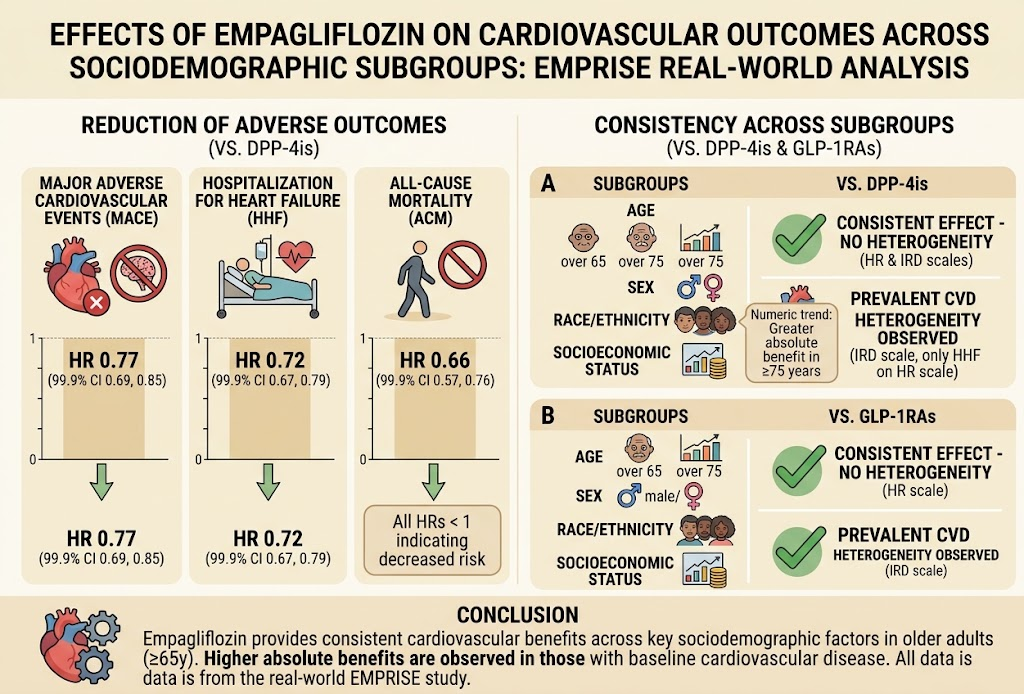
- Empagliflozin significantly lowers major adverse cardiovascular events (MACE), hospitalization for heart failure (HHF), and all-cause mortality (ACM) in older adults with type 2 diabetes compared with DPP4 inhibitors and GLP-1 receptor agonists.
- Cardioprotective benefits are consistent across sociodemographic subgroups including age, sex, race/ethnicity, and socioeconomic status.
- Patients with existing cardiovascular disease experience greater absolute risk reductions, particularly in heart failure outcomes.
- This large real-world analysis from Medicare data complements randomized clinical trials, reinforcing the broad applicability of empagliflozin in clinical practice.
Study Background
Type 2 diabetes (T2D) is a major global health challenge, characterized by increased risk of cardiovascular disease (CVD), heart failure, and premature mortality. Despite advancements in antidiabetic pharmacotherapy, cardiovascular complications remain the leading cause of morbidity and mortality in this population. Emerging glucose-lowering agents such as sodium-glucose cotransporter-2 (SGLT2) inhibitors have demonstrated significant cardioprotective effects beyond glucose reduction in pivotal randomized controlled trials (RCTs). However, there remains a need to understand how these benefits vary across different patient groups in routine clinical settings, especially considering diverse sociodemographic factors and preexisting cardiovascular conditions.
Empagliflozin is a leading SGLT2 inhibitor approved for glycemic control and cardiovascular risk reduction. While RCTs like EMPA-REG OUTCOME have shown robust cardiovascular benefits, real-world evidence reflecting broader patient populations, including older adults and those with comorbidities, is crucial for informing clinical decision-making. The EMPRISE study aimed to evaluate the consistency of empagliflozin’s cardiovascular effects across sociodemographic and clinical subgroups in a Medicare population aged 65 years or older.
Study Design
This observational, real-world study utilized Medicare claims data from 2014 to 2020, identifying adults aged ≥65 years with T2D who initiated treatment with empagliflozin. Comparator groups included patients initiating dipeptidyl peptidase-4 inhibitors (DPP4is) and glucagon-like peptide-1 receptor agonists (GLP-1RAs), two other common glucose-lowering drug classes. Propensity score matching was applied to balance baseline demographics, clinical characteristics, and cardiovascular risk profiles, mitigating confounding bias.
Primary cardiovascular endpoints included major adverse cardiovascular events (MACE)—comprising myocardial infarction, stroke, and all-cause mortality (ACM)—hospitalization for heart failure (HHF), and ACM alone. The study calculated hazard ratios (HRs) and incidence rate differences (IRDs) to assess relative and absolute risk reductions, respectively. Subgroup analyses examined heterogeneity by age groups (65-74 vs. ≥75 years), sex, race/ethnicity, socioeconomic measures, and presence of baseline cardiovascular disease.
Key Findings
Empagliflozin initiation conferred significant reductions in cardiovascular events compared with DPP4is, including an approximate 23% lower risk of MACE (HR 0.77, 99.9% CI 0.69–0.85), 28% lower risk of HHF (HR 0.72, 99.9% CI 0.67–0.79), and 34% lower risk of ACM (HR 0.66, 99.9% CI 0.57–0.76). On an absolute scale, the incidence rate differences per 1000 person-years were −10.3 for MACE, −18.3 for HHF, and −8.6 for ACM, indicating clinically meaningful benefit.
When compared with GLP-1RAs, empagliflozin showed a modest but statistically significant 12% reduction in HHF risk (HR 0.88, 99.9% CI 0.81–0.95), with an absolute rate difference of −6.9 events per 1000 person-years. No significant differences for MACE or ACM were observed against GLP-1RAs.
Crucially, subgroup analyses showed no significant effect heterogeneity across sociodemographic parameters, supporting consistent benefits in men and women, various racial and ethnic groups, and across socioeconomic strata. A numerical trend suggested slightly greater absolute benefit in patients aged ≥75 years compared to those aged 65–74 years.
Baseline cardiovascular disease status influenced absolute but not relative treatment effects markedly. Patients with prevalent CVD derived larger absolute event reductions, particularly for HHF, emphasizing empagliflozin’s utility in secondary prevention.
Expert Commentary
The EMPRISE study robustly extends the evidence base for empagliflozin from controlled clinical trial settings to real-world Medicare patients, addressing key concerns about generalizability to older adults and disadvantaged populations. The consistent efficacy across diverse groups alleviates concerns about differential treatment response by demographics or social determinants.
These findings align with and complement major RCTs such as EMPA-REG OUTCOME and DECLARE-TIMI 58, which have demonstrated SGLT2 inhibitors’ cardiovascular and renal benefits. The greater absolute risk reductions observed in patients with baseline CVD reinforce guideline recommendations for empagliflozin use in secondary cardiovascular prevention among individuals with T2D.
Limitations inherent to claims-based research include potential residual confounding, lack of granular clinical data such as glycemic control metrics or lifestyle factors, and reliance on diagnostic codes for event ascertainment. Nonetheless, rigorous propensity matching and large sample size enhance result robustness.
Mechanistically, empagliflozin improves cardiovascular outcomes through multiple pathways beyond glucose lowering, including natriuresis, blood pressure reduction, improved myocardial metabolism, and attenuation of cardiac remodeling and fibrosis.
Conclusion
This comprehensive real-world analysis confirms that empagliflozin significantly reduces major cardiovascular events, heart failure hospitalizations, and mortality in older adults with T2D, with consistent benefits across sociodemographic groups. Patients with preexisting cardiovascular disease obtain greater absolute benefit, underscoring empagliflozin’s critical role in cardiovascular risk management.
Clinicians should consider empagliflozin early in the therapeutic algorithm for diverse patients with T2D, leveraging its proven cardiovascular and survival advantages. Future research is warranted to explore long-term effects in broader populations and integrate patient-centered outcomes.
Funding and ClinicalTrials.gov
The EMPRISE study was funded by Boehringer Ingelheim, the manufacturer of empagliflozin. ClinicalTrials.gov registration and additional details can be accessed via the published study link.
References
1. Zinman B, Wanner C, Lachin JM, et al. Empagliflozin, Cardiovascular Outcomes, and Mortality in Type 2 Diabetes. N Engl J Med. 2015;373(22):2117-2128.
2. Patorno E, Pawar A, Franklin JM, et al. Cardiovascular Outcomes with Empagliflozin in Routine Clinical Care: Results from the EMPRISE Study. Diabetes Care. 2022;45(3):706-713.
3. American Diabetes Association. 10. Cardiovascular Disease and Risk Management: Standards of Medical Care in Diabetes—2023. Diabetes Care. 2023;46(Suppl 1):S158-S179.
4. Wiviott SD, Raz I, Bonaca MP, et al. Dapagliflozin and Cardiovascular Outcomes in Type 2 Diabetes. N Engl J Med. 2019;380(4):347-357.
5. Neal B, Perkovic V, Mahaffey KW, et al. Canagliflozin and Cardiovascular and Renal Events in Type 2 Diabetes. N Engl J Med. 2017;377(7):644-657.
6.Cromer SJ, Tesfaye H, Cho H, Wexler DJ, Ortega-Montiel J, Schmedt N, Shay CM, Paik JM, Patorno E. Effects of Empagliflozin on Cardiovascular Outcomes Are Consistent Across Sociodemographic Subgroups: A Real-World Analysis From the EMPRISE Study. Diabetes Care. 2026 Sep 21:dca260039. doi: 10.2337/dca26-0039. Epub ahead of print. PMID: 42765974.