Highlight
– Immune checkpoint inhibitors (ICIs) are standard in recurrent/metastatic head and neck squamous cell carcinoma (HNSCC), but their benefit in tumors with PD-L1 combined positive score (CPS) <1 is uncertain.
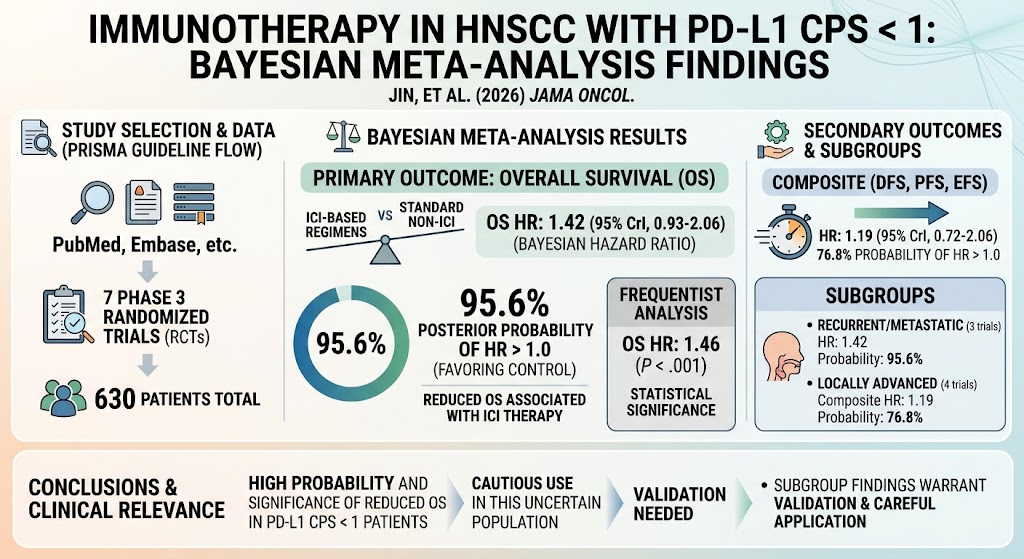
– A Bayesian meta-analysis of seven phase 3 randomized trials showed a higher hazard ratio (HR) for mortality in patients with PD-L1 CPS <1 receiving ICIs versus standard therapy, implying reduced overall survival (OS).
– This finding was statistically significant with frequentist analysis, indicating ICIs may be harmful in this subgroup.
– Cautious use and further validation in this understudied population are advised.
Study Background
Head and neck squamous cell carcinoma (HNSCC) is a heterogeneous group of cancers arising in the mucosal linings of the oral cavity, pharynx, and larynx. Despite advances in multimodality treatments, recurrent or metastatic HNSCC is associated with poor prognosis. Immune checkpoint inhibitors (ICIs), particularly those targeting the PD-1/PD-L1 axis, have transformed therapeutic approaches and are recommended for recurrent/metastatic HNSCC due to survival benefits in general populations.
PD-L1 expression measured as combined positive score (CPS) serves as a predictive biomarker for ICI efficacy. Current guidelines endorse ICIs regardless of PD-L1 status, including patients with CPS below 1, but the benefit in this subgroup remains unclear. This poses a clinical challenge as indiscriminate use could lead to ineffective or even detrimental outcomes.
Study Design
This study conducted a systematic review and Bayesian meta-analysis of phase 3 randomized clinical trials comparing ICI-based regimens to standard non-ICI therapies in patients with HNSCC who had tumors with PD-L1 CPS <1. The literature search encompassed PubMed, Embase, Web of Science, and ClinicalTrials.gov up to January 11, 2026.
The primary endpoint was overall survival (OS), while secondary endpoints included a composite of disease-free survival (DFS), progression-free survival (PFS), and event-free survival (EFS). Separate analyses were performed for recurrent/metastatic and locally advanced settings.
Effect sizes were estimated using Bayesian random-effects models reporting hazard ratios (HRs) with 95% credible intervals (CrIs) and posterior probabilities, alongside frequentist models providing HRs with 95% confidence intervals (CIs) and P values. Methodological rigor was ensured by adherence to PRISMA guidelines and dual independent reviewers.
Key Findings
Seven randomized clinical trials from 2018 to 2025 involving a total of 630 patients with PD-L1 CPS <1 tumors were included.
Recurrent/Metastatic Setting (3 trials)
- Bayesian analysis demonstrated an HR for OS of 1.42 (95% CrI, 0.93-2.06), indicating a trend to worse survival with ICIs.
- The posterior probability that the HR exceeded 1 (favoring control) was 95.6%.
- The frequentist HR was 1.46 (95% CI, 1.17-1.83), statistically significant with P<.001.
Locally Advanced Setting (4 trials)
- The Bayesian HR for the composite endpoint (DFS, PFS, and EFS) was 1.19 (95% CrI, 0.72-2.06) with a posterior probability of 76.8% that HR > 1, indicating less conclusive findings in this subgroup.
Overall Analysis (All Trials)
- For OS (4 trials), Bayesian HR was 1.43 (95% CrI, 0.97-2.07) with a 96.2% posterior probability that ICIs were associated with worse survival.
- For composite PFS/DFS/EFS (6 trials), Bayesian HR was 1.30 (95% CrI, 0.94-1.75), again with a 95.5% posterior probability of HR > 1.
- Frequentist analysis confirmed these findings with HRs 1.47 (95% CI, 1.18-1.83) for OS and 1.31 (95% CI, 1.02-1.69) for the composite survival endpoints, both reaching statistical significance.
Collectively, these results imply that ICIs in patients with PD-L1 CPS <1 HNSCC may reduce survival rather than improve outcomes, contrasting with the broader population that benefits from these agents.
Expert Commentary
The study uniquely applies Bayesian meta-analysis, offering a nuanced probability framework supporting traditional frequentist findings. The high posterior probabilities reinforce concerns regarding the safety and efficacy of ICIs in patients with very low or absent PD-L1 expression.
Biologically, PD-L1 expression indicates tumor immune evasion capacity that ICIs can reverse. A minimal PD-L1 CPS might correspond to limited immune checkpoint-mediated suppression, thus ICIs may lack therapeutic targets or might provoke harmful immune responses.
Limitations include subgroup analyses derived from larger trials not primarily powered for this specific population, heterogeneity in treatment regimens, and varying definitions of PD-L1 CPS thresholds.
Clinicians should apply these findings cautiously. Current guidelines promoting ICIs irrespective of PD-L1 cut-offs may warrant reconsideration or at least more personalized patient selection. Future trials explicitly enrolling PD-L1 CPS <1 patients and exploring combinational or alternative immunotherapies are essential.
Conclusion
This Bayesian meta-analysis challenges the uniform application of immune checkpoint inhibitors in HNSCC patients with PD-L1 combined positive scores less than 1. The evidence suggests a significant association between ICIs and decreased overall survival in this subgroup. These findings underscore the necessity for refined biomarker-driven patient stratification and highlight an urgent need for targeted research validating treatment strategies for this understudied population.
Funding and ClinicalTrials.gov
The included trials span 2018 to 2025 and are registered in relevant trial registries. Specific funding sources for the meta-analysis were not disclosed but likely involve institutional and governmental research grants.
References
Jin M, Shi S, Li Z, Xing S, Wang J, Han F. Immunotherapy in Head and Neck Squamous Cell Carcinoma With PD-L1 Combined Positive Score Less Than 1: A Bayesian Meta-Analysis. JAMA oncology. 2026 Sep 17. PMID: 42752536.
Ferris RL, Blumenschein G Jr, Fayette J, et al. Nivolumab for Recurrent Squamous-Cell Carcinoma of the Head and Neck. N Engl J Med. 2016;375:1856-1867.
Cohen EEW, Horn L, Cohen RB, et al. Pembrolizumab versus methotrexate, docetaxel, or cetuximab for recurrent or metastatic head and neck squamous cell carcinoma (KEYNOTE-040): a randomised, open-label, phase 3 study. Lancet. 2019;393(10167):156-167.
Ribas A, Wolchok JD. Cancer immunotherapy using checkpoint blockade. Science. 2018;359(6382):1350-1355.