Highlights
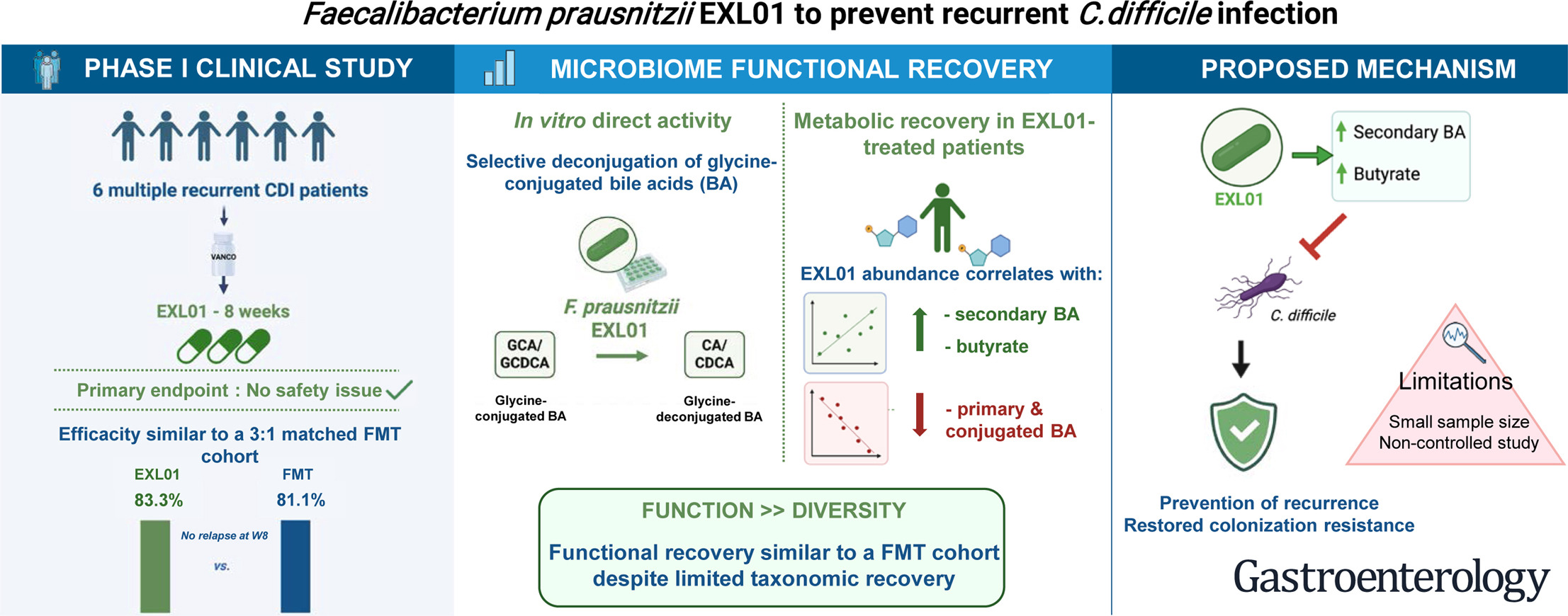
- Faecalibacterium prausnitzii EXL01, a single bacterial strain, effectively prevents recurrent Clostridioides difficile infection (rCDI) with safety comparable to fecal microbiota transplantation (FMT).
- EXL01 restores critical microbiome functions by modulating bile acid metabolism and increasing short-chain fatty acid production, especially butyrate.
- Multi-omics analyses reveal that microbiome functional restoration is achievable without extensive taxonomic complexity, underscoring precision microbiome therapeutics.
- Preclinical murine models support EXL01’s anti-inflammatory and colonization resistance effects, aligning with early-phase clinical trial results in high-risk patients.
Background
Clostridioides difficile infection (CDI) remains a leading cause of healthcare-associated diarrhea worldwide, particularly challenging due to frequent recurrences (rCDI). Recurrent CDI affects up to 25%–30% of patients after primary episodes, with risk increasing after multiple recurrences, largely due to persistent dysbiosis and impaired colonization resistance. Traditional antibiotic therapies eradicate the pathogen but further disrupt gut microbiota, perpetuating susceptibility.
Fecal microbiota transplantation (FMT) has emerged as an effective intervention to restore microbiome diversity and prevent rCDI, achieving cure rates exceeding 80%. However, FMT’s limitations include variable donor material, scalability challenges, regulatory hurdles, and risk of pathogen transmission. Consequently, there is an unmet need for well-defined, scalable, and safe microbial therapies.
Faecalibacterium prausnitzii, a major human gut commensal, is recognized for its anti-inflammatory properties and its role in maintaining intestinal homeostasis. Its marked depletion in rCDI patients suggests therapeutic potential. The proof-of-concept study by Benech et al. (2026) investigates the single-strain Faecalibacterium prausnitzii EXL01 for prevention of multiple-recurrent CDI, heralding a precision microbiome therapeutic approach.
Key Content
Preclinical Evidence and Mechanistic Insights
In antibiotic-disrupted murine CDI models, oral administration of EXL01 significantly reduced C. difficile intestinal burden and ameliorated inflammation, indicating direct or indirect antagonism against CDI pathogenesis. EXL01’s selective ability to deconjugate bile acids was demonstrated in vitro, a critical function since bile acid profiles influence C. difficile spore germination and vegetative growth.
Specifically, EXL01 restored bile acid metabolism, reducing primary bile acids and increasing secondary bile acids that confer colonization resistance. Moreover, EXL01 increased short-chain fatty acids (SCFAs), notably butyrate, a metabolite known to support mucosal integrity and modulate host immune responses. These functional shifts occurred despite limited broad taxonomic microbial diversity recovery, highlighting function-focused restoration over simple compositional replacement.
Clinical Phase I Trial Findings
A multicenter, open-label, single-arm phase I trial enrolled six adults with a history of at least three CDI episodes (multiple-recurrent CDI), using vancomycin preconditioning followed by eight weeks of oral EXL01 daily administration and an eight-week follow-up period. Primary outcomes focused on safety; no treatment-related serious adverse events were reported.
Efficacy signals were promising—five of six patients (83.3%) remained CDI recurrence-free at week 8, paralleling outcomes observed in matched FMT cohorts. EXL01 was detectable in stools up to eight weeks post-treatment, indicating successful engraftment. Longitudinal shotgun metagenomic and metabolomic analyses confirmed correlations between EXL01 presence and restoration of bile acid metabolism and SCFA profiles, particularly butyrate production.
Comparison with FMT and Other Therapeutic Strategies
FMT remains the gold standard for rCDI after multiple recurrences, yet concerns about reproducibility and safety limit universal adoption. EXL01 offers a defined, single-strain alternative that targets ecosystem function rather than broad taxonomic reinstatement. This approach could potentially reduce safety risks, manufacturing variability, and regulatory complexity.
Previous studies have explored multi-strain consortia or spore-based therapies, but EXL01 uniquely demonstrates that a single commensal strain can restore key microbiota functions linked to colonization resistance. This supports an emerging paradigm shifting focus from microbiome diversity per se toward restoration of biochemical and immunological homeostasis.
Expert Commentary
The study by Benech et al. advances the microbiome therapeutic field by demonstrating feasibility and clinical potential of single-strain interventions in highly refractory rCDI patients. The integration of robust multi-omics methodologies adds mechanistic depth absent from many earlier studies, connecting microbial engraftment to functional biomarkers such as bile acid profiles and butyrate levels.
However, the trial’s small sample size and open-label design limit definitive conclusions on efficacy and durability. Larger, placebo-controlled trials are warranted, and such trials are currently ongoing (NCT06306014). Notably, long-term safety and the potential for strain adaptation or ecological displacement should be carefully monitored.
The exclusive focus on patients with ≥3 CDI episodes positions EXL01 as a targeted therapy for high-risk populations. Future research should explore earlier intervention points and combinatorial strategies, including synergy with other microbiome modulators or immunotherapies.
Mechanistically, EXL01’s impact on bile acid metabolism reaffirms the central role of microbial-host metabolic crosstalk in CDI pathogenesis, providing a rational basis for precision therapeutics targeting functional pathways rather than broad taxonomic shifts.
Integration of such therapies into clinical practice will require harmonization of manufacturing standards, regulatory approval pathways, and adoption by clinicians accustomed to conventional antibiotics and FMT. Education about microbiome science and patient selection will be critical.
Conclusion
The Faecalibacterium prausnitzii EXL01 strain represents a pioneering precision microbiome therapeutic for preventing multiple-recurrent Clostridioides difficile infection. Preclinical and early clinical evidence demonstrates safety, engraftment, and restoration of critical microbiota functions governing colonization resistance. Although preliminary, these findings herald a shift toward single-strain, functionally active microbiome therapeutics that could overcome limitations of conventional FMT.
Ongoing controlled clinical trials will clarify EXL01’s efficacy and long-term impact, potentially reshaping management of rCDI and other microbiome-related diseases. This approach exemplifies a broader trend leveraging mechanistic insights to design targeted microbial therapies that restore ecosystem function rather than mere microbial diversity.
References
- Benech N, Guarino-Vignon P, McLellan P, et al. Faecalibacterium prausnitzii EXL01 Strain for the prevention of multiple-recurrent Clostridioides difficile Infection. Gastroenterology. 2026 Sep 17. PMID: 42753987. https://pubmed.ncbi.nlm.nih.gov/42753987/
- Khanna S, Pardi DS. Clinical Updates on the Treatment of Clostridioides difficile Infection. Gastroenterology. 2020;158(4):1545-1552. PMID: 32051861.
- Smits LP, Bouter KE, de Vos WM, Borody TJ, Nieuwdorp M. Therapeutic potential of fecal microbiota transplantation. Gastroenterology. 2013;145(5):946-953. PMID: 23954073.
- Seekatz AM, Theriot CM, Young VB. Restoration of colonization resistance against Clostridium difficile by the intestinal microbiota. Gut Microbes. 2015;6(3):176-182. PMID: 25963407.
- Buffie CG, Pamer EG. Microbiota-mediated colonization resistance against intestinal pathogens. Nat Rev Immunol. 2013;13(11):790-801. PMID: 24096339.