Highlight
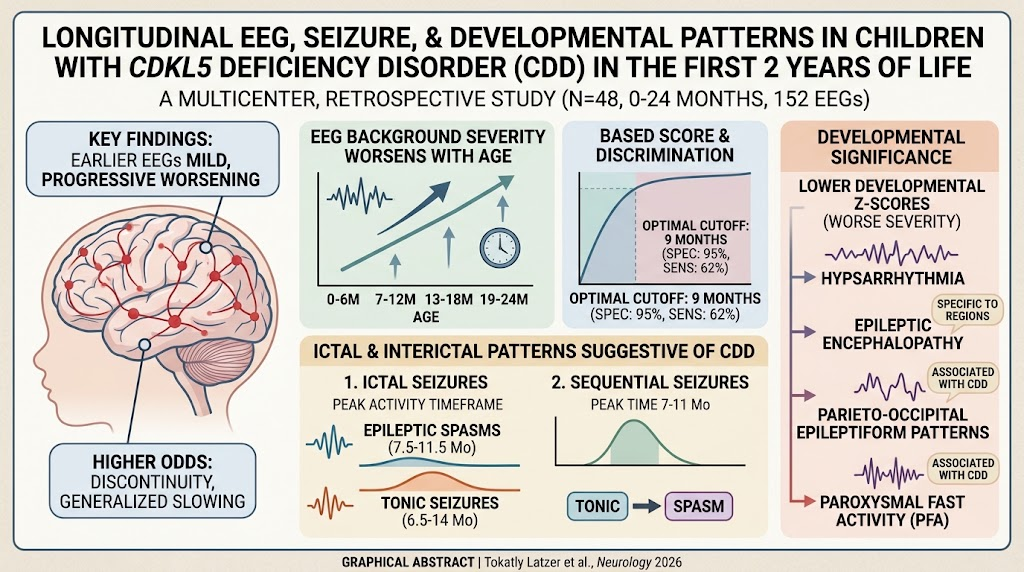
This longitudinal multicenter study on infants and toddlers with CDKL5 deficiency disorder (CDD) demonstrates a progressive worsening of EEG background abnormalities over the first two years of life. Key seizure types include epileptic spasms and tonic seizures with a notable period of sequential seizures occurring between 7 and 11 months. Parieto-occipital paroxysmal fast activity and generalized slowing correlate with higher epileptic encephalopathy severity and poorer developmental outcomes.
Study Background
CDKL5 deficiency disorder is a rare X-linked neurodevelopmental condition characterized by early-onset epileptic encephalopathy and severe developmental impairment. While seizures manifest almost universally at an early age, the progression and specific electroencephalogram (EEG) abnormalities have been variably described. Clinicians have observed that EEG may be only mildly abnormal initially but worsen substantially in infancy. Understanding the temporal EEG and seizure pattern evolution is crucial to optimize diagnosis, prognosis, and therapeutic targeting in this population with profound unmet clinical needs.
Study Design
This retrospective longitudinal analysis included 48 infants and young children aged 0 to 24 months with genetically confirmed CDKL5 deficiency disorder, recruited from two dedicated CDKL5 Centers of Excellence. A total of 152 clinical EEG recordings were rigorously evaluated using the Burden of AmplitudeS and Epileptiform Discharges (BASED) scoring system, which quantifies the severity of epileptiform discharges and background abnormalities. Demographic data, seizure semiology including ictal and interictal features, and developmental outcomes were assessed using a CDKL5-specific developmental scale. Statistical mixed-effects models accounted for repeated EEG measures within the cohort to examine age-dependent changes and correlations.
Key Findings
Progressive EEG Background Abnormalities: EEG background severity worsened significantly with age (p = 0.002 for discontinuity; p < 0.001 for generalized slowing). Discontinuity reflects interrupted EEG background rhythms and is a marker of encephalopathy. Generalized slowing indicates widespread cerebral dysfunction. These changes underscore an evolving encephalopathic process during infancy.
Seizure Phenotypes and Temporal Patterns: Epileptic spasms and tonic seizures were the predominant seizure types. Epileptic spasms peaked between 7.5 and 11.5 months, while tonic seizures peaked between 6.5 and 14 months. Sequential seizures, most commonly tonic seizures immediately followed by epileptic spasms, clustered between 7 and 11 months, suggesting a characteristic seizure progression phase within this age window.
Paroxysmal Fast Activity Localization: Paroxysmal fast activity (PFA), abnormal rapid rhythmic EEG discharges, was predominantly localized to the parieto-occipital regions more frequently than other brain regions (frontal, central, temporal). The presence of PFA was significantly associated with higher BASED severity scores and worse developmental scores (p = 0.008).
BASED Score Cutoff and Diagnostic Utility: A cutoff age of 9 months for the BASED scale showed the best discrimination for identifying high-severity epileptic encephalopathy with 95% specificity and 62% sensitivity, suggesting a critical window for EEG-based disease severity assessments.
Developmental Correlations: Poorer developmental outcomes, evaluated by Z-scores on the CDD-specific developmental scale, correlated significantly with the presence of hypsarrhythmia (p = 0.03), overall epileptic encephalopathy severity by EEG (p = 0.001), parieto-occipital epileptiform patterns (p = 0.04), and PFA (p = 0.008). Age was also significantly correlated (p = 0.03), indicating worsening developmental trajectory alongside EEG deterioration.
Expert Commentary
This study robustly characterizes the temporal evolution of EEG abnormalities and seizure phenotypes in CDKL5 deficiency disorder within infancy, offering vital insights into the natural history of the encephalopathy. The findings on parieto-occipital predominant PFA and sequential spasms emphasize neurophysiological hallmarks aiding early recognition. The strong correlative associations between EEG markers and developmental assessments underscore EEG’s utility as a biomarker to stratify clinical severity and potentially monitor treatment response.
Limitations include the retrospective design and clinical EEGs that might vary in recording conditions. The cohort was majority female (75%), reflecting the X-linked nature of CDD but which may influence generalizability. Furthermore, while distinctive, parieto-occipital PFA and sequential seizures are not exclusively specific to CDD but should heighten diagnostic consideration in context.
Conclusion
This study elucidates key longitudinal EEG and seizure patterns in CDKL5 deficiency disorder, highlighting progressive encephalopathic changes closely associated with clinical severity and developmental impairment. Recognizing these characteristic electrophysiological features and their temporal evolution enables earlier diagnosis and more informed prognostication. Moreover, the demonstrated EEG biomarkers could enhance clinical trial design by providing quantifiable neurophysiological endpoints to evaluate novel therapeutic interventions targeting epileptic encephalopathy and developmental delay in CDD.
Future prospective studies incorporating standardized EEG protocols and detailed neurodevelopmental evaluations will optimize biomarker validation and advance understanding of pathophysiological mechanisms to ultimately improve care and outcomes in this devastating disorder.
Funding and ClinicalTrials.gov
Information on funding sources and trial registration was not provided within the primary publication.
References
- Tokatly Latzer I, Hong W, Zhang B, Lucash J, Zhang XX, Olson HE, Pestana Knight EM. Longitudinal EEG, Seizure, and Developmental Patterns in Children With CDKL5 Deficiency Disorder in the First 2 Years of Life. Neurology. 2026 Sep 16;107(7):e218500. PMID: 42748393.
- Fehr S, et al. CDKL5-Related Disorders: A Review of Clinical Presentation, Molecular Aspects, and Potential Therapies. Orphanet J Rare Dis. 2013;8:196.
- Neul JL, et al. Diagnostic approach to early-onset epileptic encephalopathies: Epileptic spasms and beyond. Epilepsy Curr. 2014;14(1):15-19.