Highlight
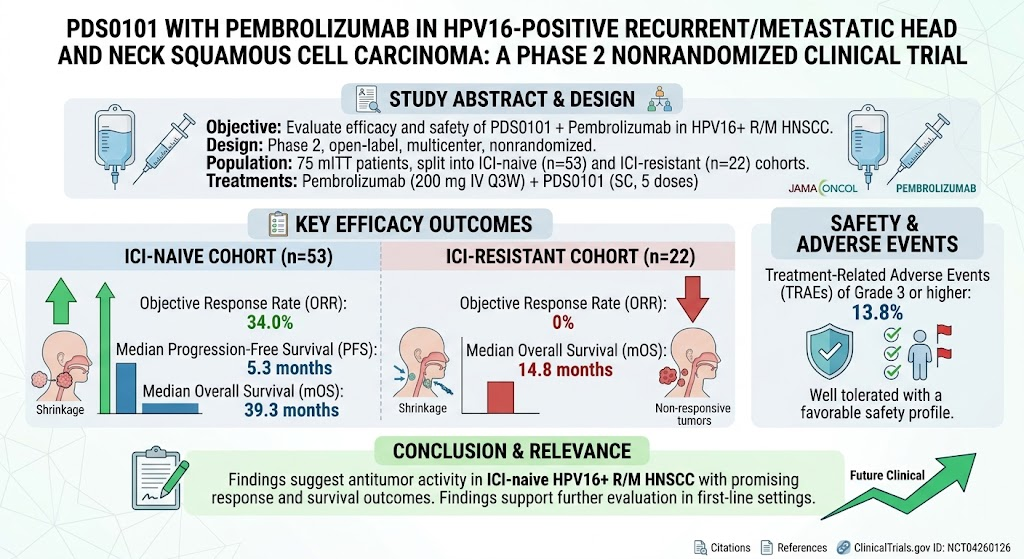
This phase 2 trial evaluated the HPV16-targeted therapeutic vaccine PDS0101 combined with pembrolizumab in recurrent/metastatic (R/M) head and neck squamous cell carcinoma (HNSCC). Among immune checkpoint inhibitor (ICI)-naive patients, the combination yielded a 34% objective response rate (ORR), median progression-free survival (PFS) of 5.3 months, and median overall survival (mOS) of 39.3 months. Safety was favorable, with 13.8% experiencing grade ≥3 treatment-related adverse events. No responses were seen in the ICI-resistant cohort, although survival outcomes remained notable. Results support further development in the first-line setting for HPV16-positive R/M HNSCC.
Study Background
Human papillomavirus type 16 (HPV16) has emerged as a significant etiological factor in a rising subset of head and neck squamous cell carcinoma (HNSCC), specifically within oropharyngeal cancers. Despite an improving prognosis compared to HPV-negative disease, recurrent/metastatic (R/M) HPV16-positive HNSCC remains challenging to treat effectively. Current frontline therapies, including immune checkpoint inhibitors (ICIs) such as pembrolizumab, achieve durable responses in only a minority of patients. Hence, novel therapeutic strategies such as HPV16-specific immunotherapies are under investigation to improve outcomes by harnessing tumor-specific immunity.
Study Design
The VERSATILE-002 trial is a phase 2, open-label, multicenter, nonrandomized clinical study conducted from March 2021 to May 2025 across 26 oncology centers in the US, UK, and Ireland. It enrolled 88 participants with histologically confirmed R/M HPV16-positive HNSCC. Among them, 87 initiated treatment and constituted the safety population, while 75 were included in the modified intent-to-treat (mITT) efficacy analysis. The study stratified patients into ICI-naive (n=53) and ICI-resistant (n=22) cohorts.
Participants received pembrolizumab 200 mg intravenously every three weeks for up to 35 cycles combined with subcutaneous PDS0101 vaccine administered in five scheduled doses as per protocol. The primary endpoint was objective response rate (ORR) assessed by masked independent central review, utilizing RECIST 1.1 criteria. Secondary endpoints included progression-free survival (PFS), median overall survival (mOS), safety and tolerability metrics. Exploratory endpoints encompassed duration of response, disease control rate, and response stratified by programmed cell death ligand 1 (PD-L1) combined positive score (CPS).
Key Findings
The mITT population had a median age of 64 years with a predominance of males (95%) and predominantly White ethnicity (95%).
ICI-Naive Cohort (n=53)
– ORR: 34.0% (confirmed by central review)
– Median PFS: 5.3 months (95% CI, 2.10–9.00)
– Median OS: 39.3 months (95% CI, 23.90 to not evaluable)
– Responses were observed predominantly in patients with PD-L1 CPS ≥1).
ICI-Resistant Cohort (n=22)
– No objective responses were observed; the primary endpoint was not met
– Median OS: 14.8 months (95% CI, 8.50–26.00)
– Disease control was limited but survival was notable given prior ICI resistance.
Safety
Treatment was generally well tolerated. Grade 3 or higher treatment-related adverse events occurred in 13.8% of participants, with no new safety signals identified beyond the known profiles of pembrolizumab and PDS0101. Common adverse events were consistent with immune-related and vaccine-associated effects.
Expert Commentary
The trial’s demonstration of clinical activity of PDS0101 combined with pembrolizumab in ICI-naive HPV16-positive R/M HNSCC is encouraging, especially given the durability of survival outcomes that compare favorably against historical data for pembrolizumab monotherapy. The lack of responses in the ICI-resistant cohort underscores the challenge of overcoming established immune checkpoint inhibitor resistance. The safety profile suggests that adding a therapeutic vaccine does not significantly increase toxicity, supporting further frontline investigation.
Mechanistically, PDS0101 targets HPV16 viral antigens to mobilize specific cytotoxic T cell responses, potentially synergizing with PD-1 blockade to enhance anti-tumor immunity. This biologic rationale aligns with the improved efficacy observed in ICI-naive patients, who may have more intact immune competence. Limitations of the study include its nonrandomized design and relatively small sample size, which may confine generalizability. Further randomized trials, ideally with biomarker stratification, are necessary to confirm these findings and establish optimal patient selection.
Conclusion
This phase 2 trial provides proof-of-concept that PDS0101 vaccination combined with pembrolizumab offers meaningful antitumor activity for ICI-naive patients with HPV16-positive R/M HNSCC while maintaining an acceptable safety profile. The data advocate for larger, randomized phase 3 trials to evaluate this combination as a first-line treatment approach, potentially improving long-term survival and response rates in this growing patient population. Overcoming resistance in the ICI-refractory setting remains a critical unmet need.
Funding and Trial Registration
This study was registered at ClinicalTrials.gov under identifier NCT04260126. The trial was conducted across multiple international centers under protocols supported by the sponsoring institution and cooperative clinical groups. Details regarding funding sources were not specified in the abstract.
References
- Weiss J, et al. PDS0101 With Pembrolizumab in HPV16-Positive Recurrent/Metastatic Head and Neck Squamous Cell Carcinoma: A Phase 2 Nonrandomized Clinical Trial. JAMA Oncol. 2026 Sep 17. PMID: 42752531.
- Burtness B, et al. Pembrolizumab alone or with chemotherapy for recurrent/metastatic head and neck squamous cell carcinoma: KEYNOTE-048 study analysis. Lancet. 2019.
- Gillison ML, et al. HPV-positive head and neck cancer: biology, epidemiology, and clinical management. Nat Rev Clin Oncol. 2019.
- Morris VK, et al. Immunotherapy in HPV-related head and neck cancer. Curr Treat Options Oncol. 2022.