Highlight
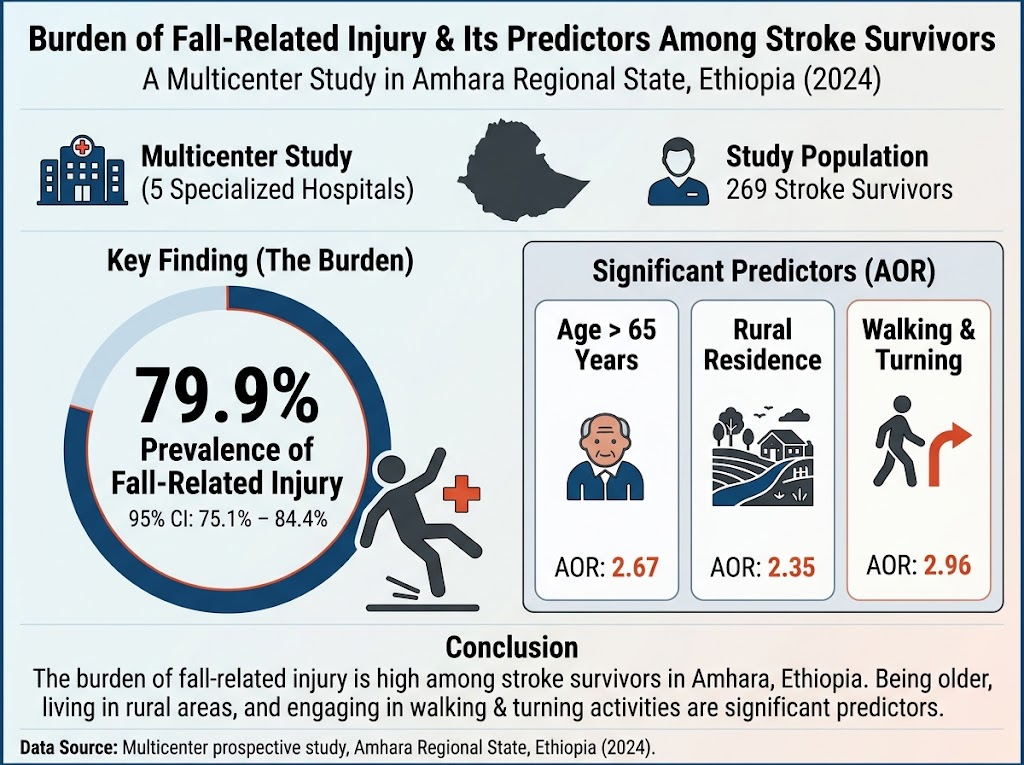
- Nearly 80% of stroke survivors in Amhara Regional State, Ethiopia, experienced fall-related injuries.
- Older age (>65 years), rural residence, and injury occurrence during walking and turning were significant predictors.
- High prevalence emphasizes the need for targeted fall prevention strategies in post-stroke rehabilitation, especially in resource-limited rural settings.
Study Background
Stroke is a leading cause of long-term disability worldwide, with survivors frequently facing challenges related to mobility and balance. Falls constitute a major complication post-stroke, contributing significantly to morbidity, reduced independence, and increased healthcare utilization. While fall incidence is well-documented in high-income settings, data from sub-Saharan Africa, including Ethiopia, remain sparse. Addressing this gap is critical to developing context-appropriate interventions. The Amhara Regional State, with a large population relying on specialized hospitals for stroke care, represents an important geographical area to evaluate the burden and predictors of fall-related injuries among stroke survivors.
Study Design
This prospective multicenter cross-sectional study was conducted from June 1 to August 1, 2024, encompassing five comprehensive specialized hospitals in Amhara: University of Gondar, Bahir Dar’s Feleghiwot and Tebebe Ghion facilities, Debreberhan, and Dessie hospitals. The study recruited 269 stroke survivors attending outpatient physiotherapy departments who met inclusion criteria: at least one previous fall, ability to walk independently or with a mobility aid. Participants were selected using a systematic random sampling method with a sampling interval of 2, proportionally allocated across centers.
The main outcome measure was fall-related injury, defined as any injury attributable to a fall reported by patients, caregivers, or documented in medical records during data collection.
Key Findings
The study revealed a strikingly high prevalence of fall-related injuries at 79.9% (95% CI: 75.1-84.4) among the stroke survivor cohort. Multivariate logistic regression identified significant predictors:
– Age greater than 65 years was associated with a 2.67-fold increased odds of fall-related injury (AOR=2.670, 95% CI: 1.083-6.585).
– Rural residence doubled the risk (AOR=2.352, 95% CI: 1.037-5.332), reflecting potential disparities in access to rehabilitative care or fall prevention resources.
– Injuries occurring during walking and turning activities had nearly a 3-fold higher risk (AOR=2.960, 95% CI: 1.081-8.103), underscoring mobility challenges inherent to post-stroke patients.
These results underscore a substantial unmet need in fall prevention strategies tailored for stroke survivors, especially in rural and older populations.
Expert Commentary
This study is among the first to characterize fall-related injuries in stroke survivors in Ethiopia, contributing valuable epidemiological data for a resource-limited setting. The remarkably high injury burden aligns with broader evidence linking stroke-related motor and sensory impairments to heightened fall risk. The identification of age and rural residence as predictors reveals critical social determinants impacting patient outcomes, including healthcare access and environmental risks.
Limitations include the cross-sectional design which precludes causal inference, potential reporting biases in injury documentation, and absence of detailed functional and cognitive assessments that might further stratify fall risk. Nonetheless, the multicenter nature with systematic sampling enhances generalizability within the Amhara region.
Interdisciplinary interventions emphasizing balance training, environmental modification, and community-based rehabilitation could mitigate these risks. Integration of fall risk assessments into routine post-stroke care protocols in Ethiopia is imperative.
Conclusion
The burden of fall-related injury among stroke survivors in the Amhara region of Ethiopia is alarmingly high, with important implications for patient safety and rehabilitation outcomes. Advanced age, rural residency, and movement-related activities such as walking and turning significantly increase injury risk. These findings highlight an urgent need for context-specific fall prevention programs integrated within stroke rehabilitation services. Future research should explore longitudinal outcomes and intervention efficacy to optimize post-stroke recovery and reduce injury-related morbidity in similar low-resource settings.
Funding and Clinical Trials
Not reported.
References
1. Yalew ES, Sany K, Gobezie M, et al. Burden of fall-related injury and its predictors among stroke survivors attending comprehensive specialized hospitals in the Amhara Regional State, Ethiopia, 2024: A multicenter prospective study. Arch Phys Med Rehabil. 2026 Oct 06. PMID: 42838487.
2. van Duijnhoven HJ, Nienhuis B, Geurts AC, et al. Falls in patients with stroke: A systematic review. Stroke Res Treat. 2013;2013:896245.
3. Batchelor FA, Mackintosh SF, Said CM, Hill KD. Falls after stroke. Int J Stroke. 2012 Sep;7(6):482-90.
4. World Health Organization. WHO global report on falls prevention in older age. 2007.
5. Gebregziabher M, et al. Stroke epidemiology and care in Ethiopia: A systematic review. Neurol Ther. 2023;12(1):31-43.