Highlight
This study from an independent tertiary academic voice center confirms silk protein-hyaluronic acid (silk-HA) injection laryngoplasty as a safe and effective office-based option for glottic insufficiency. Voice outcome improvements were comparable to hyaluronic acid (HA) injections alone. Despite a higher rate of elective operative revisions for overaugmentation, no increase in serious adverse events was observed.
Study Background
Glottic insufficiency, characterized by incomplete closure of the vocal folds, results in dysphonia, breathy voice, and reduced phonatory efficiency. It is often caused by vocal fold paralysis, paresis, or atrophy and significantly impacts communication and quality of life, particularly in elderly populations. Injection laryngoplasty is a widely accepted minimally invasive intervention aimed at medializing the vocal folds to improve glottic closure and voice function.
Hyaluronic acid-based injectables have been commonly used due to their biocompatibility and temporary augmentation properties. Recently, silk protein-hyaluronic acid composite agents have been introduced, aiming to leverage silk protein’s favorable biological properties to potentially enhance longevity and tissue integration. However, data on the safety and effectiveness of silk-HA in clinical practice remain limited, and comparative studies to existing HA treatments are needed.
Study Design
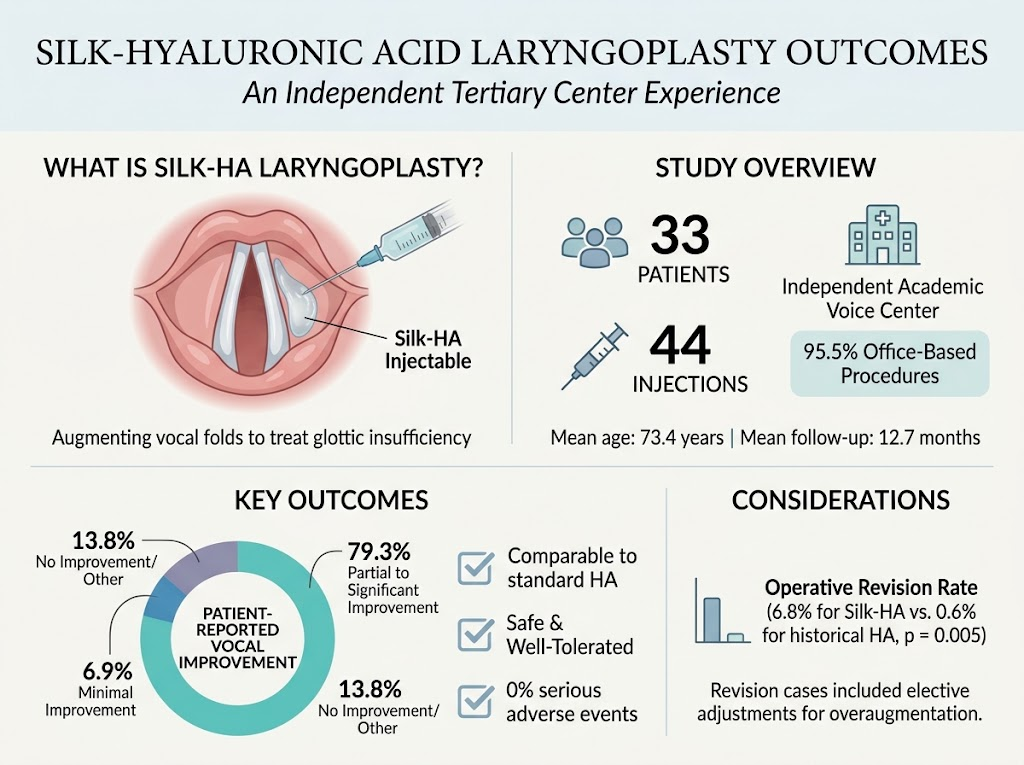
This retrospective study reviewed patients undergoing silk-HA injection laryngoplasty, branded as SilkVoice augmentation, between June 2022 and August 2025 at a single independent tertiary academic voice center. The study population consisted of 33 patients (mean age 73.4 years, 51.5% female) who received a total of 44 silk-HA injections, predominantly performed in an office setting (95.5%).
Outcomes assessed included patient-reported vocal improvement, emergency department visits, hospitalizations, and operative interventions related to the injections. A within-patient comparison was conducted among 20 patients who had also received prior HA injections, allowing direct comparison of efficacy and safety between silk-HA and standard HA treatments. Furthermore, outcomes were compared to a historical HA cohort of 691 patients (1,146 injections) from the same institution to contextualize complication and revision rates.
Key Findings
Voice outcomes following silk-HA injections were promising. Among patients with available follow-up (87.9%), 86.2% reported at least minimal vocal improvement, and 79.3% noted partial to significant improvement, indicating meaningful clinical benefit.
The within-patient comparative analysis of 20 individuals receiving both injection types demonstrated no significant difference in median improvement scores between silk-HA and HA (p = 0.776), supporting equivalent efficacy between the two augmentation agents.
Safety analysis revealed that silk-HA injections were well tolerated, with no increase in serious adverse events such as emergency department visits or hospitalizations. However, the rate of operative intervention following silk-HA (6.8%) was significantly higher than in the historical HA cohort (0.6%, p = 0.005). These revisions mainly comprised elective surgical procedures to address overaugmentation. Notably, one surgical intervention occurred in the context of progressive lung cancer, suggesting patient comorbidity factors may have influenced complications.
Most injections were performed safely in an office setting, demonstrating the feasibility of silk-HA as a minimally invasive augmentation option without requiring general anesthesia or operating room resources.
Expert Commentary
Silk-HA injection laryngoplasty holds promise as an alternative or adjunct to traditional HA injections for glottic insufficiency. Its comparable voice improvement outcomes with established HA material support its efficacy. The higher rate of operative revisions suggests a learning curve or dosing adjustment may be necessary when integrating silk-HA into clinical practice. The overaugmentation-related revisions, although elective, highlight the importance of careful patient selection and injection technique to optimize outcomes.
Given silk protein’s potential biological advantages, including enhanced durability and tissue integration, further longitudinal studies are warranted to evaluate the long-term benefits and cost-effectiveness relative to existing treatments.
Limitations of this study include its retrospective design, single-center setting, and relatively small sample size for silk-HA patients. Additionally, comparisons with the historical HA cohort may be confounded by differences in patient characteristics or procedural factors over time. Prospective randomized trials would better establish comparative effectiveness.
Conclusion
Silk protein-hyaluronic acid injection laryngoplasty is a safe, effective, and office-based treatment modality for glottic insufficiency, yielding voice improvements comparable to hyaluronic acid injections. Although revisions for overaugmentation are more frequent with silk-HA, serious adverse events remain rare. This independent tertiary center experience provides external validation supporting silk-HA as a viable voice augmentation option, expanding the armamentarium for otolaryngologists treating glottic insufficiency.
Future research should focus on optimizing dosing protocols, longer-term outcomes, and head-to-head randomized trials to firmly establish its role in laryngeal augmentation therapy.
Reference
Wajsberg B, Christ AM, Benyo SE, Keuchel CA, Duggal R, Wu R, Benninger MS, Nelson RC, Bryson PC, Tierney WS. Silk-Hyaluronic Acid Laryngoplasty Outcomes: An Independent Tertiary Center Experience. Laryngoscope. 2026 Oct;136(10):4354-4360. doi: 10.1002/lary.70665. Epub 2026 Jun 5. PMID: 42248802; PMCID: PMC13569702.