Highlight
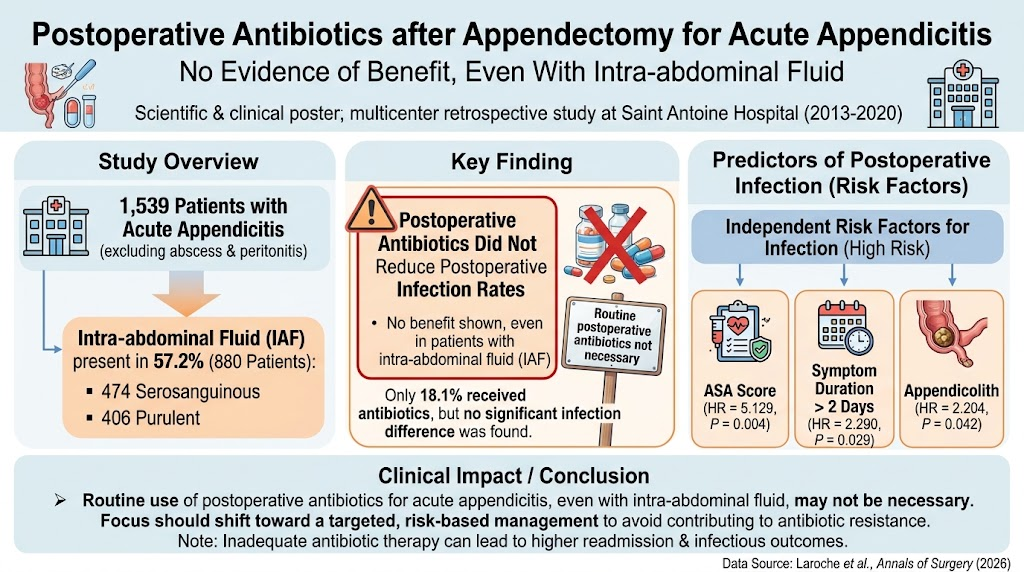
- Routine postoperative antibiotics after appendectomy for acute appendicitis do not reduce infection rates, even when intra-abdominal fluid is present.
- Three independent risk factors for postoperative infection are ASA score, symptom duration over 2 days, and presence of appendicolith.
- Inadequate antibiotic therapy is linked with higher readmission and infectious complications, emphasizing targeted rather than empirical antibiotic use.
- Findings challenge current empirical antibiotic practices and support more individualized postoperative care strategies to prevent antibiotic resistance.
Study Background
Acute appendicitis (AA) is one of the most common surgical emergencies worldwide, with appendectomy as the standard of care. Despite advances in surgical techniques and perioperative management, postoperative infections remain a significant concern, impacting patient outcomes and healthcare costs. Typically, antimicrobial therapy is considered in the perioperative period to reduce the risk of infectious complications, especially when intra-abdominal contamination is evident. However, the necessity and efficacy of postoperative antibiotics remain contentious, particularly in patients with intra-abdominal fluid accumulation but without overt abscess or generalized peritonitis. Unwarranted use of antibiotics risks promoting resistance and adverse drug events, underscoring the need for clear evidence-based guidelines defining appropriate postoperative antibiotic strategies after appendectomy.
Study Design
This retrospective cohort study analyzed data from 1539 patients diagnosed with acute appendicitis who underwent appendectomy at the Saint Antoine Hospital from 2013 to 2020. Patients with abscess formation or peritonitis were excluded to specifically focus on uncomplicated and early complicated cases presenting intra-abdominal fluid. Intra-abdominal fluid was classified as serosanguinous or purulent during surgery. The main intervention of interest was the administration of postoperative antibiotics, which was at the discretion of the treating surgical team. The primary endpoint was the incidence of postoperative infectious complications, including surgical site infections and intra-abdominal abscesses. Secondary analyses focused on identifying risk factors associated with postoperative infections. Statistical methods included univariate and multivariate analyses to adjust for confounders and identify independent predictors.
Key Findings
Intra-abdominal fluid was observed in 880 (57.2%) patients, with 474 (54%) having serosanguinous and 406 (46%) purulent fluid. Postoperative antibiotics were administered to 18.1% of patients. Crucially, there was no statistically significant difference in infection rates comparing patients who received postoperative antibiotics with those who did not, regardless of the presence or type of intra-abdominal fluid.
Multivariate analysis revealed three independent predictors of postoperative infection:
– American Society of Anesthesiologists (ASA) score (hazard ratio [HR] = 5.129; P = 0.004), indicating that patients with poorer preoperative health had a higher risk.
– Symptom duration longer than 2 days before surgery (HR = 2.290; P = 0.029), reflecting delayed intervention and probable progression of inflammation.
– Presence of an appendicolith (HR = 2.204; P = 0.042), suggesting that an obstructing fecalith contributed to infection risk.
Importantly, inadequately prescribed antibiotic therapy (incorrect choice or duration) correlated with increased readmissions and infectious complications, highlighting the need for appropriate antibiotic stewardship rather than blanket antibiotic use.
Expert Commentary
These findings challenge the common surgical practice of empirical postoperative antibiotics after appendectomy, especially in cases where intra-abdominal fluid is identified but no frank abscess or peritonitis is present. The lack of benefit associated with routine postoperative antibiotics suggests that the host response and clinical risk factors rather than fluid presence should guide antibiotic administration.
In the context of increasing antimicrobial resistance, this evidence supports a more conservative and targeted antibiotic approach, reserving postoperative antibiotics for patients with established risk factors such as high ASA score, prolonged symptom duration, or appendicolith presence.
Limitations of the study include its retrospective nature and possible selection biases inherent in observational designs. However, the large sample size and comprehensive analysis strengthen the validity of the conclusions. Future prospective randomized controlled trials would further clarify optimal antibiotic use in these settings.
Conclusion
This study provides robust evidence against the routine use of postoperative antibiotics following appendectomy for acute appendicitis, including in patients with intra-abdominal fluid accumulation. Identifying patients at increased risk for postoperative infections using clinical parameters such as ASA score, symptom duration, and appendicolith presence should guide a more tailored antibiotic strategy. Such an approach could reduce unnecessary antibiotic exposure and its consequences while ensuring patient safety. Continued research is warranted to delineate risk-adapted postoperative antibiotic protocols that optimize outcomes without promoting resistance.
Funding and Trial Registration
No specific funding was reported for this retrospective study. The research was conducted at Saint Antoine Hospital, Paris. There is no indication of clinical trial registration for this retrospective analysis.
References
1. Laroche S, Voron T, Raimbert P, Collard MK, Debove C, Paye F, Lefèvre JH, Parc Y. Postoperative Antibiotics after Appendectomy for Acute Appendicitis: No Evidence of Benefit, Even With Intra-abdominal Fluid. Ann Surg.2026 Oct 1;284(4):831-838. doi: 10.1097/SLA.0000000000006693.. PMID: 40071332.
2. Di Saverio S, Podda M, De Simone B, et al. Diagnosis and treatment of acute appendicitis: 2020 update of the WSES Jerusalem guidelines. World J Emerg Surg. 2020;15(1):27.
3. Bhangu A, Søreide K, Di Saverio S, Assarsson JH, Drake FT. Acute appendicitis: modern understanding of pathogenesis, diagnosis, and management. Lancet. 2015 Sep 26;386(10000):1278-87.
4. WSES guidelines for the management of intra-abdominal infections. World J Emerg Surg. 2017;12:29.
5. Solomkin JS, Mazuski JE, Bradley JS, et al. Diagnosis and management of complicated intra-abdominal infection in adults and children: guidelines by the Surgical Infection Society and the Infectious Diseases Society of America. Clin Infect Dis. 2010;50(2):133-164.