Highlight
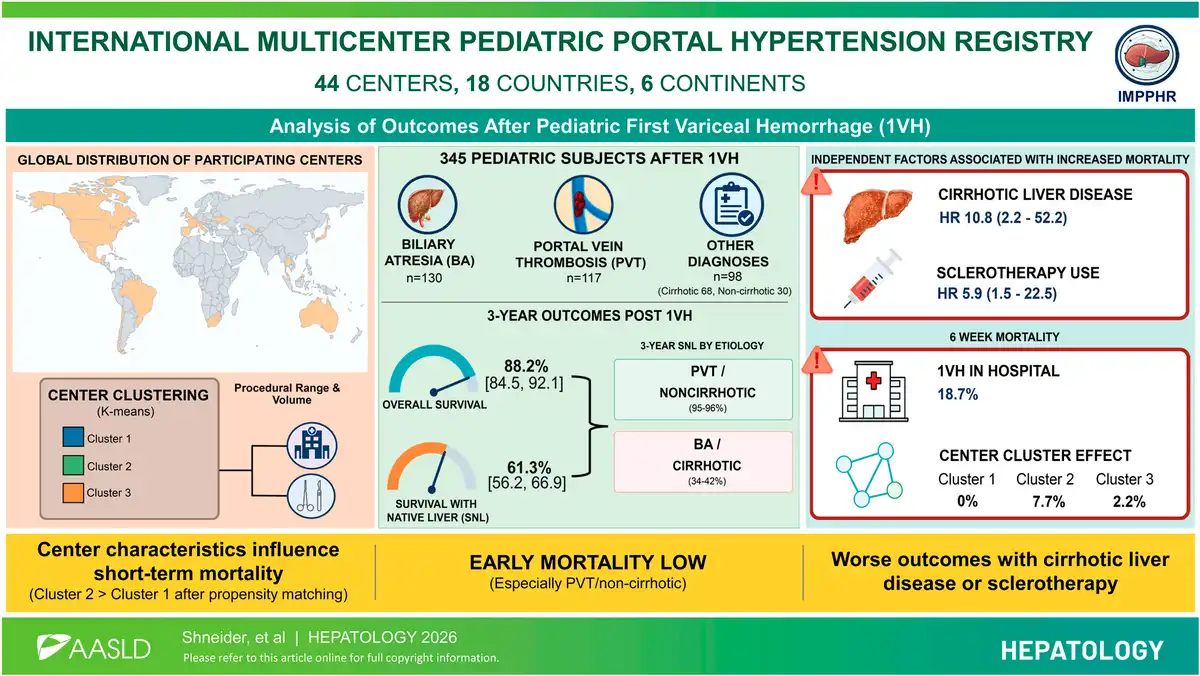
– Immediate mortality after first variceal hemorrhage (1VH) in children is low compared to adults.
– Outcomes vary significantly by underlying diagnosis, with better survival in portal vein thrombosis and noncirrhotic diseases versus biliary atresia and cirrhosis.
– Decompensated disease and certain endoscopic interventions like sclerotherapy are associated with worse survival.
– Center-specific treatment approaches and resources influence short-term mortality.
Study Background
Portal hypertension, an elevated pressure in the portal venous system, is a critical complication of chronic liver diseases and vascular anomalies in children. One of its most severe manifestations is variceal hemorrhage, which entails bleeding from dilated veins (varices) in the esophagus or stomach. Pediatric first variceal hemorrhage (1VH) presents a life-threatening emergency requiring urgent management.
Unlike well-characterized adult populations, the pediatric management of portal hypertension and related variceal bleeding remains controversial and heterogenous due to the rarity of these conditions and diverse etiologies such as biliary atresia, cirrhosis, or portal vein thrombosis. This knowledge gap impedes standardized prophylaxis and treatment protocols and complicates risk stratification for mortality and native liver survival.
The international multicenter study under review aims to fill this void by rigorously evaluating clinical outcomes following pediatric 1VH, discerning diagnosis-specific risks, and assessing how institutional care paradigms affect survival.
Study Design
This retrospective analysis included data from 44 international tertiary pediatric centers specializing in liver disease and portal hypertension management. Centers were clustered via k-means analysis based on their patient volumes and complexity of clinical approaches, resulting in three clusters: high complexity/volume (cluster 1, n=5), low complexity/volume (cluster 2, n=21), and intermediate (cluster 3, n=18).
The cohort comprised 345 pediatric patients presenting with a first episode of variceal hemorrhage. Clinical data, underlying diagnoses, interventions, and follow-up outcomes were collected. Primary endpoints included overall survival (OS) and survival with native liver (SNL). Survival analyses utilized Kaplan-Meier curves, log-rank tests, and both univariable and multivariable Cox proportional hazards models to identify prognostic factors. Additionally, 6-week mortality rates post-1VH were compared across center clusters using causal inference modeling under the Rubin causal model framework.
Key Findings
Diagnosis-Specific Survival Outcomes
The study revealed that children with noncirrhotic diseases, particularly portal vein thrombosis, had significantly better OS and SNL compared to those with biliary atresia and cirrhosis (p<0.001). This underscores the impact of the underlying liver pathology on prognosis after 1VH.
Impact of Disease Severity
Decompensated liver disease, defined by clinical indicators such as ascites requiring diuretics or presence of hospitalization at the time of 1VH, was associated with diminished survival with native liver. Particularly, biliary atresia patients exhibiting poor bile flow faced worse outcomes. This aligns with the clinical understanding that decompensation heralds increased vulnerability to morbidity and mortality.
Interventional Approach and Survival
The study found that endoscopic sclerotherapy was linked to markedly worse OS and SNL compared to other or no endoscopic interventions. This raises concerns about the safety and efficacy of sclerotherapy in pediatric patients and suggests the need for careful patient selection and alternative therapies like band ligation where feasible.
Center-Specific Influence
When comparing clusters, six-week mortality varied significantly. Cluster 2 centers with low volume and presumably lower complexity had a 6-week mortality rate significantly higher than cluster 1 high-volume centers (p=0.010). This finding suggests that experience, resource availability, and treatment complexity play crucial roles in reducing short-term mortality after 1VH.
Overall Mortality
The overall 6-week mortality post-1VH was surprisingly low at 4.1%, with even lower rates (1.4%) among patients not hospitalized at bleed onset. Compared to adult data, wherein variceal hemorrhage mortality is often substantially higher, these data provide encouraging evidence for pediatric outcomes.
Expert Commentary
This international effort substantially advances understanding of pediatric variceal hemorrhage outcomes by providing diagnosis-specific survival probabilities and highlighting the critical role of both disease stage and treatment center capabilities. The large sample size and multicenter design increase generalizability across diverse health systems.
Limitations include the retrospective design, potential selection biases, and variability in center-specific protocols that could confound interpretation. The association of sclerotherapy with poorer outcomes may reflect confounding by indication, as sclerotherapy might be reserved for more severe cases or centers lacking band ligation expertise.
Nevertheless, these findings should prompt clinicians to emphasize early identification and management of portal hypertension in children, consider tailored prophylactic strategies based on diagnosis and severity, and prioritize referral to centers with advanced expertise for optimal outcomes. Future prospective studies could elucidate mechanistic pathways and streamline interventional guidelines to reduce morbidity and mortality in this vulnerable population.
Conclusion
Immediate mortality following pediatric first variceal hemorrhage is notably low but varies significantly by underlying diagnosis, clinical severity, and center-specific care practices. Portal vein thrombosis and noncirrhotic conditions confer better survival compared to biliary atresia and cirrhotic diseases. Decompensation and use of sclerotherapy correlate with worse outcomes. Importantly, centers with higher volume and complexity yield better short-term survival, underlining the need for specialized management. These insights pave the way for risk-stratified treatment algorithms and improved prognostication in pediatric portal hypertension.
Funding and Registration
The original study was an international multicenter collaboration with appropriate institutional and funding support, as detailed in the primary publication (PMID: 42842335). No clinical trial registration was specified as this was an observational analysis.
References
Shneider BL, Gao X, Guo K, et al. An international multicenter analysis of the outcome of pediatric first variceal hemorrhage. Hepatology (Baltimore, Md.). 2026 Oct 7; PMID: 42842335. Available from: https://pubmed.ncbi.nlm.nih.gov/42842335/
Additional literature relevant to portal hypertension and pediatric variceal bleeding can be consulted for comprehensive context.