Introduction and Context
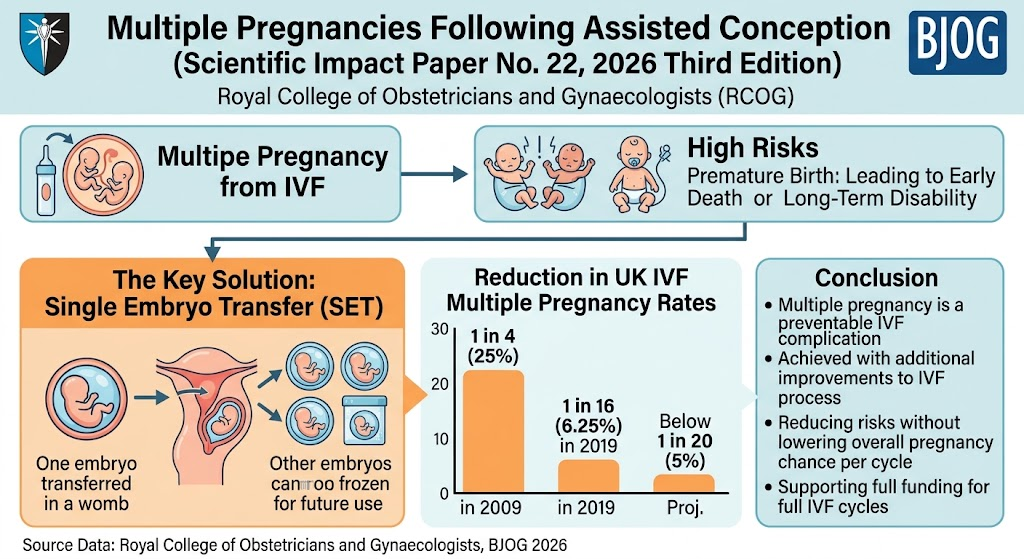
Multiple pregnancy (twins or higher-order multiples) remains one of the most important iatrogenic complications of assisted conception. The Royal College of Obstetricians and Gynaecologists (RCOG) published the third edition of Scientific Impact Paper No. 22 in 2026 to summarise current evidence and to renew practical recommendations for reducing multiple pregnancies after in vitro fertilisation (IVF). The core message is simple and evidence-based: multiple pregnancy is largely preventable and prevention should be the default aim of assisted conception programmes.
This update arrives after sustained collaborative work across UK regulators, clinicians, embryologists, clinic managers and patient advocates. The 2026 edition reflects important advances in laboratory techniques (particularly vitrification/freezing), growing registry evidence of the harms of multiple pregnancy to mothers and babies, and evolving health policy debates about how funding can influence patient and clinic choices.
Why this paper matters now
– IVF-associated multiple pregnancies carry markedly higher risks of preterm birth, neonatal morbidity and long-term disability; there is currently no treatment that reliably prevents preterm birth for multiples.
– Advances in cryopreservation and embryo selection have made elective single embryo transfer (eSET or SET) a practical way to keep live-birth rates high while minimising multiples.
– Real-world practice depends on clinic policies, counselling and the financial context for patients; the paper addresses all three, and for the first time explicitly links broader NHS funding policy (three funded cycles) to expected adoption of SET across the UK.
New Guideline Highlights
Key themes and headline recommendations from RCOG SIP No.22 (2026):
– Elective single embryo transfer (SET) should be the default policy in IVF cycles for women deemed to have a good prognosis, with remaining embryos cryopreserved for subsequent transfer.
– Routine double embryo transfer (DET) should be uncommon and only considered after shared, documented discussion where there is a clear, individualised rationale.
– Full, informed counselling of patients and partners is essential. Counselling should explain relative risks and benefits of SET vs multiple embryo transfer, the role of freezing and cumulative live-birth chances across cycles.
– Clinics must maintain high-quality laboratory processes (embryo culture, selection, vitrification) and report outcomes including multiple pregnancy rates. There should be transparent audit and public reporting.
– Commissioners and funders should consider enabling access to multiple funded cycles (the paper highlights how NHS-funded access to three full cycles would substantially increase uptake of SET and reduce multiples nationally).
Key takeaways for clinicians
– Offer and recommend SET in good-prognosis patients (younger age, good embryo quality, previous reproductive history consistent with success).
– When SET is chosen, use robust vitrification and a plan for frozen-thawed single embryo transfer(s) to preserve cumulative success.
– Document shared decision-making, including the patient’s understanding of perinatal risks of multiples and the clinic’s local multiple pregnancy rate.
Updated Recommendations and Key Changes from Previous Editions
The 2026 third edition updates and sharpens previous RCOG advice by:
– Reaffirming SET as the primary prevention strategy but with stronger emphasis on embedding it as the clinic default (rather than optional), supported by policy levers and funding models.
– Placing greater weight on cumulative live-birth rates (per initiated cycle including frozen transfers) as the correct metric for comparing SET and DET, and citing registry data showing maintained cumulative success with SET when freezing is available.
– Highlighting technology-driven changes: routine use of vitrification has improved frozen embryo survival and outcomes, strengthening the case for SET.
– Adding explicit operational recommendations: improved consent templates, clear clinic policies about elective DET, and mandatory reporting of multiple pregnancy rates to regulators and the public.
– Linking health-economics: the 2026 paper quantifies how neonatal intensive care costs and long-term disability costs from multiples make SET economically attractive when combined with commissioning for multiple cycles.
Table: Select changes (summary)
– Previous editions: Advocated limiting embryo number but offered more permissive DET pathways. 2026: SET default; DET exceptional.
– Previous emphasis: Per-transfer success rates. 2026: Emphasises cumulative per-cycle live birth (including frozen transfers).
– Previous approach: Clinic-level advice. 2026: Stronger cross-sector policy recommendations (funding, public reporting).
Topic-by-Topic Recommendations
Clinical scope and intended users
– Audience: fertility clinicians, embryologists, clinic directors, obstetricians who manage pregnancies after ART, commissioners, patient groups.
Risk assessment and patient selection for SET
– Good-prognosis patients for whom SET is recommended: women generally aged <37–38 with at least one high-quality embryo (or blastocyst) available, previous uncomplicated fertility history, and adequate embryo freezing options.
– Intermediate/poor-prognosis scenarios: consider individualised discussion; SET remains preferred where feasible, but some patients (advanced maternal age, repeated implantation failure with no cryopreserved embryos) may have an evidence-based rationale for multi-embryo transfer after counselling.
Counselling and informed consent
– Mandatory elements: numerical estimates of multiple pregnancy risk with DET vs SET; per-cycle vs cumulative live-birth rates; neonatal and maternal risks of multiple pregnancy; the plan for freezing and future transfers; clinic-specific multiple pregnancy rates and outcomes.
– Use clear written materials and allow time for questions; document the discussion and the patient’s informed preference.
Laboratory practices and embryo selection
– Vitrification: clinics should use validated vitrification protocols to support high survival and implantation rates with frozen embryos.
– Embryo selection: morphological grading and, where used locally, adjunctive methods (time-lapse imaging, preimplantation genetic testing for aneuploidy, PGT-A) should be explained to patients; none remove the fundamental benefit of SET.
Operational and policy recommendations
– Clinic targets: measure and publish multiple pregnancy rate; aim to reduce IVF multiple pregnancy rate substantially (the 2026 paper documents reduction from ~1:4 in 2009 to ~1:16 nationally in 2019 and suggests further lowering to 40): individualised discussion; consider the trade-offs between per-cycle chance and risks of multiples.
– Recurrent implantation failure or limited embryos: shared decision-making; consider whether fresh transfer of more than one embryo is justified after explicit counselling.
– Patients undergoing fertility preservation or egg banking: plan for future SET when embryos are used.
Evidence base and performance measures
– The paper emphasises registry data, RCTs and cohort studies showing that elective SET plus frozen embryo transfer yields cumulative live-birth rates comparable to DET while dramatically reducing twin/triplet pregnancies. It notes that continuing improvements in lab techniques have strengthened this evidence since the last edition.
– Recommended performance metrics for clinics: multiple pregnancy rate per clinical pregnancy, live-birth per initiated cycle (including frozen transfers), and neonatal intensive care admissions related to multiples.
Expert Commentary and Insights
Committee perspectives
– The RCOG authors and advisory committee underscore that preventing avoidable preterm births and their long-term burdens on children, families and health services is an ethical and practical imperative.
– The committee frames SET adoption as a quality-of-care choice that must be supported by laboratory standards and by system-level commissioning decisions.
Areas of consensus
– SET is the preferred strategy for most patients where high-quality embryo freezing and a programme for frozen embryo transfer are available.
– Transparent counselling and reporting are essential.
Controversies and tensions
– Funding pressure vs patient autonomy: Some patients who face limited funded cycles still choose DET to maximise the per-cycle chance of pregnancy. RCOG’s stronger policy stance—recommending commissioners enable access to more funded cycles—is intended to reconcile public health goals with individual autonomy.
– Use of adjunctive technologies: while tools such as PGT-A may help embryo selection, their routine use is not required to justify SET and must be discussed in terms of cost, evidence and local practice.
Future research and gaps
– Better interventions to prevent preterm birth in multiples remain an unmet need.
– More comparative data in older age groups and poor-prognosis populations to refine selection guidance for single vs multiple embryo transfer.
– Health-economic modelling in different funding systems to support commissioning decisions.
Practical Implications for Clinicians and Services
How practice should change right now
– Adopt SET as the default for good-prognosis patients and formalise clinic policies to that effect.
– Strengthen pre-treatment counselling and documentation; provide patient-friendly materials that present cumulative success and harms quantitatively.
– Invest in or partner for robust vitrification and frozen embryo transfer workflows.
– Measure, audit and publish multiple pregnancy rates and outcomes; use those data in continuous quality improvement.
– Advocate with local commissioners for funding models that reduce financial incentives for DET (RCOG highlights the potential impact of offering three funded cycles).
A brief patient vignette
Sarah, 33, is counseled for IVF. She produces two good-quality blastocysts. Her clinic recommends elective SET with vitrification of the second embryo. The clinician explains that SET will keep Sarah’s chance of a live birth across the cycle (including a frozen transfer) similar to transferring both embryos now, but will reduce her chance of twins dramatically—lowering the risk of prematurity and neonatal complications. Sarah chooses SET and later achieves a singleton live birth after a frozen embryo transfer.
References
– El-Toukhy T, Bhattacharya S, Akande V; Royal College of Obstetricians and Gynaecologists. Multiple Pregnancies Following Assisted Conception (Scientific Impact Paper No. 22, 2026 Third Edition). BJOG. 2026 Apr 7;133(7):e45–e49. PMID: 42809513. https://pubmed.ncbi.nlm.nih.gov/42809513/
– HFEA. Fertility treatment 2019: trends and figures. Human Fertilisation and Embryology Authority; 2020. (HFEA publishes annual data and trend analyses showing declines in IVF-related multiple pregnancy rates over recent years.) https://www.hfea.gov.uk/
– National Institute for Health and Care Excellence (NICE). Fertility: assessment and treatment for people with fertility problems. Clinical guideline CG156. 2013. https://www.nice.org.uk/guidance/cg156
– Royal College of Obstetricians and Gynaecologists. Multiple pregnancy: the management of twin and triplet pregnancies. Green-top Guideline No. 51. 2011. https://www.rcog.org.uk/guidance
– World Health Organization. Preterm birth. Fact sheet. 2018. https://www.who.int/news-room/fact-sheets/detail/preterm-birth
(higher-resolution references and the RCOG SIP No.22 text should be consulted for local implementation details and exact wording of recommendations.)
Conclusion
RCOG’s 2026 Scientific Impact Paper No.22 renews a clear clinical and public-health vision: prevent multiple pregnancies from assisted conception. The essential tools are well established—elective single embryo transfer, high-quality embryo freezing, honest counselling, transparent reporting and system-level commissioning that removes perverse financial incentives. Where these elements come together, clinics can preserve or improve cumulative live-birth rates while substantially reducing the avoidable harms of prematurity and long-term disability linked to multiple pregnancy. For clinicians, commissioners and patient advocates alike, the paper provides both practical steps and a policy agenda to make single embryo transfer the norm where it is safe and effective.