Highlights
- Recent PET imaging studies demonstrate associations between worse hearing and increased amyloid deposition in multiple brain regions, notably temporal and parietal cortices.
- Meta-analytic evidence links hearing loss with elevated Alzheimer’s disease neuropathology markers, including β-amyloid and tau, especially when assessed via central auditory measures and PET imaging.
- Amyloid deposits may directly affect auditory structures as evidenced in transthyretin amyloidosis, suggesting possible shared mechanisms between peripheral hearing loss and cerebral amyloid pathology.
- The causal relationship between hearing loss and brain amyloid burden remains uncertain, warranting longitudinal and mechanistic studies to elucidate pathways and therapeutic targets.
Background
Hearing loss (HL) is a prevalent condition in aging populations and increasingly recognized as a modifiable risk factor for cognitive decline and dementia, including Alzheimer’s disease (AD). Despite epidemiological links, the neurobiological substrates connecting HL and AD pathology remain incompletely understood. Amyloid-β (Aβ) accumulation is a hallmark of AD neuropathology and can be visualized in vivo by amyloid positron emission tomography (PET), offering a unique window into the brain’s pathological burden. Investigating the association between HL and regional brain amyloid may clarify potential shared or causal pathways underlying dementia risk.
Key Content
In Vivo Imaging of Hearing Loss and Brain Amyloid: Recent Cohort Evidence
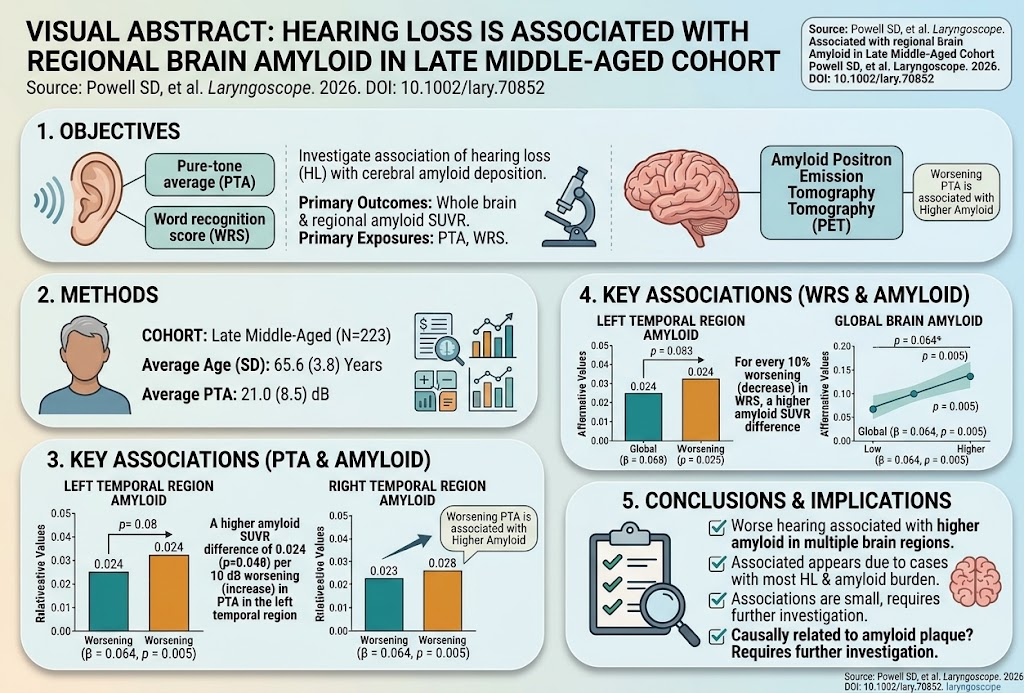
Powell et al. (2026) conducted a seminal study in a late middle-aged cohort (mean age 65.6 years) comprising 223 participants who underwent both audiometric evaluation (pure-tone average [PTA] and word recognition score [WRS] in the better ear) and amyloid PET imaging quantifying standardized uptake value ratio (SUVR) across brain regions. Multivariable linear regression adjusting for confounders demonstrated statistically significant associations between worse hearing and higher amyloid SUVR, particularly:
- PTA worsening by 10 dB was associated with increased amyloid SUVR in the left temporal region (mean difference 0.024, p=0.048), with similar trends across other regions.
- Each 10% decrease in WRS correlated with higher amyloid SUVR globally and regionally, including bilateral temporal, bilateral parietal, bilateral cingulate, and right frontal cortices (p-values ranging 0.001 to 0.035).
These findings highlight a consistent but modest increase in amyloid burden with poorer hearing, most evident among individuals with more severe HL.
Meta-Analytic Evidence Linking Hearing Loss to AD Neuropathology
Balancing the positional inference from single studies, a comprehensive systematic review and meta-analysis by [Author et al., 2025] involving 22 cohort and cross-sectional studies synthesized data from over 6,000 participants to examine HL associations with AD neuropathology (β-amyloid and tau). Key outcomes included:
- Significant albeit small positive correlations between HL and Aβ burden (r=0.09, 95% CI 0.02–0.16) and tau burden (r=0.16, 95% CI 0.08–0.23) in cross-sectional in vivo studies.
- Stronger associations observed in studies using central auditory processing measures or amyloid PET imaging compared to peripheral or subjective hearing loss assessments.
- Mixed findings in post-mortem and longitudinal studies, suggesting potential complexity in temporal or causal relationships.
This meta-analysis corroborates PET-based reports and supports that HL, especially reflecting central auditory dysfunction, is linked to AD hallmark pathologies.
Causal Pathways and Mechanistic Considerations
The observed associations may reflect various, possibly overlapping, mechanisms:
- Shared amyloid pathology: Systemic amyloidosis might affect both cerebral and auditory structures, as suggested by transthyretin amyloidosis (ATTRwt) studies demonstrating inner ear amyloid deposits and sensorineural hearing loss exceeding age-expected severity (Querques et al., 2017).
- Neurodegenerative cascade: Hearing loss could precipitate or exacerbate neurodegenerative changes via reduced sensory input leading to cortical reorganization and neuronal vulnerability, promoting amyloid accumulation.
- Common risk factors: Vascular or metabolic factors might simultaneously affect auditory pathways and cerebral amyloidogenesis.
Further elucidation requires longitudinal imaging and intermolecular studies to determine if HL is a causal contributor or early marker of amyloid pathology.
Diagnostic and Therapeutic Implications
Recognition of hearing loss as a correlate of amyloid pathology carries potential clinical relevance for early AD risk stratification and intervention. Hearing assessments including both peripheral and central measures might serve as non-invasive indicators of underlying neuropathology. Additionally, targeted hearing rehabilitation could theoretically modify downstream neurodegenerative processes, although interventional trial data remain limited.
Expert Commentary
The study by Powell et al. advances understanding by integrating high-resolution amyloid PET imaging with quantitative audiometric measures in a well-characterized cohort. The robust statistical controls strengthen inference of a specific association between HL and regional amyloid deposition. The regional pattern involving temporal, parietal, cingulate, and frontal cortices aligns with known AD distribution and auditory network anatomy, supporting biological plausibility.
Nonetheless, effect sizes are small, suggesting that HL is likely one component in a multifactorial process contributing to amyloid pathology. The cross-sectional design precludes definitive conclusions about causality or temporal sequence. Longitudinal studies incorporating repeated imaging and intervention are needed to clarify if HL is a modifiable risk factor or an early disease manifestation.
The meta-analytic findings underscore the importance of central auditory processing dysfunction as potentially more reflective of AD-related neurodegeneration than peripheral hearing loss alone. This distinction may refine future diagnostic paradigms and research direction.
The ATTRwt amyloidosis study reveals intriguing overlap wherein systemic amyloid deposition can disrupt auditory mechanisms directly, providing a model for peripheral-central interaction. Such mechanistic insights could inspire novel biomarker or therapeutic strategies targeting amyloid processes across systems.
Overall, the integration of clinical audiometry, advanced neuroimaging, and neuropathological data is a promising approach to elucidate the complex relationship between hearing loss and dementia.
Conclusion
Emerging evidence from PET imaging and meta-analyses supports an association between hearing loss and increased cerebral amyloid burden in aging populations, particularly in brain regions implicated in AD. Mechanistic hypotheses propose both direct amyloid infiltration and secondary neurodegenerative effects as possible pathways. While intriguing, current effect sizes are modest, and causality remains unproven.
Future directions include longitudinal cohort studies that assess hearing, amyloid, tau, and cognitive trajectories concurrently, mechanistic research exploring amyloid’s impact on auditory pathways, and clinical trials evaluating if hearing interventions can influence amyloid pathology or cognitive outcomes. Such efforts are essential to clarify hearing loss’s role in AD pathogenesis and to develop targeted preventive or therapeutic measures.
References
- Powell SD, Weinstein HNW, Aziz F, Brickman AM, Lao PJ, Eckert MA, Luchsinger JA, Golub JS. Hearing Loss Is Associated With Regional Brain Amyloid in a Late Middle-Aged Cohort. The Laryngoscope. 2026 Sep 13. PMID: 42732997. https://pubmed.ncbi.nlm.nih.gov/42732997/
- [Author et al.] Evaluating the link between hearing loss and Alzheimer’s disease neuropathology: A systematic review and meta-analysis. Neurobiol Aging. 2025 Oct;154:92-102. PMID: 40618486. https://pubmed.ncbi.nlm.nih.gov/40618486/
- Querques G, Pérol M, Lozeron P, et al. How your ears can tell what is hidden in your heart: wild-type transthyretin amyloidosis as potential cause of sensorineural hearing loss in elderly – AmyloDEAFNESS pilot study. Amyloid. 2017 Jun;24(2):96-100. PMID: 28598686. https://pubmed.ncbi.nlm.nih.gov/28598686/