Introduction and Context
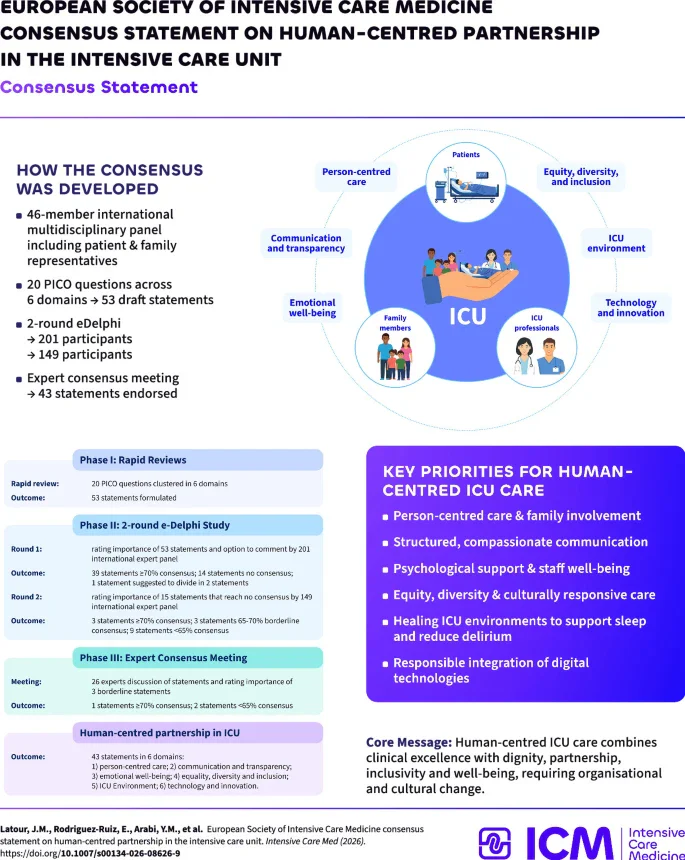
The intensive care unit (ICU) treats the sickest patients in modern hospitals. Advances in technology and treatments have improved survival, but surviving critical illness increasingly draws attention to the human experience: communication, dignity, psychological recovery, equity, family involvement, clinician wellbeing and how the physical and digital environment shape care. In recognition of this, the European Society of Intensive Care Medicine (ESICM) convened an international multidisciplinary panel that has produced the 2026 “Human-Centred Partnership in the Intensive Care Unit” consensus statement (Latour et al., Intensive Care Med. 2026). The statement synthesises evidence and stakeholder values to produce actionable guidance for clinicians, managers, patients and families. Why this consensus matters now – Clinical gaps: Variation in family visitation policies, inconsistent communication, rising clinician burnout, and persistent disparities in care have been documented across diverse ICUs. – New evidence: Increased data on long-term survivorship, delirium prevention, the effects of visitation policies and digital tools for communication created the opportunity to create an integrated, multidisciplinary approach. – Systems pressure: Resource constraints and infection-control priorities require guidance that works across high- and low-resource settings. The ESICM process 46 multidisciplinary panel members (clinicians, researchers, patients/families) answered 20 PICO questions across six domains and created 53 draft statements, which were refined through a two-round eDelphi with 201 international stakeholders (round 1) and 149 (round 2). After an expert consensus meeting, 43 statements were endorsed. The process prioritized evidence, feasibility, and patient/family input.New Guideline Highlights
Major recommended directions (high-level themes) – Person-centred care: Structural and cultural changes to place the patient and family as partners in care planning and decision-making. – Communication and transparency: Routine, structured interdisciplinary communication that includes families and employs clear, compassionate language. – Emotional well-being: Proactive psychological support for patients, families and ICU professionals; empathy-based training for staff. – Equity, diversity & inclusion (EDI): Culturally responsive care, interpreter access, and practices that identify and mitigate structural bias. – ICU environment: Environmental interventions to support sleep and reduce delirium (lighting, noise, visitation) and design that promotes dignity and privacy. – Technology & innovation: Responsible integration of digital tools to support communication, documentation and patient engagement while protecting privacy and reducing clinician burden. Key takeaways for clinicians – Adopt flexible, family-centred visitation where safe and feasible. – Use structured communication tools (checklists for family meetings, daily goals, bedside rounds with family inclusion when possible). – Incorporate staff training in empathy and trauma-informed communication. – Provide routine psychological screening and access to support services for patients, families and staff. – Apply environmental measures known to protect sleep and reduce delirium, consistent with PADIS and ABCDEF frameworks. – Evaluate digital tools for patient/family access and staff workload before implementation.Updated Recommendations and Key Changes
What’s new or emphasized compared with prior guidance? – Family presence: A stronger, consensus-backed endorsement for flexible family visitation as a default, balanced with clinical safety and privacy considerations. Many prior statements permitted family presence without actively promoting it; ESICM now frames family partnership as a core element. – Holistic staff support: Explicit recommendations for psychological support for ICU professionals as a system responsibility rather than an optional wellness program. – Equity and cultural responsiveness: New, detailed expectations for culturally adapted care and interpreter access—an area previously under-emphasised in ICU guidance. – Environment and sleep: More concrete environmental strategies (lighting schedules, ear protection, noise reduction, clustering care) tied to delirium prevention and sleep promotion. – Digital integration: The consensus recognizes digital communication tools (teleconferencing, patient portals, mobile updates) as enablers but stresses governance to avoid depersonalisation. Why these changes? – Growing evidence links family involvement and structured communication with improved satisfaction, reduced anxiety, and better decision-making. – Post-ICU morbidity (physical, cognitive, psychological) is increasingly recognised; interventions that target sleep, delirium and early psychological support have potential to alter trajectories. – The COVID-19 era exposed both the harms of rigid visiting restrictions and the promise of remote technologies, creating impetus for balanced, humane policies.Topic-by-Topic Recommendations
Below are condensed, clinician-facing recommendations organized by ESICM domains. Wherever possible, these map to existing evidence such as the PADIS guidance and the ABCDEF bundle for delirium and long-term outcome mitigation. Person-centred care – Principle: Treat patients and families as partners; support shared decision-making and personalised goals of care. – Actions: Document patient values and goals at admission, include family in daily care planning where appropriate, support advance care planning conversations early. – Implementation tip: Use a bedside ‘‘what matters to you’’ prompt to capture priorities, and incorporate them into daily goals. Communication and transparency – Principle: Use structured, consistent, interdisciplinary communication with families. – Actions: Schedule regular family meetings (initial and as the clinical picture changes); use plain language and teach-back; provide written summaries when possible. – Tools: Checklists for family meetings, scripts for breaking bad news, and standardised daily goal sheets. Emotional well-being (patients, families, staff) – Principle: Normalise psychological distress after critical illness and make timely support available. – Recommendations: – Screen patients and families for distress during and after ICU stay. – Provide access to psychological therapies or referrals (e.g., ICU follow-up clinics or community mental health). – Offer structured peer and professional support for ICU staff; embed mental health resources into staff scheduling. – Evidence link: Early rehabilitation and ABCDEF elements reduce delirium and may help long-term outcomes (see PADIS guidance). Equity, diversity & inclusion (EDI) – Principle: Recognise and address disparities in ICU access, communication and outcomes. – Actions: – Provide interpreter services and translated materials. – Train staff in culturally responsive communication. – Monitor local data for disparities (e.g., visitation, family contact, treatment differences) and act on findings. ICU environment – Principle: The physical ICU environment influences sleep, delirium, dignity and communication. – Environmental interventions recommended: – Implement noise-reduction strategies (alarm management, quiet hours). – Preserve circadian cues (daytime light exposure, dimming at night). – Use non-pharmacologic sleep aids (earplugs, eye masks), cluster care to reduce nighttime disturbances. – Design patient spaces that allow privacy and family presence, where possible. – Clinical impact: These strategies support delirium prevention and recovery, consistent with PADIS and ABCDEF approaches. Technology and innovation – Principle: Digital tools can extend communication and coordination but must be deployed with attention to privacy, equity and clinician workload. – Guidance: – Pilot telepresence for families when in-person visiting is limited; ensure consent and privacy safeguards. – Use electronic care plans accessible to families where feasible and secure. – Evaluate digital adoption for unintended harms (additional documentation burden, inequitable access). Recommendation grades and evidence notes The ESICM statement is a consensus document integrating rapid reviews, expert opinion and stakeholder values. It endorses 43 statements emerging from the eDelphi; it does not assign traditional GRADE levels across all items, but aligns with high-quality evidence where available (for example, delirium prevention strategies aligning with PADIS 2018 and ABCDEF evidence frameworks). Selected crosswalk with existing evidence-based guidance – PADIS 2018 (pain, agitation/sedation, delirium, immobility, sleep): The ESICM consensus reinforces PADIS recommendations for non-pharmacologic delirium prevention and sleep promotion and puts them into a broader human-centred context (Devlin et al., Crit Care Med. 2018). – ABCDEF bundle (pain, spontaneous awakening/breathing trials, choice of analgesia/sedation, delirium management, early mobility, family engagement): ESICM recommends family engagement and staff wellbeing as core pillars, consistent with ABCDEF principles (Pun et al.).Expert Commentary and Insights
Committee perspectives – Universal but contextual: Experts emphasised that the principles are universal but implementation must adapt to local resources, infection-control requirements and cultural norms. – Pragmatism: The panel underscored pragmatic implementation—start with modifications low in resource cost (structured communication, visiting policy review, staff training) while planning for environmental changes. Key controversies and tensions – Visiting policies vs infection control: The consensus endorses flexible visitation but recognises situations (e.g., active outbreaks, highly immunocompromised patients) where restrictions are needed. The balance requires transparent policies and alternative communication channels. – Digital inequity vs convenience: Tele-ICU and virtual visits increase access for distant families but may disadvantage those without devices or digital literacy. The panel calls for equity assessments before broad rollouts. – Resource constraints for staff support: While psychological support programs are recommended, providing protected time and staffing to allow uptake remains a practical hurdle in many institutions. Future research priorities identified by the panel – Trials of structured family-inclusive models to robustly measure effects on patient, family and clinician outcomes. – Economic analyses of environmental changes versus benefits in delirium and length of stay. – Implementation science studies to identify best approaches to scale human-centred practices in low-resource settings.Practical Implications
How ICU teams can start implementing the consensus 1. Rapid wins (weeks to months) – Review and liberalise visiting policies where safe. – Introduce standardised family meeting checklists and daily goal sheets. – Offer brief staff training sessions in empathic communication and trauma-informed care. 2. Medium-term changes (months) – Develop pathways for routine psychological screening and referral for patients and families. – Pilot telepresence options with privacy protocols and equity assessments. 3. Longer-term investment (year+) – Reconfigure ICU environment for better sleep and privacy when refurbishment occurs. – Establish ongoing staff wellbeing programmes with protected time and organisational support. Illustrative vignette John, a 62-year-old man, is admitted to the ICU with sepsis and respiratory failure. On day 2 the team documents that John values listening to music and having his daughter near him. The ICU follows the ESICM consensus: visiting hours are flexible; daily goals include family presence for morning rounds; a structured family meeting is scheduled within 48 hours; non-pharmacologic sleep protocols (earplugs, light dimming) are used; a bedside tablet allows real-time updates to his daughter when she is off-site; and staff have access to debriefing sessions. This approach helps reduce family anxiety, ensures care aligns with John’s values, and supports staff communication.References
– Latour JM, Rodriguez-Ruiz E, Arabi YM, et al.; Human-Centred Partnership in ICU Collaborators. European Society of Intensive Care Medicine consensus statement on human-centred partnership in the intensive care unit. Intensive Care Med. 2026 Oct 26. PMID: 42931902. https://pubmed.ncbi.nlm.nih.gov/42931902/ – Devlin JW, Skrobik Y, Gélinas C, Needham DM, Slooter AJC, Pandharipande PP, et al. Clinical practice guidelines for the prevention and management of pain, agitation/sedation, delirium, immobility, and sleep disruption in adult ICU patients (PADIS 2018). Crit Care Med. 2018;46(9):e825–e873. – Herridge MS, Cheung AM, Tansey CM, Matte-Martyn A, Diaz-Granados N, Al-Saidi F, et al. One-year outcomes in survivors of the acute respiratory distress syndrome. N Engl J Med. 2003;348(8):683–693. – Pun BT, Balas MC, Barnes-Daly MA, et al. Caring for critically ill patients: the ABCDEF bundle and the ICU Liberation Collaborative. Crit Care Med. 2019. (how to read these recommendations) The ESICM human-centred partnership consensus offers practical, ethically grounded guidance to reorient ICU care around people—patients, families and staff—without undermining clinical safety or scientific rigor. It complements existing clinical practice guidelines (for pain, delirium and sedation) and provides an operational framework for ICUs that want to prioritise dignity, communication and equity alongside clinical excellence.Practical next steps for leaders
– Convene a local multidisciplinary working group (including patient/family representatives) to map current practices against the ESICM statements. – Select two to three priority interventions that are feasible in your setting (e.g., flexible visitation, family communication checklist, staff debriefing) and monitor implementation and outcomes. – Share lessons across networks and contribute data to multicentre initiatives to build the evidence base for human-centred ICU care. This consensus is not a checklist to be applied mechanically; it is an invitation to embed human values into ICU practice, backed by pragmatic recommendations and a call for continued research and system support.Additional resources
Clinicians seeking implementation tools should consult the ESICM statement (Latour et al., 2026) for the endorsed statements and supporting materials; the PADIS guideline for delirium and sleep interventions; and resources from the ICU Liberation/ABCDEF community for practical implementation strategies.Specialty calculators
For clinical reference; use professional judgment.