Introduction
Nasal septal perforations represent a challenging clinical entity necessitating meticulous surgical repair due to the anatomical complexity and varied etiologies. These perforations, which compromise the structural and functional integrity of the nasal septum, can lead to symptoms including crusting, epistaxis, nasal obstruction, and whistling during breathing, significantly impacting patient quality of life. Optimal repair strategies must consider the size, location, etiology of the perforation, and patient-specific risk factors to maximize surgical success. This article critically addresses current evidence-based surgical techniques and emphasizes the management of modifiable factors to improve outcomes.
Clinical Context and Disease Burden
Nasal septal perforations result from multiple causes, including trauma, iatrogenic injury (such as septoplasty), inflammatory diseases, infections, and substance abuse (notably intranasal drug usage). Although small perforations may be asymptomatic, larger defects can cause significant morbidity. Treatment often requires surgical intervention, which remains technically demanding with variable success rates influenced by patient and defect characteristics. The literature reports closure rates ranging from 84% to 98% depending on technique and patient selection, highlighting the importance of an individualized approach.
Surgical Approach and Technique Selection
Contemporary surgical repair prioritizes techniques tailored to perforation size:
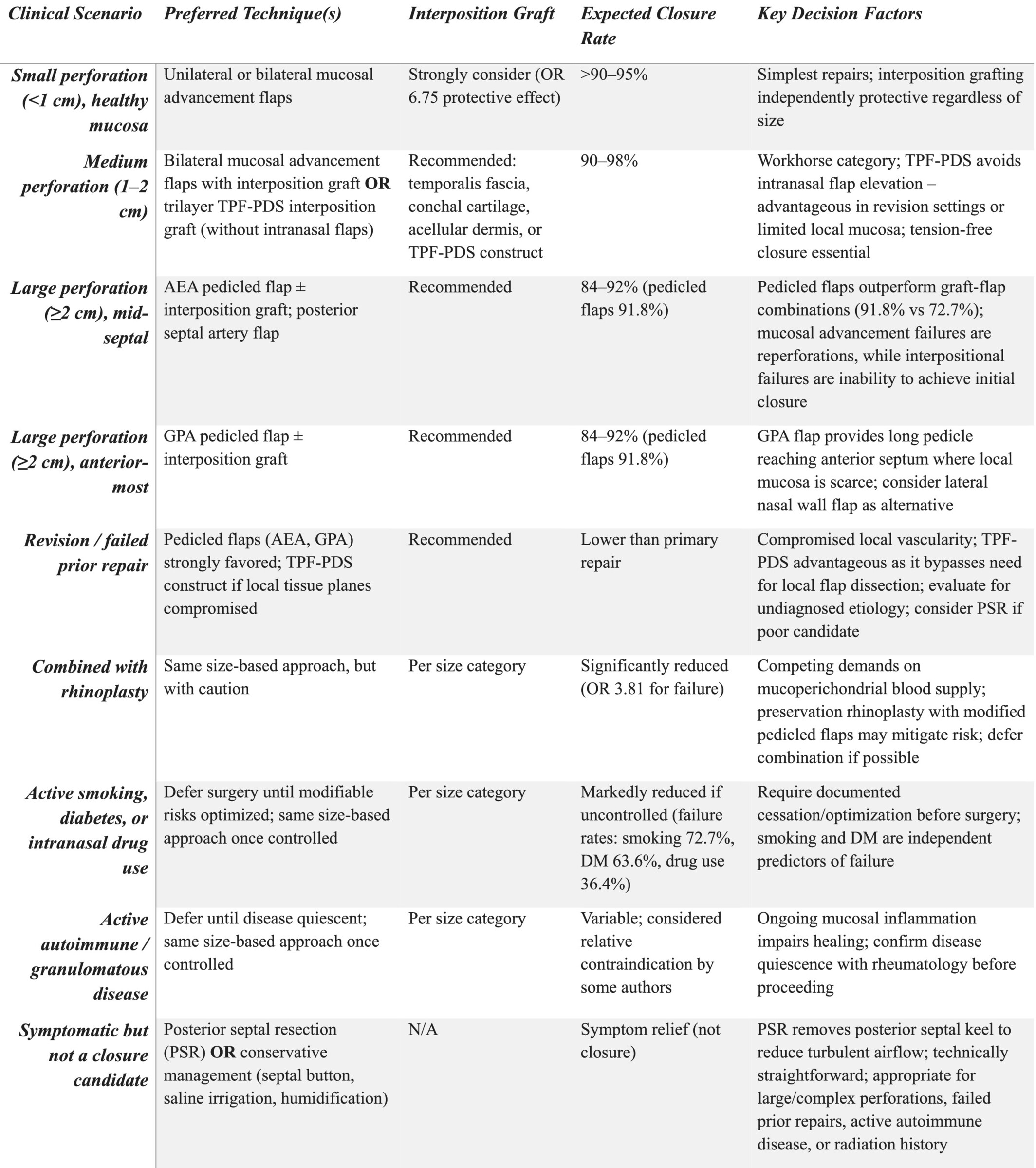
- Small perforations (<1 cm): These are effectively managed with mucosal advancement flaps. This technique involves mobilizing adjacent mucosal tissue to cover the defect, providing a vascularized closure with minimal donor site morbidity.
- Medium perforations (1–2 cm): Bilateral mucosal advancement combined with interposition grafting demonstrates enhanced structural support and healing. Grafts often incorporate materials such as temporoparietal fascia combined with polydioxanone (PDS) mesh to create a trilaminar construct, improving tensile strength and closure durability.
- Large perforations (≥2 cm) or revision cases: Pedicled flaps, which maintain an intact blood supply, are preferred. These flaps provide robust vascularized coverage, critical in cases with compromised local tissue or previous surgical failure.
Each technique requires precise surgical planning to preserve mucosal integrity and ensure tension-free closure.
Role of Modifiable Risk Factors
Patient-specific factors significantly influence surgical outcomes. Current evidence underscores that active smoking, uncontrolled diabetes mellitus, and ongoing intranasal drug use are independently associated with substantially increased rates of repair failure due to impaired wound healing and local tissue ischemia. Preoperative optimization of these risk factors is imperative:
- Smoking cessation: Cessation reduces mucosal hypoxia and inflammation, promoting better flap viability.
- Glycemic control: Effective management of diabetes prevents microvascular complications that impair mucosal healing.
- Discontinuation of intranasal drug use: Eliminates ongoing mucosal irritation and contamination, improving the graft bed environment.
Multidisciplinary involvement may be necessary to support behavioral interventions and medical optimization prior to surgery.
Outcomes and Evidence Synthesis
Recent studies consistently report high closure rates (84–98%) when surgical technique selection aligns with perforation characteristics and modifiable risk factors are addressed. The mucosal advancement flap technique alone achieves excellent results in small defects, while integration of interposition grafts markedly improves intermediate perforation repairs. Pedicled flaps offer the best vascular support in large or complex cases but require advanced surgical expertise and entail longer operative times.
Complications are infrequent but can include persistent perforation, synechiae formation, septal hematoma, and donor site morbidity. Safety profiles are favorable when meticulous surgical technique and appropriate patient selection criteria are employed.
Expert Commentary
The approach to nasal septal perforation repair remains a nuanced balance between procedural complexity and expected outcomes. As elucidated by Reynoso et al., tailored surgery grounded in perforation size and etiology alongside rigorous preoperative optimization of modifiable risk factors significantly enhances closure success. This aligns with contemporary otolaryngology best practices emphasizing patient-specific strategies.
Some limitations in current literature include a lack of large randomized controlled trials and heterogeneity in outcome reporting. Nonetheless, the strong consensus supports the outlined tiered surgical algorithm. Future research focusing on novel biomaterials and regenerative techniques may further improve closure rates, especially for challenging large defects.
Conclusion
Effective surgical repair of nasal septal perforations demands a personalized approach integrating defect size, anatomical considerations, and patient comorbidities. Mucosal advancement flaps remain the cornerstone for small perforations, with graft augmentation and pedicled flaps reserved for larger or revision cases. Crucially, addressing modifiable risk factors such as smoking, diabetes, and intranasal drug use is essential to optimize healing and reduce repair failure. Ongoing innovation and multidisciplinary care promise further advancements in restoring nasal septal integrity and improving patient outcomes.
References
1. Reynoso NJ, Park AM, Knott PD. Approach to Surgical Repair of Nasal Septal Perforation. The Laryngoscope. 2026 Sep 27; PMID: 42801325.
2. Schlosser RJ. Nasal septal perforation: etiology, diagnosis, and management. Curr Opin Otolaryngol Head Neck Surg. 2004;12(1):43-47.
3. Modrzynski M, Waszkiewicz J, Lukasik M. Results of the surgical treatment of nasal septal perforations. Auris Nasus Larynx. 2011;38(2):223-8.
4. Lancaster JL, Mashiko T, Curry KJ, et al. Surgical management of nasal septal perforations: systematic review and meta-analysis. Laryngoscope. 2020;130(12):E817-E825.
5. Romo T 3rd. Nasal septal perforation repair. Otolaryngol Clin North Am. 2001;34(3):745-764.