Introduction and Context
Lymphatic surgery—chiefly procedures such as lymphaticovenous anastomosis (LVA) and vascularized lymph node transfer (VLNT)—has evolved rapidly over the past decade. Surgeons and multidisciplinary teams increasingly offer operative options to treat or prevent lymphedema, a chronic and often disabling disorder of lymphatic circulation that affects quality of life and increases infection risk. Despite the growing evidence base, progress has been hampered by inconsistent outcome reporting: different centers use different tests, thresholds, and time points, making pooled analysis and meta-research difficult. To address that gap, leadership of the Society of Lymphatic Surgery (SLS) convened a small expert panel and used a modified Delphi process to propose a minimum standard set of outcome measures for lymphatic surgery. The resulting report—Fanning et al., Plastic and Reconstructive Surgery, 2025—defines six baseline characteristics that should be included in any standardized dataset for surgical lymphedema research and quality reporting. That concise, consensus-based core set is intended to be pragmatic and implementable across centers of varying resources, enabling meaningful comparison of surgical strategies and better evidence synthesis. This article summarizes the SLS consensus, explains why it was needed, outlines the core recommendations and unresolved issues, and interprets what the new minimum set means for surgeons, multidisciplinary teams, researchers and patients.New Guideline Highlights
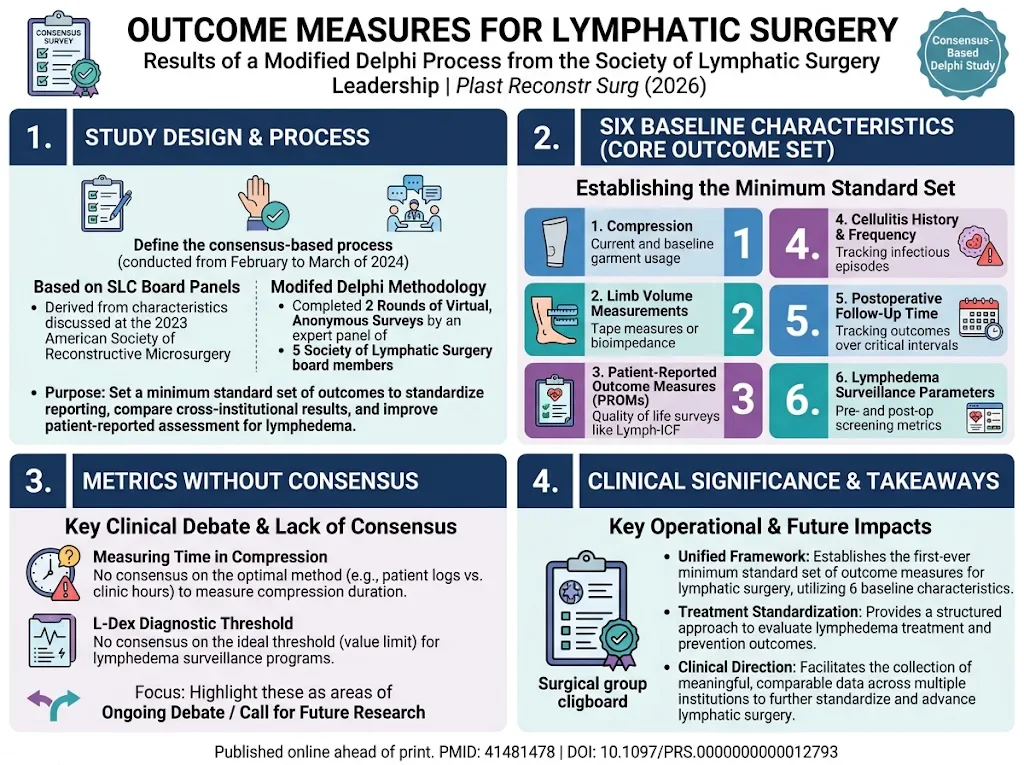
Major takeaways from the SLS leadership consensus: – The panel recommends a limited, pragmatic minimum standard set of six baseline outcome characteristics for reporting on lymphatic surgery. These are: compression therapy, limb volume measurement, patient-reported outcome measures (PROMs), cellulitis (infectious episodes), follow-up time, and lymphedema surveillance parameters. – The intent is not to replace detailed study-specific measures, but to establish a baseline that every dataset should include so results can be compared and pooled across centers. – Consensus was explicitly not reached on two measurement details: how best to quantify time spent in compression and what L-Dex (bioimpedance spectroscopy) threshold should be used for surveillance programs. Why this matters now – Rapidly accumulating surgical techniques and devices demand consistent outcome reporting so clinicians can identify which procedures produce durable clinical benefit. – With standardized core measures, registries and multicenter collaborations can more readily aggregate data, power comparative effectiveness research, and improve guideline quality. Key takeaway for clinicians: adopt the six core elements when reporting surgical outcomes; capture them consistently at defined time points; and document the measurement technique and thresholds used so data remain interpretable.Updated Recommendations and Key Changes
This SLS product is not a clinical practice guideline for treatment selection; it is a consensus-derived minimum dataset for outcome reporting. As such, its contribution is structural rather than prescriptive: it standardizes what should be measured and reported after lymphatic surgery, rather than recommending specific surgical indications or techniques. What is new compared with prior practice and documents – Prior literature and consensus documents (for example, the International Society of Lymphology consensus on diagnosis and the International Lymphoedema Framework recommendations on assessment) describe many acceptable measurement tools but stop short of declaring a minimum dataset for surgical reporting. Fanning et al. provide the first compact, SLS-endorsed core set specifically for lymphatic surgery outcomes. – The SLS set emphasizes PROMs and cellulitis frequency alongside objective limb measures—a recognition that patient experience and infection burden are central outcomes. Evidence driving the update – Heterogeneous measurement—circumference vs volume, different thresholds, inconsistent follow-up—has limited meta-analyses and registry comparability. The panel selected measures that are clinically meaningful, broadly feasible, and commonly used in the lymphedema literature, aligning with prior international recommendations to combine objective and patient-centered outcomes.Topic-by-Topic Recommendations
Below is a practical breakdown of the six core elements the SLS panel recommends every lymphatic surgery outcome report should include. For each element we summarize the consensus recommendation and, where appropriate, practical options. 1) Compression – What to record: Whether the patient is using compression garments or devices preoperatively and postoperatively; the type (bandaging, class of garment), and any changes over time. – Why: Compression affects limb volume, symptoms and infection risk; failure to account for it confounds interpretation of surgical effect. – Practical note: The panel sought but did not reach consensus on the exact way to measure “time in compression” (hours/day or percent of waking hours). For now, report compression status at each follow-up visit and record any documented changes in garment class or adherence. 2) Limb volume measurement – What to record: Limb volume change from baseline using a specified technique and expressed as absolute volume and percent excess volume (%EV). Record the method used (perometry, truncated-cone circumference method, water displacement) and device details where applicable. – Why: Quantitative limb measures are a primary objective outcome for lymphedema interventions. – Practical options and recommendations: – Perometry or optoelectronic volumetry is preferred when available for precision. – Circumferential measurements with a standardized protocol (e.g., 4–10 cm intervals with a truncated-cone formula) are acceptable and more widely available. – Always report the method and the calculation used so readers can interpret the results. 3) Patient-Reported Outcome Measures (PROMs) – What to record: At minimum use a validated lymphedema-specific PROM (examples include the LYMQOL, Lymph-ICF, or ULL-27 for upper-limb disease). Capture baseline and identical follow-up time points. – Why: Symptoms, function, and quality of life often drive the patient’s perceived success of surgery more than numeric volume change. 4) Cellulitis and infectious episodes – What to record: Number of documented cellulitis episodes requiring antibiotics (and/or hospitalization) in defined pre- and postoperative intervals (e.g., per year). Specify criteria used to define cellulitis. – Why: Recurrent infection is a major lymphedema morbidity and an important, patient-centered outcome. 5) Follow-up time – What to record: Minimum recommended follow-up for reporting surgical outcomes is at least 12 months, with additional time points at 3 and 6 months, then annually. The panel stresses the importance of longer-term follow-up (2–5 years) because lymphedema and functional improvements can evolve over time. – Why: Early changes may not reflect durable benefit; standardized time points improve comparability. 6) Lymphedema surveillance parameters – What to record: If an active surveillance program (eg, for at-risk patients) is used, record baseline surveillance measures and the diagnostic criteria/thresholds being applied (e.g., limb volume % change, L-Dex bioimpedance values). – Areas lacking consensus: The SLS panel did not reach agreement on a universal L-Dex threshold for surveillance programs. Centers should therefore state the L-Dex threshold they use and continue to report the exact metric values rather than only binary outcomes. Recommendation grades and note on evidence – The SLS set is a consensus-derived minimum standard rather than an evidence-graded guideline. It is pragmatically focused: inclusion of each element was selected because it is clinically meaningful and feasible across settings.Expert Commentary and Insights
What the expert panel and other leaders emphasized – Practicality and adoption: The SLS leadership prioritized measures that are feasible in typical clinical settings. The six-element set aims to minimize the reporting burden while maximizing comparability. – Importance of PROMs and cellulitis data: Experts underscored that objective volume measures alone underrepresent important outcomes such as pain, function, and infection risk. – Standardization enables registries: If centers adopt the minimum set consistently, pooled datasets will better support comparative effectiveness studies and health policy decisions. Areas of controversy and unresolved issues – L-Dex thresholds: Bioimpedance spectroscopy is sensitive for early extracellular fluid changes, but absolute diagnostic thresholds vary between studies and devices; the panel deferred to local practice while advocating transparency of reporting. – Time in compression: Quantifying adherence objectively is difficult. Wearable sensors may change this in the future, but the panel did not endorse a specific metric now. – Granularity vs feasibility: Some experts called for more granular core elements (e.g., exact garment compression pressures, hours/day), while others favored keeping the dataset minimal to encourage uptake. Future trends and research needs – Comparative effectiveness research using standardized endpoints will be essential to determine which surgical techniques best prevent or mitigate lymphedema across etiologies. – Technology advances (wearables for adherence, remote bioimpedance monitoring) may refine surveillance measures and enable objective compression adherence data. – Collaborative registries built around this minimum set can produce real-world evidence to inform guidelines and payer coverage.Practical Implications for Clinicians and Researchers
How to implement the SLS minimum set in everyday practice – Incorporate the six core elements into surgical intake forms, operative reports, and follow-up templates. – Document the exact measurement technique and devices used for limb volume and L-Dex so your data are interpretable by others. – Use validated PROMs at baseline and at standardized follow-up intervals (3, 6, 12 months, then annually). – Record infectious episodes with standardized criteria and separate outpatient-treated episodes from hospitalizations. A brief clinical vignette Sarah is a 56-year-old breast cancer survivor with early-stage, unilateral upper-limb lymphedema who undergoes a lymphaticovenous bypass. Using the SLS minimum set, the surgical team records: – Compression: pre-op nightly compression garment (class II), post-op instruction to resume nightly use; adherence documented by patient report. – Limb volume: perometry performed pre-op and at 3, 6, 12 months; reported as baseline volume and % excess volume. – PROMs: LYMQOL completed pre-op and at follow-ups; reports improved symptoms at 6 months. – Cellulitis: none in the year before or after surgery. – Follow-up: visits recorded at 3, 6 and 12 months; plan for annual follow-up through year 3. – Surveillance: L-Dex measured at baseline and 6 months; the program records the absolute L-Dex score and the center’s internal alert threshold. The consistent dataset allows Sarah’s center to contribute data to a regional registry and compare outcomes across similar patients and procedures.References
Fanning JE, Aly MAI, Chang DW, Dayan JH, Higgins JP, Lee BT, Masià J, Mehrara BJ, Neligan PC, Smith ML, Singhal D. A Proposed Minimum Standard Set of Outcome Measures for Lymphatic Surgery: Results of a Modified Delphi Process from the Society of Lymphatic Surgery Leadership. Plast Reconstr Surg. 2025 Dec 30;158(5):817-824. PMID: 41481478. https://pubmed.ncbi.nlm.nih.gov/41481478/ Rockson SG, Failor K, Simental A, et al. The diagnosis and treatment of peripheral lymphedema: 2020 Consensus Document of the International Society of Lymphology. Lymphology. 2020;53(1):3-19. International Lymphoedema Framework. Best Practice for the Management of Lymphoedema. 2012. (Available at: https://www.lympho.org/) Note: The SLS minimum set is a foundational step toward harmonized outcome reporting. Centers and investigators should adopt the core measures and continue to contribute to collective datasets so that the field can move from descriptive series to robust comparative evidence that answers which patients benefit most from which surgical approaches.Specialty calculators
For clinical reference; use professional judgment.