Highlights
- Development of the first PDTC-specific TNM staging system to address limitations of applying differentiated thyroid cancer criteria to PDTC.
- Reclassification of lymph node metastases, especially level VII from N1a to N1c, reflecting its prognostic significance.
- Robust multi-national cohort analysis with external validation demonstrating superior prognostic discrimination by the new staging system compared to TNM-8.
- Potential for integration of this PDTC-specific TNM system into future AJCC/UICC guidelines to standardize prognosis assessment and guide clinical management.
Background
Poorly differentiated thyroid cancer (PDTC) is an aggressive thyroid malignancy with biological and clinical behavior distinct from well-differentiated thyroid cancer (DTC) and anaplastic thyroid cancer. It lies intermediate between differentiated and anaplastic thyroid carcinomas in terms of morphology and prognosis. Despite this unique biology, PDTC currently lacks a dedicated TNM staging system and relies on the eighth edition of the American Joint Committee on Cancer (AJCC) and Union for International Cancer Control TNM staging schema designed for differentiated thyroid cancer (TNM-8). This usage is suboptimal because PDTC has different patterns of tumor spread, recurrence risk, and survival outcomes compared to DTC. This gap necessitated an international effort to develop a PDTC-specific staging system to improve prognostic stratification and better inform clinical decisions.Key Content
Study Design and Population
The global proposal emanates from a large retrospective cohort study conducted by the International Aggressive Thyroid Cancer Collaborative Group (IATCCG), evaluating 1010 surgically treated PDTC patients from 91 centers across 14 countries over a period spanning January 1984 to January 2026. The study also externally validated its findings using a cohort of 170 patients from the US Surveillance, Epidemiology, and End Results (SEER) database. Data analysis from December 2025 to June 2026 assessed overall survival as the primary endpoint.Rationale for a PDTC-Specific Staging System
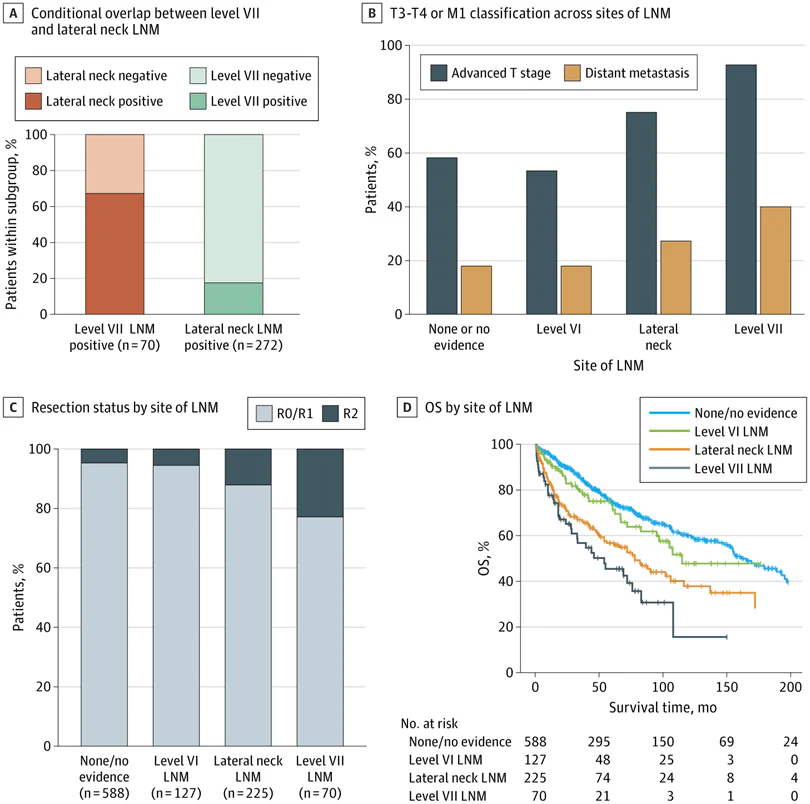
The existing TNM-8 system, geared towards DTC, does not adequately account for differences in metastasis patterns and prognostic implications of lymph node involvement in PDTC. Notably, the study found that lymph node metastasis (LNM) at level VII—previously classified as N1a in TNM-8—was associated with significantly lower five-year overall survival (45.2%) compared to level VI (73.2%) or lateral neck node LNM (56.7%). This prompted the reclassification of level VII LNM to N1c in the proposed system.Development of the New Staging Schema
The research team exhaustively evaluated 16,738 possible TN combinations using multivariable Cox proportional hazards models. The proposed staging was selected based on the lowest Akaike information criterion (AIC), maximizing model parsimony and prognostic accuracy. The schema defines stages I through IVB as follows (with M1 disease predefined as stage IVB):- Stage I: T1N0/NX/N1a or T2N0/NX
- Stage II: T1N1b/N1c, T2N1a/N1b, or T3N0/NX/N1a
- Stage III: T2N1c, T3N1b, or T4aN0/NX/N1a
- Stage IVA: T3N1c, T4aN1b/N1c, or T4b any N
- Stage IVB: M1 disease
Comparative Performance and Validation
Compared with TNM-8, the proposed system more accurately stratified patients, with stage I cases decreasing from 44.4% to 24.6% and stage IV cases rising from 18.5% to 32.4% in the IATCCG cohort, reflecting a more stringent classification. The proposed model achieved a higher C statistic (0.74) than TNM-8 (0.71), indicating better prognostic discrimination. External validation using the SEER cohort confirmed these findings, with a C statistic difference favoring the new system (0.76 vs 0.74).Clinical and Translational Implications
By incorporating PDTC-specific features such as the differential prognostic impact of lymph node stations and tumor extent, this staging system better captures the biological aggressiveness of PDTC. It enables clinicians to more accurately estimate survival probabilities, tailor treatment intensities, and plan surveillance strategies. Moreover, the data support advocating for the American Joint Committee on Cancer (AJCC) to adopt a stand-alone PDTC TNM staging system in future editions.Expert Commentary
This landmark multinational study addresses a critical unmet need in thyroid oncology by developing a refined prognostic model specific to PDTC, which has historically been understaged by schemas focused on well-differentiated disease. The extensive multinational dataset including long follow-up improves generalizability. The reclassification of level VII lymph node metastases highlights the importance of anatomical nodal involvement beyond standard lateral/central designations. However, the retrospective nature and heterogeneity of surgical and pathological approaches across centers may introduce bias. Future prospective validation and incorporation of molecular markers could further optimize risk stratification. Also, integrating this system into existing clinical guidelines will require consensus-building among international thyroid oncology communities. From a biological standpoint, the unique behavior of PDTC likely reflects complex molecular drivers distinct from DTC, necessitating dedicated staging frameworks. The proposed TNM system aligns staging more closely with biological aggressiveness, a critical step toward personalized management.Conclusion
In summary, the proposed global TNM staging system for PDTC represents a pivotal advancement providing improved prognostic discrimination over current differentiated thyroid cancer staging. The system’s rigorous development and external validation lend strong evidence for its adoption as a standalone AJCC staging schema. Implementation will enhance clinical decision-making, facilitate standardized reporting, and ultimately improve patient outcomes in this challenging thyroid cancer subtype.References
- Shi X, Liu Q, Scholfield D, et al. Global Proposal for the TNM Staging System for Poorly Differentiated Thyroid Cancer. JAMA Oncol. 2026 Nov 6; PMID: 42994809. https://pubmed.ncbi.nlm.nih.gov/42994809/
- Hughes DT, et al. Poorly Differentiated Thyroid Cancer: Diagnosis and Clinical Management. Endocrinol Metab Clin North Am. 2019 Jun;48(2):397-412. PMID: 31122302
- Volante M, Asioli S, Pilotti S, et al. Poorly differentiated thyroid carcinoma: current clinical and pathological perspectives. Endocr Pathol. 2015 Jun;26(2):115-24. PMID: 25955551
- Elisei R, Ugolini C. Diagnostic Challenges and Management of PDTC: Clinical and Molecular Insights. Thyroid. 2020;30(7):1012-1024. PMID: 32534962
Specialty calculators
For clinical reference; use professional judgment.