Highlights
- Takotsubo syndrome (TTS) mimics acute coronary syndrome (ACS), complicating early differential diagnosis and often necessitating invasive coronary angiography (ICA).
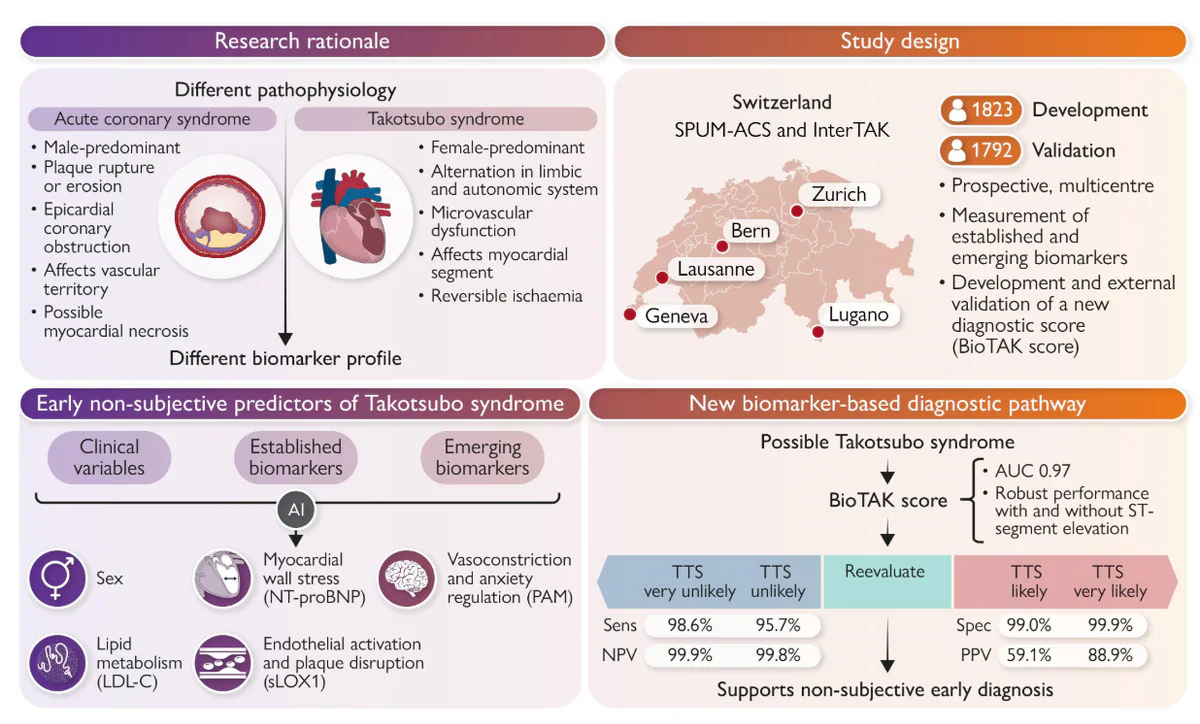
- The BioTAK score, a novel biomarker-based diagnostic tool, utilizes myocardial stress, vasoconstriction, plaque instability, lipid metabolism markers, and sex to differentiate TTS from ACS with high accuracy.
- External validation confirms BioTAK’s excellent discrimination (AUC 0.93) and calibration, stratifying nearly 90% of patients before ICA, thus optimizing clinical workflows and potentially reducing invasive procedures.
- Complementary approaches including echocardiographic pattern analysis and clinical scores like InterTAK support multifaceted diagnostic strategies in TTS versus ACS.
Background
Takotsubo syndrome (TTS), also known as stress cardiomyopathy, presents acutely with symptoms and ECG changes closely resembling acute coronary syndrome (ACS). TTS typically features transient left ventricular apical ballooning without obstructive coronary artery disease. Despite increasing recognition, early differentiation from ACS remains challenging, often relying on invasive coronary angiography (ICA) to exclude culprit coronary lesions. The diagnostic ambiguity burdens patients with unnecessary invasive procedures, delays targeted management, and impacts healthcare resource utilization. Hence, a non-invasive, objective diagnostic tool is urgently needed to streamline early differentiation before ICA.Key Content
Chronological Development of Diagnostic Models
Initial diagnostic approaches relied heavily on clinical presentation and imaging. The International Takotsubo Registry developed the InterTAK Diagnostic Score incorporating clinical variables such as female sex, triggers, ECG changes, and psychiatric comorbidities (Ghadri et al., 2017, PMID:27928880). This score demonstrated high sensitivity and specificity (AUC ~0.97 in derivation, 0.90 in validation), highlighting the role of clinical assessment in suspicion of TTS. However, despite its utility, InterTAK depends on subjective clinical history and ECG interpretation. More recently, advances in cardiac imaging have improved differentiation. For example, the TAKO study (2024, PMID:38945184) demonstrated a simplified transthoracic echocardiographic (TTE) parameter focusing on regional wall motion abnormalities in the apical two-chamber view, distinguishing TTS from left anterior descending artery-related ACS with reasonable accuracy (~75%). Yet, imaging requires expertise and may still require ICA confirmation. Biomarker research has evolved as an objective adjunct. Meta-analyses comparing troponin and natriuretic peptides (NPs) revealed distinct biomarker profiles: TTS presents with significantly lower troponin levels but higher NPs than ACS (Asher et al., 2024, PMID:38508657). However, sole reliance on traditional biomarkers like troponin or NPs shows moderate discrimination power (AUCs ranging ~0.69 to 0.82) and no improvement with combined analyses.BioTAK Score Development and Validation
Wenzl et al. (2026, PMID:42670759) advanced the diagnostic paradigm by creating the BioTAK score, a biomarker-based tool derived from a cohort of 1823 patients (ACS n=1754; TTS n=69) and externally validated in 1792 patients (ACS n=1715; TTS n=77). Using machine learning-guided feature selection and logistic regression, five key predictors were identified:- N-terminal pro-B-type natriuretic peptide (NT-proBNP) — reflecting myocardial stress.
- Peptidylglycine α-amidating monooxygenase (PAM) — associated with vasoconstriction and anxiety regulation.
- Soluble lectin-like oxidized low-density lipoprotein receptor-1 (sLOX-1) — indicating atherosclerotic plaque instability.
- Low-density lipoprotein cholesterol (LDL-C) — indicative of lipid metabolism.
- Sex — acknowledging female predominance in TTS.
Complementary Diagnostic Evidence and Clinical Profiles
Systematic reviews and meta-analyses evaluating diagnostic models reveal a variety of tools with acceptable-to-good discriminative ability but concerning risk of bias and underreporting of calibration metrics (Ritz et al., 2025, PMID:39809594). This underscores the importance of rigorous development and validation exemplified by BioTAK. Clinical profiles differ between TTS and ACS. Meta-analysis (Chen et al., 2020, PMID:31446536) shows TTS patients often have fewer traditional cardiovascular risk factors, lower left ventricular ejection fraction (LVEF) on admission but more complete recovery, and similar mortality rates compared to ACS cohorts. Emotional and physical triggers are more frequent in TTS, along with higher prevalence of psychiatric and neurological comorbidities. Additionally, distinct pathophysiological mechanisms include microvascular dysfunction, catecholamine excess, and anxiety-related neurohormonal responses, which the BioTAK biomarkers partially capture. For example, elevated PAM levels relate to anxiety-induced vasoconstriction, sLOX-1 reflects differing plaque instability compared to atherosclerotic ACS, and NT-proBNP indicates myocardial stress distinct from ischemic injury.Expert Commentary
The BioTAK score represents a paradigm shift toward objective, biomarker-based TTS diagnosis before ICA. Its development using state-of-the-art machine learning facilitates integration of novel biomarkers capturing diverse pathophysiological pathways. Compared to the InterTAK score which relies on subjective variables such as emotional triggers and neurological history, BioTAK offers a reproducible, quantifiable approach. This is clinically valuable in emergency and resource-limited settings to streamline triage and avoid unnecessary invasive angiography. Nonetheless, limitations include the relative rarity of TTS cases in the cohorts (approximately 4%) which may affect generalizability. Moreover, certain biomarkers (e.g. PAM) are not widely available in routine clinical laboratories, limiting immediate adoption. Future efforts should focus on validation in more diverse populations, integration with clinical and imaging parameters, and cost-effectiveness analyses. Ongoing challenges in TTS diagnosis remain due to overlapping features with ACS and other acute cardiac conditions (e.g., myocarditis, spontaneous coronary artery dissection). Combining biomarker scores like BioTAK with echocardiographic assessments (e.g., A2C hinge point ratios) and clinical scores could enhance diagnostic accuracy. Current guidelines do not yet incorporate biomarker-based algorithms like BioTAK, but accumulating evidence supports their potential role. Incorporation into clinical pathways could reduce invasive procedures, expedite targeted management, and improve patient experience.Conclusion
Takotsubo syndrome poses a diagnostic challenge due to its clinical mimicry of ACS. The recently developed BioTAK score, leveraging a specific biomarker signature and sex, robustly differentiates TTS from ACS before coronary angiography, with high external validity. This non-subjective, biomarker-driven tool complements existing clinical scores and imaging techniques, offering a pathway to streamline diagnosis, optimize resource use, and reduce unnecessary invasive interventions. Future research should validate BioTAK in broader populations, evaluate integration with multimodal diagnostics, and explore real-world impact on clinical decision-making.References
- Wenzl FA et al. Takotsubo syndrome diagnosis: the biomarker-based BioTAK score. Eur Heart J. 2026 Nov;47(41):6166-6179. PMID:42670759.
- Ritz W et al. Diagnostic models to differentiate Takotsubo syndrome from acute coronary syndrome: A systematic review and meta-analysis. Eur J Heart Fail. 2025 Dec;27(12):3019-3028. PMID:39809594.
- Ghadri JR et al. A novel clinical score (InterTAK Diagnostic Score) to differentiate takotsubo syndrome from acute coronary syndrome: results from the International Takotsubo Registry. Eur J Heart Fail. 2017 Aug;19(8):1036-1042. PMID:27928880.
- Asher E et al. Comparison of troponin and natriuretic peptides in Takotsubo syndrome and acute coronary syndrome: a meta-analysis. Open Heart. 2024 Mar;11(1):e002607. PMID:38508657.
- Chen J et al. Comparison of clinical profiles between takotsubo syndrome and acute coronary syndrome: a systematic review and meta-analysis. Heart Fail Rev. 2020 Sep;25(5):847-860. PMID:31446536.
- Schweiger V et al. Simplified echocardiographic assessment of regional left ventricular wall motion pattern in patients with takotsubo and acute coronary syndrome: The randomized blinded TAKO study. Curr Probl Cardiol. 2024 Sep;49(9):102731. PMID:38945184.
Specialty calculators
For clinical reference; use professional judgment.