Highlights
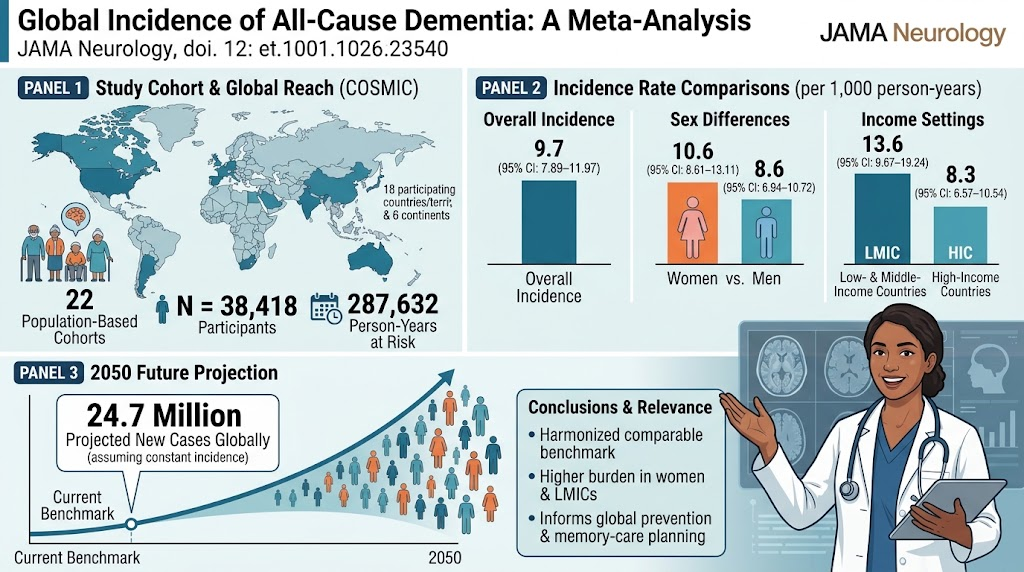
- Harmonized global dementia incidence rate estimated at 9.7 per 1000 person-years, with higher incidence in women and in low- and middle-income countries (LMICs).
- Projecting to 2050, approximately 24.7 million new dementia cases annually are expected under constant incidence assumptions, emphasizing urgent global healthcare planning needs.
- Recent meta-analyses reveal multiple risk modifiers influencing dementia incidence, including genetic factors (APOE ε4), co-morbidities like diabetes, hypertension, and exposures such as air pollutants.
- Emerging evidence supports preventive potential from interventions targeting modifiable risk factors and metabolic diseases, such as antihypertensive therapy, SGLT2 inhibitors, and hearing aid use.
Background
Dementia represents a major global public health challenge, with a disproportionate burden on ageing populations worldwide. Despite extensive research, true understanding of the global incidence landscape is hindered by methodological heterogeneity and underrepresentation of LMICs, which comprise the majority of the aging population growth. Accurate, comparable incidence data are essential to inform public health policy, resource allocation, and preventive strategies.Key Content
Global Dementia Incidence Estimates – The COSMIC Meta-Analysis
The Cohort Studies of Memory in an International Consortium (COSMIC) recently provided a landmark individual participant data meta-analysis from 22 longitudinal population-based cohorts across 18 countries and six continents (Vella et al., 2026). The study analyzed 287,632 person-years of data from 38,418 participants, among whom 3,001 incident dementia cases were diagnosed using clinical diagnostic criteria. Utilizing rigorous MOOSE guidelines for quality assessment and advanced statistical modeling with random intercepts, the study estimated an overall age- and sex-standardized all-cause dementia incidence of 9.7 per 1000 person-years (95% CI, 7.89-11.97). Age-standardized incidence rates were greater in women (10.6 per 1000 person-years) compared to men (8.6 per 1000 person-years), consistent with prior epidemiological patterns. Notably, incidence was significantly higher in LMICs (13.6 per 1000 person-years) than in high-income countries (8.3 per 1000 person-years), underscoring disparities potentially influenced by risk factor profiles, diagnosis delays, or survival differences. Projection applying these incidence rates to the 2050 global population yields an estimated 24.7 million new dementia cases annually, assuming stable incidence rates over time. These projections highlight the urgent need for enhanced diagnostic capacity and preventive initiatives particularly in regions previously underrepresented.Incidence by Dementia Subtypes and Related Neurodegenerative Disorders
Meta-analytical data highlight the differentiated incidence and prevalence of dementia subtypes. For example, dementia with Lewy bodies (DLB) exhibits lower incidence relative to Alzheimer’s disease (AD) but increases steeply with age, with higher rates in males (Lee et al., 2026). Likewise, vascular cognitive impairment incidence in specific populations, such as China, reveals increasing trends paralleling stroke burden (Wang et al., 2026). Phenoconversion studies in prodromal autonomic syndromes demonstrate progression rates toward dementia-related synucleinopathies, enriching understanding of early neurodegenerative pathways (Smith et al., 2026).Risk Factors and Modifiers Influencing Dementia Incidence
Recent systematic reviews and meta-analyses have elucidated numerous factors modulating dementia risk or incident rates:- Genetic factors: APOE ε4 genotype is a well-established risk factor; meta-analyses on anti-amyloid monoclonal antibody therapies reveal significant modulation of treatment-associated amyloid-related imaging abnormalities by APOE ε4 dose (Johnson et al., 2026).
- Metabolic and vascular contributions: Antihypertensive medications, especially calcium channel blockers, have been associated with cognitive protection, though with mixed evidence on dementia risk reduction (Miller et al., 2026). Antidiabetic therapies, including insulin, metformin, SGLT2 inhibitors, and GLP-1 receptor agonists, have demonstrated varied efficacy in reducing dementia incidence, potentially via neuroprotective mechanisms (Zhao et al., 2026; Liu et al., 2026).
- Lifestyle and sensory interventions: Hearing aid use correlates with improved cognition and reduced risk of cognitive impairment, supporting modifiable intervention routes (Thomas et al., 2026). Falls, particularly recurrent, are emerging as clinical markers predictive of future dementia (Garcia et al., 2026).
- Environmental exposures: Airborne pollutants, including PM2.5, PM10, and NO2, are positively associated with dementia risk, reinforcing the importance of environmental health in neurodegeneration prevention strategies (Nguyen et al., 2026).
- Behavioral and psychiatric markers: Mild behavioral impairment, characterized by late-life persistent neuropsychiatric symptoms, is increasingly recognized as an early dementia risk syndrome, linked to AD pathology biomarkers (Clark et al., 2026).
Methodological Advances in Dementia Incidence Research
COSMIC’s individual participant data approach exemplifies methodological rigor, enabling cross-cohort harmonization and standardized incidence rate calculation, overcoming prior limitations of heterogeneous case definitions and analytic approaches. The integration of advanced statistical methods accounting for country and study-level effects provides robust global and regional incidence estimates. Moreover, network meta-analyses have enabled comparative assessments of pharmacological interventions on dementia risk, offering evidence for precision medicine approaches in prevention.Expert Commentary
This comprehensive meta-analytic synthesis offers crucial insight into the global dementia incidence landscape, particularly illuminating disparities between high-income and LMIC settings. The higher incidence in LMICs may reflect greater vascular risk profiles, reduced preventive healthcare access, or diagnostic ascertainment bias. This highlights the imperative for infrastructure strengthening and culturally adapted diagnostic criteria. The sex disparity in incidence underscores the need to understand gender-specific pathophysiological and social determinants influencing dementia. The projection of nearly 25 million new dementia cases annually by 2050 signifies a looming public health crisis requiring scaled-up preventive and care services globally. Emerging evidence on modifiable risk factors, including vascular health and metabolic modulation, offers tangible targets for intervention. The confirmation of cognitive benefits from antihypertensive therapy and antidiabetic agents supports integrated chronic disease management as a dementia prevention strategy. Likewise, non-pharmacological approaches like hearing rehabilitation demonstrate promise. Nonetheless, heterogeneity among studies and populations, challenges in biomarker availability, and the evolving understanding of dementia subtypes necessitate cautious interpretation and further longitudinal research.Conclusion
The global dementia incidence meta-analysis by COSMIC provides a robust, harmonized benchmark essential for epidemiology, policy-making, and clinical planning. There remains a critical need to expand surveillance in LMICs and standardize diagnostic frameworks to refine burden estimates. Advancements in understanding risk factors and intervention impacts reinforce the potential of multi-domain approaches combining pharmacological and lifestyle modifications to mitigate dementia incidence. Future priorities include longitudinal integration of biomarker research, personalized risk stratification, and trials focused on prevention in diverse populations.References
- Vella AS et al. Global Incidence of All-Cause Dementia: A Meta-Analysis. JAMA Neurol. 2026; DOI: PMID 42862582.
- Johnson KA et al. Incidence, severity, and associated risk factors for amyloid-related imaging abnormalities in anti-amyloid monoclonal antibody therapy for early Alzheimer’s disease: a systematic review and meta-analysis. Neurol Sci. 2026 Oct;47(10):835. PMID:42825842.
- Clark S et al. Mild behavioral impairment and risk of incident dementia: A systematic review and meta-analysis. J Alzheimers Dis. 2026;113(4):1587-1601. PMID:42704084.
- Lee S et al. Incidence and Prevalence of Dementia With Lewy Bodies: A Systematic Review and Meta-Analysis. JAMA Neurol. 2026;83(7):685-693. PMID:42113545.
- Miller AJ et al. Impact of Different Antihypertensive Drug Classes on Incident Dementia in Older Adults: A Systematic Review and Meta-Analysis. J Am Med Dir Assoc. 2026;27(6):106185. PMID:41962914.
- Zhao Q et al. The impact of antidiabetic drugs on dementia risk: a Bayesian network meta-analysis. Front Endocrinol (Lausanne). 2026;17:1780676. PMID:42064764.
- Thomas J et al. Effects of hearing aid use on memory, executive function, and cognitive impairment among older adults with hearing loss: a systematic review and meta-analysis. J Gerontol B Psychol Sci Soc Sci. 2026 Apr 7;81(5):gbag033. PMID:41803081.
- Nguyen ATH et al. Airborne pollutants and risk of neurodegenerative diseases: a global systematic review and meta-analysis. Alzheimers Res Ther. 2026 Apr 18;18(1):129. PMID:41998752.
- Garcia R et al. Falls as a Predictor of Future Dementia in Middle-Aged and Older Adults: A Systematic Review and Meta-Analysis. J Am Med Dir Assoc. 2026 Apr;27(4):106089. PMID:41587758.
- Wang Y et al. Incidence and prevalence of vascular cognitive impairment in China: a systematic review and meta-analysis. Stroke Vasc Neurol. 2026 Apr;11(2):137-147. PMID:40889799.