Highlights
- Pregnancy causes significant reductions in steady-state antiseizure medication (ASM) concentrations, particularly for lamotrigine, levetiracetam, and oxcarbazepine metabolites.
- Polytherapy shifts baseline ASM concentration-to-dose (C/D) ratios but does not markedly alter the gestational decline trajectory of these drugs.
- Body weight inversely correlates with ASM C/D ratios for most ASMs, except perampanel, revealing secondary modifiers beyond pregnancy.
- Marked interindividual variability persists despite controlled variables, supporting the need for individualized therapeutic drug monitoring during pregnancy.
Background
Epilepsy affects up to 1% of the global population, with a substantial proportion being women of childbearing age. The management of epilepsy during pregnancy presents unique challenges due to physiological changes that alter drug pharmacokinetics, potentially leading to subtherapeutic anticonvulsant levels and increased seizure risk. Conversely, high ASM exposure may increase teratogenic risk. Accurate characterization of gestational changes in ASM concentrations is critical for optimizing seizure control while minimizing fetal risk.
Previous research has predominantly focused on western cohorts and limited sets of ASMs. The WECARE prospective multicenter cohort study in China provides comprehensive longitudinal data to quantify gestational effects on multiple ASMs and elucidate the impact of polytherapy and patient factors such as body weight.
Key Content
Study Design and Methodology
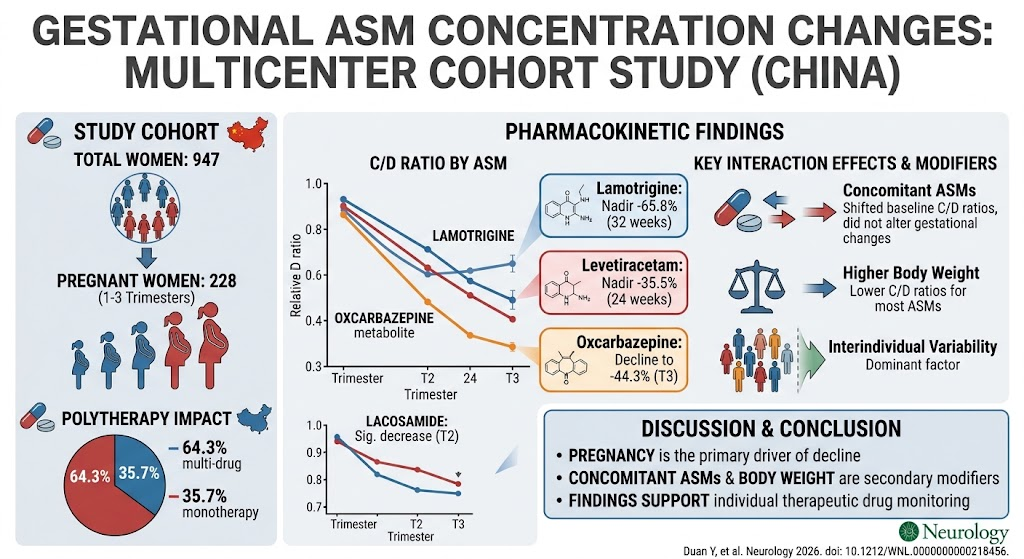
The WECARE study enrolled 947 women with epilepsy aged 18–45 years across multiple centers in China between 2019 and 2025. Across 1,638 samples, steady-state trough ASM concentrations were measured longitudinally, both in nonpregnant (1,187 samples, 821 women) and pregnant states (451 samples, 228 women). The primary pharmacokinetic endpoint was the concentration-to-dose (C/D) ratio, a standard parameter for dose-adjusted plasma concentration.
A linear mixed-effects model with model averaging was employed to assess independent effects of gestational age, concomitant ASMs (polytherapy), and demographic variables (notably body weight) on ASM C/D ratios, adjusting for interindividual variability.
Gestational Pharmacokinetic Changes in Specific ASMs
- Lamotrigine: Exhibited the most pronounced gestational decline, with C/D ratios reduced by approximately 29% in the first trimester, escalating to 54% in the second, and peaking at 63% in the third trimester (p < 0.001 for all). The nadir at 32 weeks showed a 65.8% reduction in dose-adjusted concentration, reflecting enhanced clearance likely mediated by increased glucuronidation during pregnancy.
- Levetiracetam: Demonstrated significant decreases across trimesters with reductions of 26%, 40%, and 31% respectively, with the lowest C/D ratio at 24 weeks (-35.5%). This pattern aligns with pregnancy-induced increases in renal clearance and volume of distribution.
- Oxcarbazepine Metabolite (MHD): Also declined by 23.1%, 32.6%, and 44.3% across trimesters, consistent with increased metabolism and renal elimination mechanisms.
- Lacosamide: Showed a modest but statistically significant decrease (-10.8%) in the second trimester only.
- Perampanel: Displayed an increasing trend in concentrations during pregnancy, though limited by small sample size and confounding polytherapy, warranting further study.
Impact of Polytherapy and Drug-Drug Interactions
Approximately 64.3% of participants were on ASM polytherapy. Concomitant ASMs primarily influenced baseline C/D ratios, altering steady-state concentrations outside pregnancy but did not significantly modify the slope or pattern of gestational concentration decline. Several drug-drug interactions were identified, indicating that specific ASM combinations can modulate plasma levels independently of pregnancy.
Demographic Covariates
Higher body weight was associated with lower C/D ratios for all measured ASMs except perampanel, reflecting the influence of increased volume of distribution and clearance mechanisms. Interindividual variability remained the dominant determinant of C/D ratios over measured covariates, underscoring the complexity of ASM pharmacokinetics in pregnancy.
Comparison with Prior Studies and External Validation
These findings corroborate previous European and North American studies highlighting lamotrigine’s marked clearance increase during pregnancy. The present study uniquely adds data for multiple other ASMs in an Asian population and evaluates the polytherapy context.
An external validation study of the AntiEpileptic Drug Monitoring in PREgnancy (EMPiRE) model in Chinese women with epilepsy also highlights the importance of monitoring seizure risk during pregnancy, reinforcing that pharmacokinetic variability affects clinical outcomes, and that predictive models still require refinement for real-world application.
Expert Commentary
Pregnancy-associated pharmacokinetic changes in ASMs predominantly result from increased hepatic metabolism (notably glucuronidation for lamotrigine) and elevated renal clearance (for drugs like levetiracetam and oxcarbazepine metabolite). These alterations necessitate frequent monitoring because decreased plasma concentrations increase the risk of breakthrough seizures, with potential maternal and fetal consequences.
The current study robustly quantifies these declines across gestation and delineates clinically relevant modifiers such as polytherapy and body weight. The finding that polytherapy alters baseline exposures but not gestational declines simplifies monitoring strategies to focus on individual drug kinetics and clinical response rather than complex interaction adjustments during pregnancy.
The considerable interindividual variability, however, supports individualized therapeutic drug monitoring (TDM) as a cornerstone for managing epilepsy in pregnancy. TDM should guide dose adjustments to maintain therapeutic concentrations, balancing seizure control with teratogenic risks.
In clinical practice, these data advocate for proactive dose escalation protocols for lamotrigine and levetiracetam during pregnancy, with planned reductions postpartum to avoid toxicity. Weight-based dosing considerations may further optimize therapy.
Challenges remain in establishing standardized TDM protocols and thresholds for dose adjustment, particularly for under-studied ASMs such as perampanel. Moreover, the clinical impact of observed gestational declines on seizure frequency and pregnancy outcomes warrants further investigation.
Conclusion
The WECARE multicenter cohort study provides comprehensive and high-quality evidence that pregnancy is the primary driver of decreased ASM C/D ratios, especially pronounced for lamotrigine, levetiracetam, and oxcarbazepine metabolites. Polytherapy and body weight act as secondary modifiers but do not fundamentally alter the gestational decline pattern.
These findings reinforce the critical need for individualized therapeutic drug monitoring and dose management across pregnancy to optimize seizure control and minimize risks to mother and fetus. Future research should focus on validating dosing algorithms informed by these pharmacokinetic insights and exploring the translational impact on neurodevelopmental and obstetric outcomes.
References
- Duan Y, Huang S, Sha L, et al.; WECARE study group. Gestational Changes in Antiseizure Medication Concentrations and the Impact of Polytherapy: A Prospective Multicenter Cohort Study in China. Neurology. 2026 Sep 2;107(7):e218456. doi:10.1212/WNL.0000000000218456. PMID: 42685297.
- Tomson T, Battino D, Bonizzoni E, et al.; EURAP Study Group. Pharmacokinetics of lamotrigine during pregnancy and puerperium: a population study. Neurology. 2013;80(15):1474-1478. doi:10.1212/WNL.0b013e31828ea17f. PMID: 23532503.
- Vajda FJ, O’Brien TJ, Graham J, et al. Antiepileptic drug dosage and new seizures during pregnancy: a prospective study. Seizure. 2014;23(1):72-76. doi:10.1016/j.seizure.2013.10.002. PMID: 24291108.
- Tomson T, Battino D, Bonizzoni E, et al.; EURAP Study Group. Dose-dependent risk of malformations with antiepileptic drugs: an analysis of data from the EURAP epilepsy and pregnancy registry. Lancet Neurol. 2011;10(7):609-617. doi:10.1016/S1474-4422(11)70060-4. PMID: 21783466.
- Sheng J, Xu R, Dai L, et al. External validation of the AntiEpileptic Drug Monitoring in PREgnancy (EMPiRE) model for predicting seizures in pregnant women with epilepsy. BMC Pregnancy Childbirth. 2023 Jul 11;23(1):505. doi:10.1186/s12884-023-05822-z. PMID: 37434124.
- Meador KJ, Baker GA, Browning N, et al.; NEAD Study Group. Executive function at age 4 years after prenatal antiepileptic drug exposure. Neurology. 2024 Jun 25;102(12):e209448. doi:10.1212/WNL.0000000000209448. PMID: 38810172.