Highlight
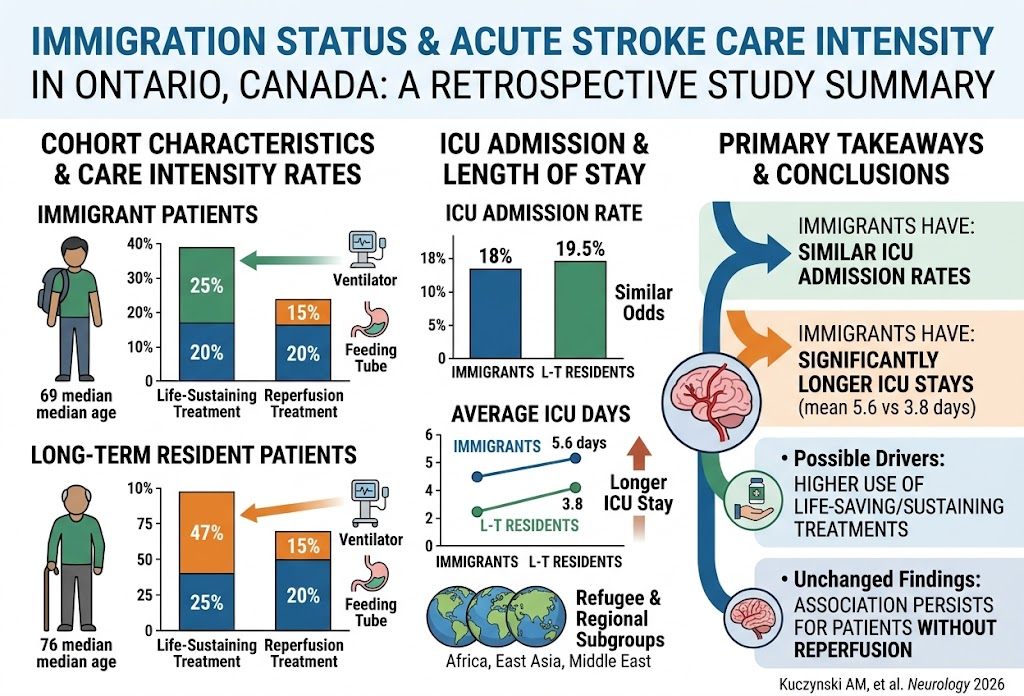
- Immigrant ischemic stroke patients in Ontario have similar ICU admission rates as long-term residents despite generally younger age and lower stroke severity.
- Immigrants experience significantly longer ICU stays than long-term residents, especially among those not receiving reperfusion treatments.
- Higher rates of life-sustaining treatments, such as ventilatory support and feeding tube insertion, may contribute to prolonged ICU stays among immigrants.
- Subgroups of immigrants, including refugees and those from Africa, East Asia, and the Middle East, exhibit notably longer ICU stays.
Study Background
Stroke remains a leading cause of morbidity and mortality worldwide. Socioeconomic and demographic factors, including immigration status, have been implicated in disparities in stroke incidence, care, and outcomes. Understanding how immigration status affects acute stroke management, particularly the intensity of care in intensive care units (ICUs), is crucial for equitable healthcare delivery. Existing literature has primarily focused on stroke incidence and long-term outcomes by immigration status, but data on acute care parameters such as ICU admission and length of stay are sparse. The described study addresses this knowledge gap by investigating the association between immigration status and ICU care among ischemic stroke patients in Ontario, Canada.
Study Design
This research utilized a population-based retrospective cohort design, encompassing all adults hospitalized with ischemic stroke in Ontario between April 1, 2014, and March 30, 2023. Immigration status was defined for individuals born outside Canada who immigrated after 1985. The study analyzed clinical interventions such as thrombolysis and thrombectomy (reperfusion therapies), ventilatory support, and feeding tube insertion within the acute care setting. Outcomes included rates of ICU admission and length of ICU stay. Adjusted odds ratios (aOR) for ICU admission were estimated using logistic regression, while adjusted risk ratios (aRR) for ICU length of stay were derived from negative binomial regression models. Subgroup analyses considered patients who did not receive reperfusion treatments and examined effects by immigrant categories such as refugees and region of origin.
Key Findings
The study included 85,507 ischemic stroke patients, with immigrants constituting approximately 12.9%. Immigrant patients were younger (median age 69 versus 76 years, standardized difference 0.38), presented with lower stroke severity, and demonstrated lower rates of reperfusion therapies compared with long-term residents. Notably, immigrants had higher utilization of life-sustaining treatments such as mechanical ventilation and feeding tube insertion.
Despite comparable rates of ICU admission (18.2% for immigrants versus 19.7% for long-term residents; aOR 0.97 [95% CI 0.91–1.04]), immigrants experienced significantly longer ICU stays (mean 5.6 ± 18.5 days versus 3.8 ± 7.7 days; aRR 1.30 [1.13–1.48]). This pattern persisted in the subgroup not receiving reperfusion therapies (aRR 1.27 [1.09–1.49]), suggesting that factors beyond reperfusion treatment status influence ICU stay duration.
Further analyses revealed no significant variation by hospital immigrant care volume. However, refugees and immigrants from Africa, East Asia, and the Middle East notably had longer ICU stays, indicating heterogeneity in ICU care intensity related to migration origins.
Expert Commentary
These findings underscore a paradox in acute stroke care among immigrants in Ontario: while ICU admission likelihood is similar across groups, immigrants endure prolonged ICU stays. The higher frequency of life-sustaining interventions may partly explain the extended ICU length of stay, though reasons for increased use of such treatments warrant further exploration. Potential factors include differences in underlying comorbidities, cultural attitudes toward aggressive care, communication barriers, and variations in health literacy or social support networks.
Moreover, younger age and lower initial stroke severity among immigrants challenge traditional predictors of ICU resource utilization, suggesting that clinicians may adopt a more cautious or extended approach to critical care in these patients. The absence of differential ICU utilization across hospitals with varying immigrant patient volumes indicates systemic rather than institution-specific factors at play.
Limitations include the retrospective design, lack of granular clinical data on functional outcomes and post-ICU trajectories, and possible residual confounding. Future prospective studies should elucidate causal pathways and assess the impact of prolonged ICU stays on long-term outcomes and healthcare resource allocation.
Conclusion
This comprehensive population-based study reveals that immigrant patients with ischemic stroke in Ontario have similar ICU admission rates compared to long-term residents but experience longer ICU stays, partly driven by increased life-sustaining interventions. These findings highlight the need for targeted research to understand underlying determinants and to develop culturally sensitive acute stroke care strategies that optimize ICU use and patient-centered outcomes. Addressing these disparities can enhance equity and efficiency in stroke critical care within increasingly diverse populations.
Funding
The original study’s funding details were not publicly reported. Further information may be available in the full publication.
References
1. Kuczynski AM, Yu AYX, Fowler R, et al. Association Between Immigration Status and the Intensity of Acute Stroke Care in Ontario, Canada: A Retrospective Study. Neurology. 2026;107(7):e218543. doi:10.1212/WNL.000000000000XX
2. Goyal M, Menon BK, van Zwam WH, et al. Endovascular thrombectomy after large-vessel ischaemic stroke: a meta-analysis of individual patient data from five randomised trials. Lancet. 2016;387(10029):1723-31.
3. Béjot Y, Daubail B, Jacquin A, et al. Incidence and outcome of stroke in immigrants of different origin and in the native population in Dijon, France. J Stroke Cerebrovasc Dis. 2014;23(4):718-724.
4. Clinical guidelines for stroke management. Canadian Stroke Best Practice Recommendations. www.strokebestpractices.ca