Highlight
- Pathogenic germline variants (gPVs) were found in approximately 12% of a community-based endometrial cancer population.
- Lynch syndrome and homologous recombination deficiency (HRD)-related variants were the most prevalent mutations identified.
- Testing at diagnosis detected 74% of gPV-positive patients, with a higher detection rate for Lynch syndrome than for HRD-related variants.
- There was no difference in overall gPV rates by race; however, Lynch syndrome mutations were more common among Asian patients.
Study Background
Endometrial cancer is one of the most common gynecologic malignancies worldwide, with significant morbidity and mortality. Pathogenic germline variants (gPVs) in DNA repair and mismatch repair (MMR) genes, especially those linked to Lynch syndrome and homologous recombination deficiency (HRD), confer increased lifetime risks and have implications for patient management, screening, and family counseling. Despite guidelines recommending genetic testing for select endometrial cancer patients, the prevalence and patterns of gPVs among diverse, community-based populations remain incompletely characterized.
Study Design
This retrospective observational study analyzed germline testing data from 10,233 women diagnosed with endometrial cancer between 2016 and 2022 within a large, ethnically diverse community healthcare setting. Genetic testing indications included testing at diagnosis, recurrence, history of other cancers (breast, colon, lung), or other timing. The primary objective was to estimate the prevalence of pathogenic germline variants and evaluate the detection yield by testing indication. Propensity score weighting was employed to extrapolate gPV prevalence to the entire endometrial cancer cohort, considering potential selection biases related to testing uptake.
Key Findings
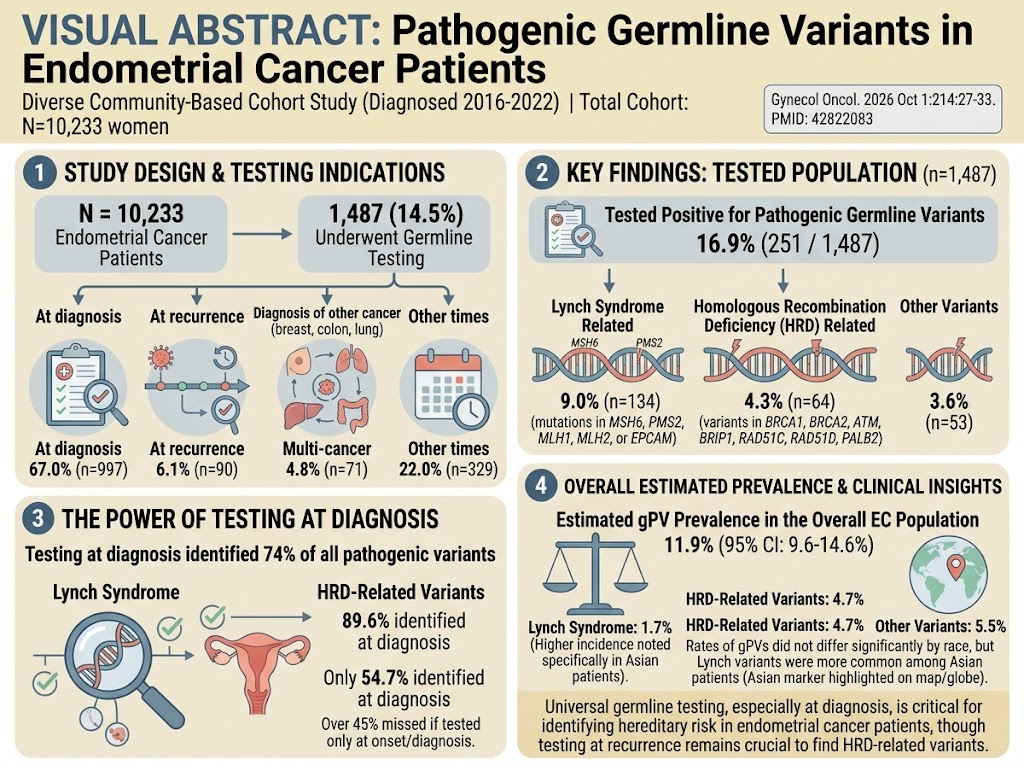
Out of 10,233 patients, 1,487 (14.5%) underwent germline testing. Among tested individuals, 251 (16.9%) carried pathogenic germline variants. Specifically, 64 patients (4.3%) harbored variants associated with homologous recombination deficiency genes including BRCA1, BRCA2, ATM, BRIP1, RAD51C, RAD51D, and PALB2. Meanwhile, 134 (9.0%) had mutations linked to Lynch syndrome genes (MSH6, PMS2, MLH1, MSH2, EPCAM).
When analyzing timing of testing, 997 patients (67% of tested) were tested at diagnosis, accounting for 74% of all gPV-positive cases. In particular, 89.6% of Lynch syndrome carriers were identified at diagnosis, while only 54.7% of HRD-related variants were detected at this time.
Using propensity weighting, the estimated prevalence of gPVs in the overall endometrial cancer cohort was 11.9% (95% CI 9.6-14.6%), with 1.7% (95% CI 1.4–2.2%) specifically for Lynch syndrome and 4.7% (95% CI 3.3–6.7%) for HRD-related mutations. No significant differences were found in overall gPV prevalence by race; however, Lynch syndrome variants were statistically more common among Asian patients.
The study highlights that a significant fraction of endometrial cancer patients harbor germline mutations, yet only a minority undergo genetic testing. Early testing, particularly at diagnosis, is critical for detecting Lynch syndrome, which may direct therapeutic decisions, surveillance, and family risk assessment. Conversely, HRD-related variants may require additional strategies to identify effectively given lower detection rates at diagnosis.
Expert Commentary
The findings from Suh-Burgmann et al. reinforce the critical role of genetic evaluation in the management of endometrial cancer. Lynch syndrome remains the most clinically actionable hereditary cause, emphasizing universal or broad-panel testing at diagnosis to optimize detection. HRD mutations, increasingly recognized for therapeutic implications including PARP inhibitor sensitivity, warrant attention but may be under-ascertained with current testing paradigms.
Current National Comprehensive Cancer Network (NCCN) guidelines advocate mismatch repair protein testing or germline testing for all endometrial cancer cases owing to Lynch syndrome prevalence. However, the observed testing rate of only 14.5% in this community setting signals systemic gaps in referral and access. Addressing barriers such as clinician awareness, genetic counseling capacity, and equitable access is essential.
The racial/ethnic findings suggest potential genetic epidemiology differences. The increased frequency of Lynch mutations in Asian patients may reflect founder mutations or population-specific variants, underlining the importance of tailored genetic screening approaches.
Limitations include the retrospective design and incomplete testing uptake, which although adjusted statistically, may still introduce selection bias. Additionally, the study did not report clinical outcomes or therapeutic modifications related to germline findings, areas for future prospective research.
Conclusion
This large, diverse community-based cohort study estimates that nearly 12% of women with endometrial cancer harbor pathogenic germline variants, predominantly Lynch syndrome and HRD-associated mutations. Testing at diagnosis captures most Lynch syndrome carriers but identifies only half of HRD variants, underscoring the need for comprehensive and timely genetic testing protocols. Furthermore, racial differences in mutation prevalence suggest a need for culturally and genetically inclusive screening strategies. Expansion of genetic testing integration into routine clinical workflows can enhance personalized therapy, secondary cancer prevention, and familial risk management in endometrial cancer.
Funding and Trial Registration
No specific funding sources or clinical trial registrations were reported for this study.
References
- Suh-Burgmann E, Finertie H, Hung YY, et al. Prevalence of pathogenic germline variants and indications for testing in a diverse community-based endometrial cancer cohort. Gynecol Oncol. 2026 Oct 1;214:27-33. PMID: 42822083.
- National Comprehensive Cancer Network. Genetic/Familial High-Risk Assessment: Colorectal. Version 2.2024.
- Ryan NAJ, Glaire MA, Blake D, et al. Pathogenic mismatch repair gene variants and endometrial cancer susceptibility: a systematic review and meta-analysis. J Clin Oncol. 2021;39(24):2745-2758.
- Beiner ME, McAlpine JN, Pollett A, et al. Diagnostic yield of universal vs selective genetic testing strategies in endometrial cancer patients. Gynecol Oncol. 2023;170(2):374-380.