Highlight
- Remote home tonometry captures dynamic intraocular pressure (IOP) fluctuations missed by conventional in-office measurements.
- Novel threshold-based IOP metrics—percentage above threshold, average and total IOP excess—at patient-specific targets correlate strongly with visual field progression.
- Standard IOP metrics, including mean and maximum IOP from in-office or remote measurements, show no significant association with glaucomatous visual field decline.
- These findings endorse the clinical value of individualized remote IOP monitoring to better stratify risk of glaucoma progression under treatment.
Study Background
Open-angle glaucoma (OAG) is a leading cause of irreversible blindness worldwide, characterized by progressive optic neuropathy and corresponding functional loss measured by visual field deterioration. Elevated intraocular pressure (IOP) is the only modifiable risk factor currently targeted by therapy. However, traditional in-office IOP measurements provide limited snapshots that may miss critical fluctuations and peaks potentially driving disease progression. The advent of remote, patient-operated tonometry devices offers new opportunities to longitudinally assess IOP dynamics in the home environment. Yet, the optimal metrics derived from such home tonometry data to predict clinical outcomes remain to be clearly defined. This study addresses the unmet need for reliable IOP parameters that correlate with visual field progression in treated OAG, comparing conventional in-office readings with home-based monitoring using novel threshold-oriented analyses.
Study Design
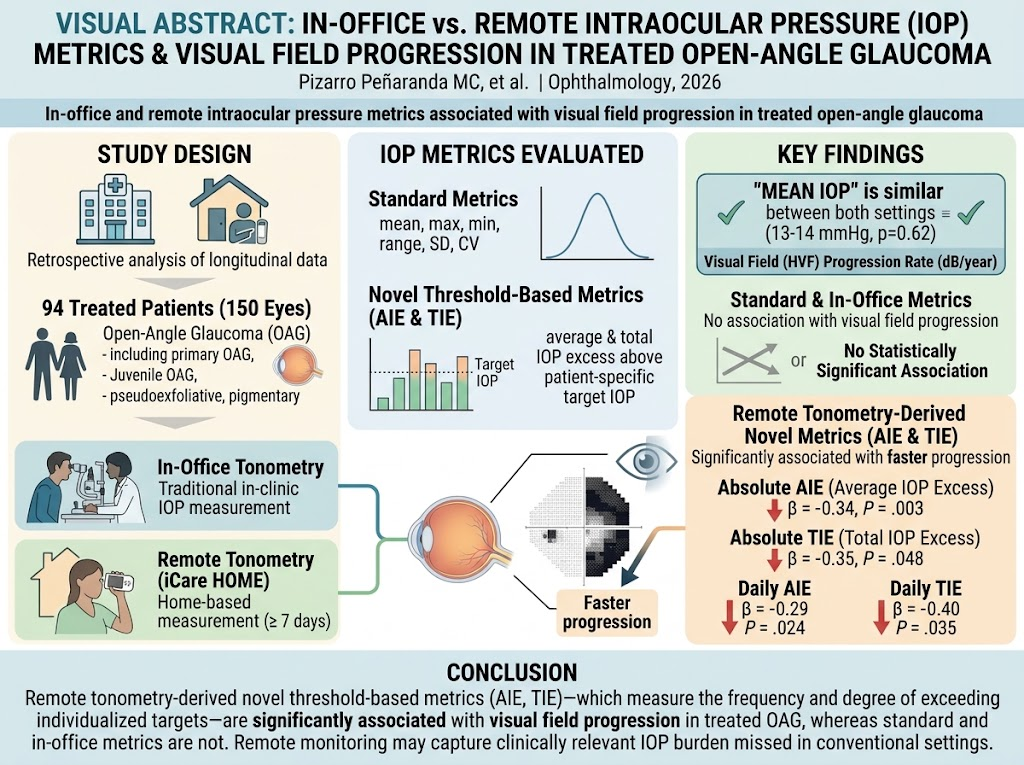
This investigation was a retrospective, longitudinal cohort analysis involving 94 treated patients (150 eyes) diagnosed with primary OAG and related subtypes (juvenile, pseudoexfoliative, pigmentary glaucoma). All participants were prescribed remote tonometry using the iCare HOME device for a minimum of 7 days to capture intra-day and inter-day variations. Standard IOP metrics—including mean, maximum, minimum, range, standard deviation, and coefficient of variation—were calculated from both in-office and remote measurements.
Additionally, three novel, threshold-based metrics were computed across five predefined cutoffs (12, 15, 18, 21 mmHg, and individualized target IOP set by glaucoma specialists):
- Percentage of Measurements Above Threshold (PMAT)
- Average IOP Excess (AIE) – mean difference of IOP above the threshold
- Total IOP Excess (TIE) – cumulative sum of IOP above the threshold
These remote metrics were analyzed as absolute values over the entire monitoring period and as daily aggregated averages.
Visual field progression was quantified by the rate of change in mean deviation slopes from a minimum of three reliable Humphrey Visual Field (HVF) tests. The statistical analysis utilized generalized estimating equations to correlate various IOP metrics with visual field progression rates (dB/year).
Key Findings
The mean IOP values ranged between 13 and 14 mmHg and showed no significant difference between remote home and in-office measurements (p=0.62). However, all other standard variability metrics markedly differed between the two settings.
Crucially, no standard IOP metric—whether from home or clinic measurements—demonstrated a statistically significant association with the rate of visual field deterioration. This highlights the limitations of relying solely on traditional IOP summaries for clinical decision-making.
In contrast, the novel threshold-based metrics derived from remote tonometry, specifically average IOP excess (AIE) and total IOP excess (TIE) calculated against the individualized target IOP, showed a robust and significant correlation with faster visual field progression:
- Absolute AIE: β = -0.34, p = 0.003
- Absolute TIE: β = -0.35, p = 0.048
- Daily AIE: β = -0.29, p = 0.024
- Daily TIE: β = -0.40, p = 0.035
Equivalent metrics derived from in-office IOP measurements did not correlate with progression, underscoring the added value of home monitoring to capture clinically relevant IOP burden.
These findings suggest that the frequency and magnitude of IOP elevations exceeding patient-specific targets are more predictive of glaucomatous progression than isolated IOP values or global averages.
Expert Commentary
This study reinforces a paradigm shift from single IOP measurements toward more comprehensive, personalized assessment of IOP exposure in glaucoma management. The use of patient-specific IOP thresholds acknowledges interindividual variability in target pressures and aligns with evolving clinical practice guidelines emphasizing individualized care.
Remote tonometry enables capturing diurnal and episodic IOP spikes that are known to contribute mechanistically to optic nerve damage. The novel threshold metrics—PMAT, AIE, and TIE—intelligently quantify not only how often but also by how much IOP overshoots predetermined targets, providing a better risk metric than traditional mean IOP values.
Limitations of the study include its retrospective design and the potential for confounding factors that were not fully accounted for. Furthermore, validation in prospective cohorts with diverse ethnic groups and glaucoma subtypes will be vital to generalize findings. Integration with other risk factors, such as corneal hysteresis and optic nerve structural imaging, may further refine prognostic models.
Conclusion
In treated OAG patients, remote home tonometry combined with novel threshold-based IOP metrics significantly predicts visual field progression, outperforming standard in-office IOP measures. These findings highlight the clinical utility of continuous, patient-operated IOP monitoring to better characterize pressure burden and to tailor interventions accordingly.
The study advocates for prospective validation of remote IOP monitoring paradigms and supports the incorporation of individualized threshold metrics in glaucoma surveillance. Such advances hold promise to enhance real-world disease control and ultimately preserve vision in this sight-threatening condition.
References
Pizarro Peñaranda MC, ScM AM, Optom SCB, Hamilton N, Nam Y, Wong VW, Jensen MS, Johnson C, Eddington D, Kanter J, Wirostko BM, Johnson TV. In-office and remote intraocular pressure metrics associated with visual field progression in treated open-angle glaucoma. Ophthalmology. 2026 Sep 30:S0161-6420(26)00739-6. doi: 10.1016/j.ophtha.2026.09.031. Epub ahead of print. PMID: 42815779.