Highlight
– Laryngeal and hypopharyngeal squamous cell carcinomas disproportionately affect men, potentially due to hormonal influences.
– Use of 5α-reductase inhibitors (5-ARIs) to inhibit testosterone conversion was associated with a 17% reduced risk of these cancers.
– This large, population-based cohort study adjusted for key lifestyle and metabolic confounders strengthens evidence for testosterone’s role in tumor development.
– Findings may influence considerations for hormonal modulation in prevention strategies for high-risk male populations.
Background
Laryngeal and hypopharyngeal squamous cell carcinomas (SC) are malignancies originating from the epithelial lining of the larynx and hypopharynx. These cancers show a strong male predominance in incidence, attributed often to differences in exposure to risk factors such as tobacco and alcohol. However, the male-biased incidence also suggests a biological component involving sex hormones. Testosterone, the primary androgen in men, is metabolized to dihydrotestosterone (DHT), a more potent androgen, by the enzyme 5α-reductase. While tobacco and alcohol remain the main modifiable risk factors, the role of androgens in the development and progression of these cancers remains insufficiently explored. Understanding this relationship can help uncover novel preventive or therapeutic pathways.
Study Design
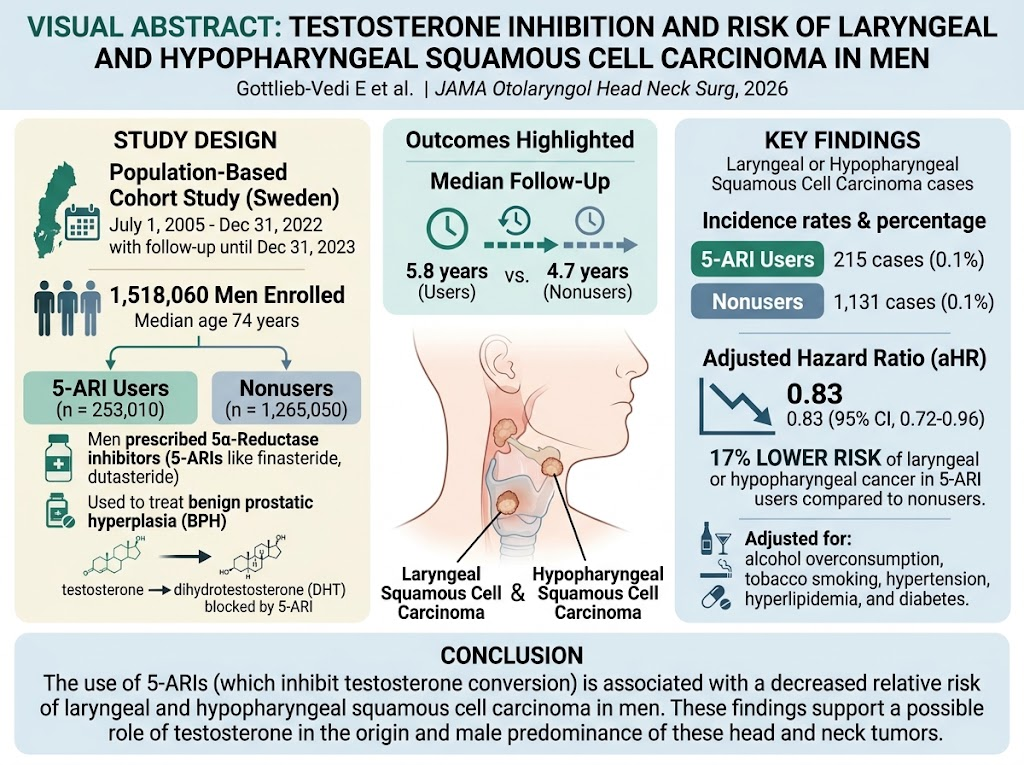
This observational, population-based cohort study leveraged data from the Swedish Prescribed Drugs and Health Cohort spanning July 1, 2005, to December 31, 2022, with follow-up until December 31, 2023. The study included men with at least two dispensations of 5α-reductase inhibitors (5-ARIs) within two years, commonly prescribed for benign prostatic hyperplasia, reflecting sustained testosterone inhibition via reduced conversion to DHT.
Users of 5-ARIs (n=253,010) were compared to a control group of 1,265,050 age- and date-matched men without 5-ARI prescriptions. Primary outcome was the incidence of newly diagnosed laryngeal or hypopharyngeal squamous cell carcinoma. Multivariable Cox proportional hazards modeling was applied to estimate the association, adjusting for key potential confounders: alcohol overconsumption, tobacco smoking, hypertension, hyperlipidemia, and diabetes.
Key Findings
The median age of participants was 74 years (interquartile range [IQR], 67–80 years). The median follow-up was 5.8 years for 5-ARI users and 4.7 years for nonusers. During this period, 215 (0.1%) 5-ARI users and 1131 (0.1%) nonusers developed laryngeal or hypopharyngeal squamous cell carcinoma.
Crucially, after adjusting for confounding variables, 5-ARI use was associated with a statistically significant 17% relative risk reduction in these cancers (adjusted hazard ratio [HR] 0.83, 95% confidence interval [CI] 0.72–0.96). This indicates that inhibition of the testosterone pathway may play a protective role.
No new or unexpected safety concerns related to 5-ARI use were reported within this context in the study.
Expert Commentary
This study provides robust epidemiological evidence supporting the hypothesis that androgens contribute to the pathogenesis or promotion of laryngeal and hypopharyngeal squamous cell carcinoma in men. The use of 5-ARIs as an indirect marker for reduced DHT activity in a large national cohort adds weight to the biological plausibility that testosterone and its metabolites influence these tumors’ male predominance.
Nevertheless, residual confounding cannot be entirely excluded, particularly lifestyle factors like smoking and alcohol consumption that are major carcinogenic drivers. The study adjusted for these exposures, but their measurement may have limitations inherent in registry data.
Mechanistic insights suggest that androgen receptor expression in squamous epithelial cells might promote oncogenic processes. Inhibition of DHT synthesis could reduce proliferative signaling pathways, thereby lowering carcinogenesis risk. Further molecular studies are warranted to explore these mechanisms.
Clinically, this research invites consideration of hormonal modulation as a complementary preventive approach. Randomized trials would be needed to establish causality and safety before altering clinical practice.
Conclusion
The population-based cohort study by Gottlieb-Vedi and colleagues demonstrates an association between testosterone inhibition via 5α-reductase inhibitors and a decreased relative risk of laryngeal and hypopharyngeal squamous cell carcinoma in men. These findings support a partial role of androgens in the etiology and male predominance of these tumors.
While promising, these results necessitate further mechanistic research and prospective clinical trials to evaluate the therapeutic implications of androgen pathway modulation in head and neck oncology. In the meantime, clinicians should continue focusing on established risk factor management, including smoking cessation and alcohol control, as primary preventive measures.
Funding and ClinicalTrials.gov
The original study was funded by Swedish research grants as detailed in the publication. There is no clinical trial registration associated with this observational cohort study.
References
1. Gottlieb-Vedi E, Santoni G, Hammarstedt-Nordenvall L, Xie SH, Lagergren J. Testosterone Inhibition and Risk of Laryngeal and Hypopharyngeal Squamous Cell Carcinoma in Men. JAMA Otolaryngol Head Neck Surg. 2026 Oct 1;PMID: 42821291.
2. Gillison ML, et al. Epidemiology of head and neck squamous cell carcinoma. In: DeVita, Hellman, and Rosenberg’s Cancer: Principles & Practice of Oncology. 11th ed. 2019.
3. Mohamad Yusof N, et al. Androgen receptor signaling in head and neck cancer: a potential therapeutic target. Cancers (Basel). 2021;13(10):2423.
4. Chen Y, et al. 5α-Reductase inhibitors and risk of prostate and colorectal cancer. JAMA Oncol. 2018;4(4):518-525.