Highlight
- Genetically proxied CETP inhibition is associated with a significantly increased risk of both early and advanced age-related macular degeneration (AMD) in European and East Asian populations.
- Drug-target Mendelian randomization (MR) analyses demonstrate increased odds of typical neovascular AMD, exudative AMD, and polypoidal choroidal vasculopathy linked to CETP inhibition.
- Observational genetic analyses from the UK Biobank and SEED cohort corroborate the genetic findings, confirming a potential retinal safety concern for CETP inhibitors used in cardiovascular disease management.
- The study underscores the need for clinical trials and longitudinal studies to carefully assess AMD risks in patients undergoing CETP inhibitor therapy.
Study Background
Cholesteryl ester transfer protein (CETP) plays a key role in lipid metabolism by mediating the transfer of cholesteryl esters from high-density lipoproteins (HDL) to other lipoprotein particles. CETP inhibition has emerged as a promising therapeutic strategy to raise HDL cholesterol levels and reduce cardiovascular risk. However, concerns about off-target effects and safety have persisted, particularly regarding ocular health.
Age-related macular degeneration (AMD) is a leading cause of irreversible vision loss in older adults globally. The disease presents in early and advanced forms, including neovascular subtypes such as typical neovascular AMD (nAMD) and polypoidal choroidal vasculopathy (PCV), each with distinct pathophysiologies. Given the complex interplay of lipid metabolism and retinal health, insights into genetic modulation of CETP function and AMD risk are crucial.
Study Design
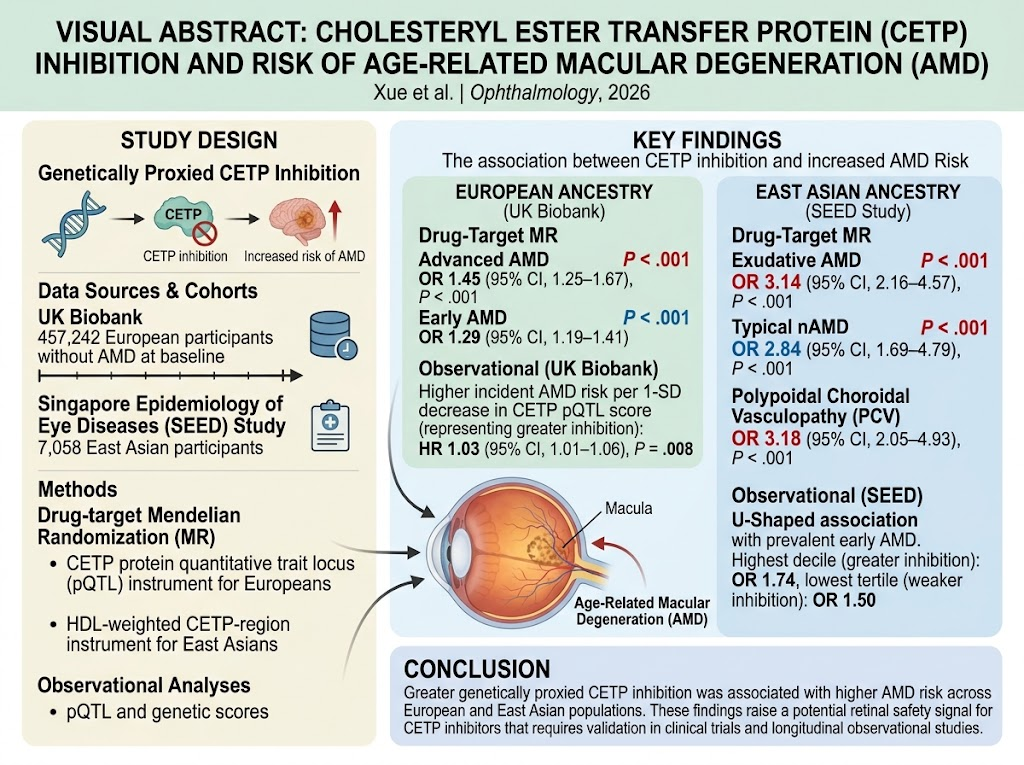
The study employed a drug-target Mendelian randomization (MR) approach leveraging genetic variants as natural proxies for CETP inhibition to examine the causal relationship with AMD risk. Two large cohorts were analyzed: the UK Biobank with 457,242 participants of European ancestry and the Singapore Epidemiology of Eye Diseases (SEED) study encompassing 7,058 participants of East Asian ancestry.
For the European cohort, a CETP protein quantitative trait locus (pQTL) was used as an instrument to model CETP inhibition, while in East Asians, a high-density lipoprotein (HDL)-weighted CETP genetic score was utilized. The outcomes studied included early and advanced AMD in Europeans, and exudative AMD, typical nAMD, and PCV in East Asians. Complementary observational genetic association analyses were conducted to validate MR findings.
Key Findings
The MR analyses demonstrated that genetically proxied CETP inhibition increased the odds of advanced AMD (odds ratio [OR], 1.45; 95% confidence interval [CI], 1.25–1.67) and early AMD (OR, 1.29; 95% CI, 1.19–1.41) in the European cohort, both with strong statistical significance (P<0.001).
Among East Asian populations, CETP inhibition was even more strongly associated with exudative AMD (OR, 3.14; 95% CI, 2.16–4.57), typical neovascular AMD (OR, 2.84; 95% CI, 1.69–4.79), and PCV (OR, 3.18; 95% CI, 2.05–4.93), with all P-values less than 0.001, highlighting a pronounced risk increase.
Observational analyses within the UK Biobank confirmed a modest but statistically significant increase in incident AMD risk per standard deviation decrease in the CETP pQTL score (hazard ratio [HR], 1.03; 95% CI, 1.01–1.06; P = 0.008). In SEED, the HDL-weighted CETP genetic score exhibited a U-shaped association with prevalent early AMD, where both the highest decile (reflecting stronger CETP inhibition) and lowest tertile (weaker inhibition) showed elevated odds compared to the midrange group.
These findings reveal a consistent pattern linking CETP inhibition to increased susceptibility to AMD across genetically distinct populations and analytical frameworks.
Expert Commentary
This study provides compelling genetic evidence that CETP inhibitors, although beneficial in reducing cardiovascular risk, have a potentially adverse impact on retinal health by increasing AMD risk. The use of robust drug-target Mendelian randomization strengthens the causal inference by mitigating confounding factors common to observational studies.
Biologically, CETP activity influences HDL metabolism, and alterations in lipid transport and composition within the retina could contribute to AMD pathogenesis through inflammatory and lipid deposition pathways. The stronger associations observed in East Asian populations may reflect genetic heterogeneity or environmental interactions affecting AMD subtypes like PCV, which are more prevalent in these groups.
Clinicians should be cautious in prescribing CETP inhibitors, particularly in patients with existing AMD risk factors or early degenerative changes. Further mechanistic studies and clinical trials integrating ophthalmic endpoints are essential to clarify the retinal safety profile of CETP inhibitors.
Limitations include the use of genetic proxies rather than direct pharmacological CETP inhibition, though genetic variants used are well-established instruments. The observational analyses corroborate but cannot completely rule out residual confounding. Generalizability must be cautiously extended to non-European and other ethnic groups despite the inclusion of East Asian cohorts.
Conclusion
Genetically proxied CETP inhibition, while pursued as a therapeutic strategy for cardiovascular disease, is linked to increased risks of age-related macular degeneration across diverse populations. These results reveal a previously underappreciated retinal safety concern that warrants vigilant evaluation in clinical settings and dedicated trials.
Healthcare providers and researchers should balance cardiovascular benefits against potential ocular risks, especially in patients predisposed to AMD. Continued research into the mechanistic pathways connecting lipid metabolism and retinal disease will be critical for developing safer interventions.
Funding and Clinical Trials
The study was supported by cardiovascular and ophthalmological research grants, with large-scale genetics data sourced from the UK Biobank and SEED study cohorts. Further clinical trials are recommended to prospectively assess CETP inhibitors’ ophthalmic safety.
References
- Xue CC, Li H, Wang S, et al. Cholesteryl Ester Transfer Protein Inhibition and Risk of Age-Related Macular Degeneration. Ophthalmology. 2026 Sep 29; PMID: 42810526.
- Kenney MC, et al. The role of cholesterol in retinal health and disease. Prog Retin Eye Res. 2020;79:100859.
- Wong TY, et al. Age-related macular degeneration. Nat Rev Dis Primers. 2016;2:16068.
- Chandra H, et al. Impact of lipid metabolism on the pathogenesis of age-related macular degeneration. J Clin Med. 2021;10(8):1693.