Introduction
Diabetic retinopathy (DR) is a leading cause of vision impairment and blindness among working-age adults worldwide. It results from damage to the retinal blood vessels caused by chronic high blood sugar levels in people with diabetes. Understanding the complex interplay between genetic predisposition and lifestyle factors is crucial for effective prevention and management strategies. Recent advances in machine learning (ML) and genetic analysis have enabled the development of polygenic risk scores (PRS) that quantify an individual’s genetic susceptibility to DR. This article explores new research that integrates genetic risk profiling with lifestyle behaviors to assess their combined effect on DR development and the potential for lifestyle modification to reduce genetic risk.
Study Design and Participants
This multicenter, multiethnic cohort study involved a large sample drawn from two significant populations: 91,691 participants with prediabetes or diabetes but no DR from the UK Biobank (UKB), and 1,119 participants with diabetes but free from DR from the Guangzhou Diabetic Eye Study (GDES) in China. Both cohorts were prospectively followed with comprehensive genetic testing and lifestyle assessments, allowing for unbiased stratification of genetic susceptibility and behavioral risk factors.
Methods
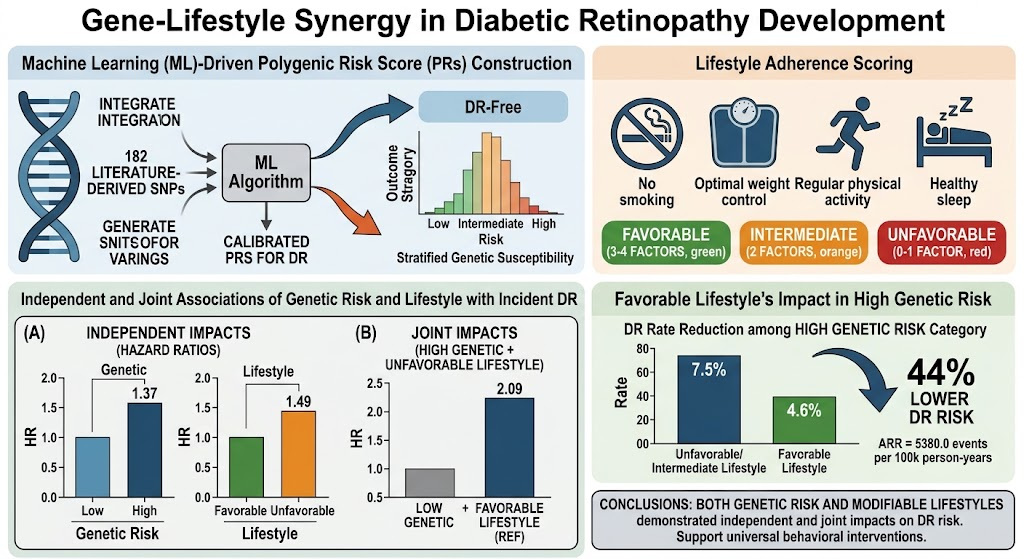
The researchers constructed an ML-driven PRS for diabetic retinopathy based on 182 single nucleotide polymorphisms (SNPs) identified from prior literature. This score was applied to the multiethnic cohorts to classify participants into low, intermediate, or high genetic risk categories. Lifestyle adherence was measured using a scoring system based on four key modifiable behaviors: no smoking, optimal weight control (healthy BMI), regular physical activity, and healthy sleep patterns. Participants were categorized as having a favorable (3–4 factors), intermediate (2 factors), or unfavorable (0–1 factor) lifestyle.
Cox proportional hazards models were employed to estimate the independent and combined effects of genetic risk and lifestyle on incident DR. The analyses considered risk reduction stratified by genetic risk categories to elucidate interaction effects.
Key Findings
1. Genetic Risk Impact: Individuals with high genetic risk had a 37% greater chance of developing DR compared to those with low genetic risk, regardless of their lifestyle habits (Hazard Ratio [HR] 1.37; 95% Confidence Interval [CI]: 1.18–1.60; P < 0.001).
2. Lifestyle Impact: An unfavorable lifestyle was linked to a 49% higher risk of DR compared to a favorable lifestyle, independent of genetic risk (HR 1.49; 95% CI: 1.34–1.65; P < 0.001).
3. Combined Risk: Participants with both high genetic risk and an unfavorable lifestyle had more than twice the risk of DR development (HR 2.09; 95% CI: 1.67–2.60; P < 0.001), underscoring gene-lifestyle synergy.
4. Benefit of Favorable Lifestyle: Among those at high genetic risk, adherence to a favorable lifestyle reduced DR risk by 44% (HR 0.56; 95% CI: 0.42–0.75; P < 0.001). This corresponded to lowering the standardized rate of DR from 7.5% to 4.6%, demonstrating substantial risk mitigation through modifiable behavior.
5. Replication in GDES cohort: The synergistic association between genetic risk and lifestyle was confirmed in the independent Chinese cohort, reinforcing generalizability across ethnicities. Participants with intermediate and high genetic risk exhibited significantly increased DR incidence. Favorable lifestyle adherence yielded a 47.4% relative risk reduction among high genetic risk individuals.
Clinical Implications
This investigation provides robust evidence that genetic predisposition and lifestyle behaviors independently and jointly affect the risk of diabetic retinopathy. Importantly, even among those with a high genetic load, optimal lifestyle choices substantially reduce disease onset, advocating for personalized yet universally applicable behavioral interventions. Smoking cessation, weight management, regular exercise, and adequate healthy sleep should be emphasized as key preventive strategies in diabetic care protocols.
Background on Diabetic Retinopathy and Risk Factors
DR develops through microvascular damage associated with prolonged hyperglycemia, leading to retinal ischemia, neovascularization, and potential vision loss. While enhanced glycemic control and glucose-lowering therapies remain foundational, increasing attention is given to genetic susceptibility based on polymorphisms affecting pathways such as angiogenesis, inflammation, and oxidative stress.
Modifiable lifestyle factors further influence disease progression by impacting metabolic control, vascular health, and systemic inflammation. For example, smoking exacerbates oxidative stress and impairs microcirculation. Physical activity improves insulin sensitivity and blood pressure regulation. Adequate sleep contributes to glucose metabolism regulation.
Advancements in Polygenic Risk Scoring Using Machine Learning
Polygenic risk scores aggregate the effects of multiple genetic variants, each contributing a small increase in risk. Machine learning techniques enable integration and weighting of complex genetic data from diverse populations, improving predictive accuracy. This tool enables early identification of high-risk individuals who might benefit most from intensified monitoring and preventive interventions.
Limitations and Future Directions
Although comprehensive, the study acknowledges limitations including reliance on self-reported lifestyle data that may introduce reporting bias. Genetic variants included in the PRS might not capture rare or population-specific mutations. Longitudinal studies are needed to confirm causal pathways and the sustained benefits of lifestyle changes.
Future research should explore interaction mechanisms at the molecular level and test lifestyle intervention programs tailored for genetically predisposed individuals. Integration of PRS into clinical workflows may facilitate precision medicine approaches to diabetic eye care.
Conclusion
This landmark study highlights the powerful synergy between genetic susceptibility and lifestyle factors in determining the risk of diabetic retinopathy. While genetic predisposition signifies inherent vulnerability, lifestyle modifications provide significant opportunity for prevention. Clinicians are encouraged to apply these insights to encourage healthy behaviors universally among diabetic populations, regardless of genetic background, to curb the rising burden of diabetic retinopathy globally.
Reference
Yang S, Xin Z, Liu B, Huang Y, Zhu Z, Tan S, He M, Tham YC, Cheng CY, Wang W. Gene-Lifestyle Synergy in Diabetic Retinopathy Development. Ophthalmology. 2026 Aug;133(8):1006-1018. doi: 10.1016/j.ophtha.2026.04.017. Epub 2026 Apr 27. PMID: 42055347.