Highlight
- Women with a history of infertility had an elevated risk of developing type 2 diabetes, particularly before age 51.
- Ovulatory disorders, tubal blockage, male factor infertility, and unexplained infertility were associated with increased type 2 diabetes risk.
- These associations persisted independently of body mass index (BMI), including in women with BMI under 25 kg/m2 at age 18.
- A modest but statistically significant increase in HbA1c levels was noted among women with infertility history, reflecting a minimal absolute difference.
Study Background
Infertility affects a substantial proportion of women worldwide, posing not only reproductive challenges but potentially reflecting broader metabolic and hormonal health issues. Type 2 diabetes mellitus, characterized by insulin resistance and hyperglycemia, is a major global health burden associated with cardiovascular disease and multiple comorbidities. Prior evidence suggests shared pathophysiological mechanisms linking reproductive dysfunction and metabolic disease, but longitudinal data elucidating the prospective risk of type 2 diabetes following infertility are limited.
The Nurses’ Health Study II (NHS II), a large prospective cohort of female nurses, provides a unique opportunity to explore the association between infertility history and subsequent risk of type 2 diabetes and glycemic control, measured by HbA1c levels. Understanding these relationships may enable earlier identification of at-risk populations and inform integrated care strategies.
Study Design
The NHS II cohort enrolled 116,429 female nurses, capturing detailed reproductive, lifestyle, and health outcome data longitudinally. Infertility was defined as attempting conception for more than 12 months without success. Participants were categorized by infertility history overall and by specific infertility causes—ovulatory disorders, tubal blockage, male factor infertility, and unexplained causes—compared to women who had been gravid without infertility.
The primary endpoint was incident type 2 diabetes, assessed via self-report and medical validation, analyzed using Cox proportional hazards models adjusting for potential confounders such as age, BMI, lifestyle factors, and comorbidities. Person-time was stratified by age (≤50 years and >50 years) to account for menopausal status and related metabolic changes. Secondary analyses focused on a subcohort with BMI less than 25 kg/m2 at age 18 to evaluate associations independent of early-life adiposity.
Additionally, a subset of 2,399 participants had prospective measurements of blood HbA1c concentrations around age 44. Linear regression assessed the relation between infertility history and HbA1c, log-transformed due to skewness.
Key Findings
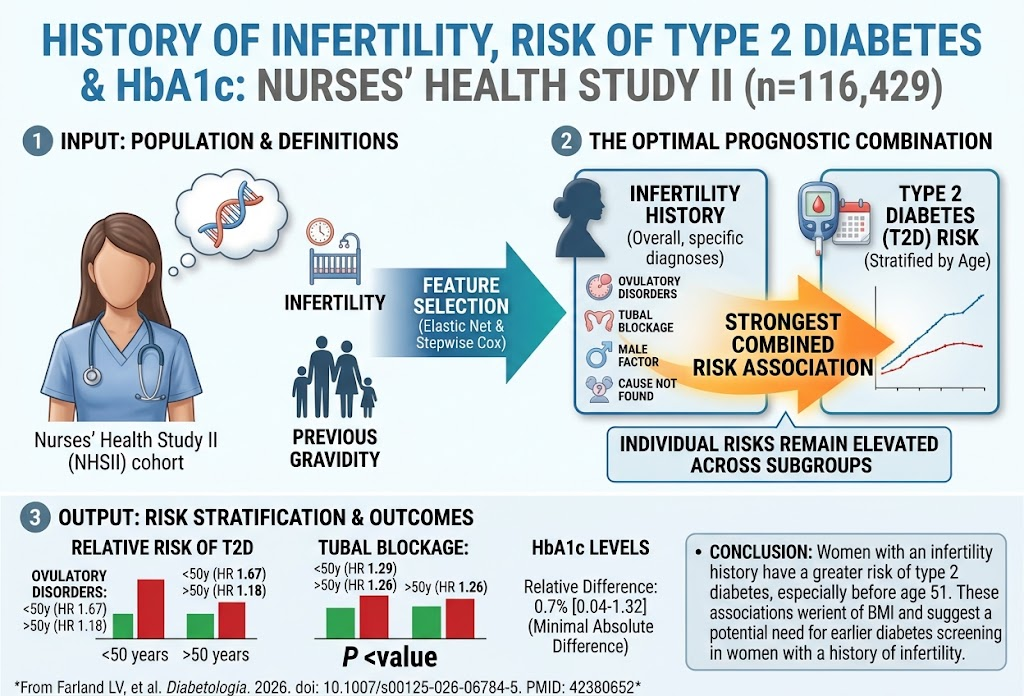
The study revealed that women with a history of infertility had a significantly greater risk of developing type 2 diabetes, especially before age 51. Overall infertility history was associated with a 32% increased risk of type 2 diabetes (HR 1.32, 95% CI 1.22–1.43) up to age 50. After 50 years, the association attenuated but remained statistically significant (HR 1.12, 95% CI 1.06–1.19), indicating a diminished but persistent risk in the postmenopausal period.
When dissecting infertility by cause, ovulatory disorders carried the highest risk increase, with a 67% elevated risk of type 2 diabetes before age 51 (HR 1.67, 95% CI 1.48–1.89) and a modestly attenuated risk post-50 (HR 1.18, 95% CI 1.05–1.32). Tubal blockage and male factor infertility were each associated with approximately 30% increased diabetes risk, persisting beyond 50 years for tubal blockage (HR 1.26, 95% CI 1.05–1.51). The cause not found group also showed about a 26% greater risk up to age 50.
Importantly, in the subgroup of women with BMI <25 kg/m2 at age 18, the association between infertility and diabetes remained elevated (HR 1.32 before 50 years, HR 1.11 after 50 years), underscoring that these risks are not solely attributable to obesity.
Regarding glycemic control, women with infertility history exhibited slightly higher mean HbA1c levels, with a relative difference of 0.7% (95% CI 0.04–1.32). However, this represented a minimal absolute increase, likely reflecting early metabolic dysfunction but still of clinical interest.
Expert Commentary
This robust longitudinal analysis highlights a clinically relevant link between reproductive health and metabolic disease risk. Ovulatory disorders, including polycystic ovary syndrome (PCOS), are well-recognized to intersect with insulin resistance pathways, mirroring the higher diabetes risk observed. The persistent risk in specific infertility causes such as tubal factor infertility suggests that other shared inflammatory or hormonal mechanisms may contribute.
Strengths of the study include the large sample size, detailed infertility subtypes, prospective design, and adjustment for BMI and other confounders. Limitations include reliance on self-reported infertility and diabetes diagnosis, though prior validation studies support their accuracy. Generalizability may be limited to largely white, healthcare professional women.
These findings align with clinical guidelines recommending metabolic screening in women with reproductive disorders, particularly ovulatory dysfunction. Further mechanistic studies are warranted to elucidate pathways linking infertility subtypes to diabetes development and to assess whether early intervention might modify this risk trajectory.
Conclusion
The Nurses’ Health Study II underscores that a history of female infertility, notably due to ovulatory disorders and tubal factors, is associated with a substantially increased risk of type 2 diabetes independent of BMI. This risk is most pronounced prior to menopause but persists thereafter. Minor elevations in HbA1c levels suggest early metabolic derangement. Clinicians managing infertility should be vigilant of long-term metabolic health implications and consider integrated screening and preventive strategies.
Future research should explore targeted interventions in reproductive-age women with infertility to mitigate subsequent diabetes risk and improve overall health outcomes.
Funding and Registration
The study was funded by the National Institutes of Health (NIH). The Nurses’ Health Study II is a well-established prospective cohort with data collection ongoing under institutional review board approvals. No clinical trial registration applies as this is an observational cohort analysis.
References
- Farland LV, Degnan WJ, Wang S, et al. History of infertility, risk of type 2 diabetes and HbA1c levels in the Nurses’ Health Study II. Diabetologia. 2026;69(9):2523-2533. doi:10.1007/s00125-026-05945-2
- Goodarzi MO, Dumesic DA, Chazenbalk G, Azziz R. Polycystic ovary syndrome: Etiology, pathogenesis and diagnosis. Nat Rev Endocrinol. 2011;7(4):219-231.
- Kim C, Halvorson LM. Cardiovascular risk and polycystic ovary syndrome. Obstet Gynecol Surv. 2017;72(6):335-342.