Highlight
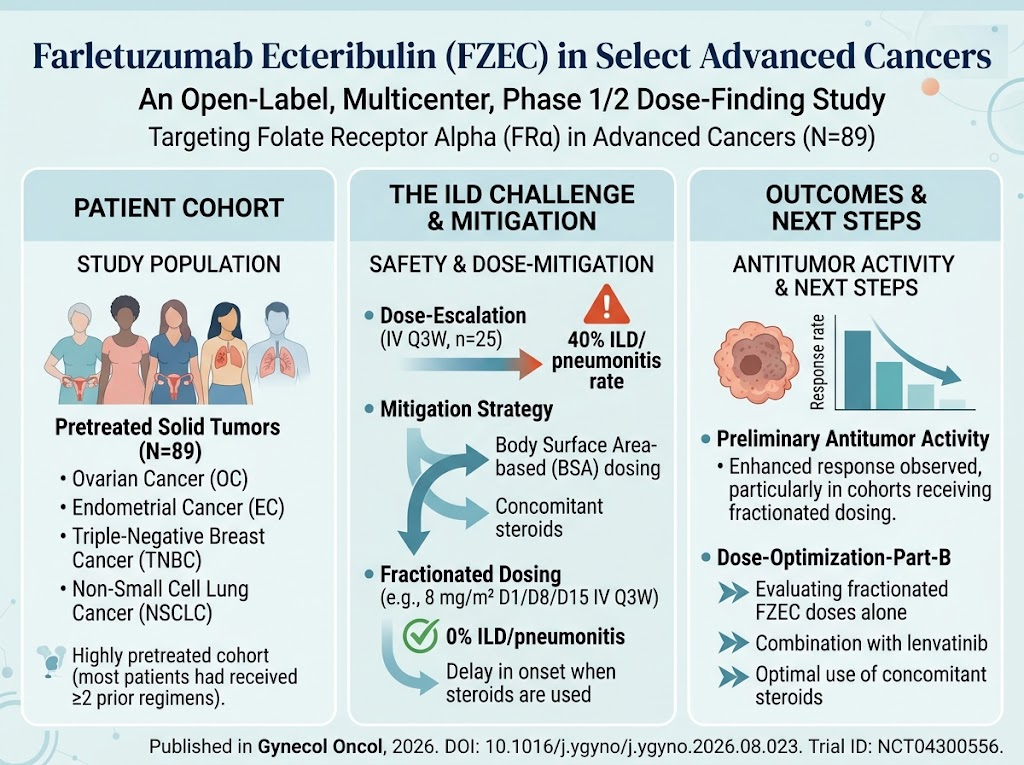
• Farletuzumab ecteribulin (FZEC) is an antibody-drug conjugate (ADC) directed against folate receptor alpha (FRα), evaluated in pretreated advanced solid tumors including ovarian, endometrial, triple-negative breast, and non-small cell lung cancer.
• Interstitial lung disease (ILD)/pneumonitis emerged as a significant toxicity, occurring in up to 40% of patients during initial dosing with flat dosing.
• Switching to body surface area (BSA)-based dosing and employing fractionated doses with corticosteroid prophylaxis reduced ILD incidence and delayed onset.
• Fractionated dosing at 8 mg/m2 on days 1, 8, and 15 without ILD events showed promising antitumor responses in a small cohort, warranting further study.
Study Background
Folate receptor alpha (FRα) is highly expressed in various epithelial cancers, notably ovarian and endometrial carcinomas, making it a compelling target for therapeutic intervention. Traditional chemotherapy regimens in advanced diseases often face limitations due to toxicity and resistance. Antibody-drug conjugates (ADCs), which combine specificity of monoclonal antibodies with potent cytotoxic payloads, represent a precision oncology approach. Farletuzumab ecteribulin (FZEC) is a novel ADC linking a FRα-targeting antibody to ecteribulin, a microtubule inhibitor, aiming to selectively deliver cytotoxic therapy while sparing normal tissues. However, ADCs can induce off-target toxicities, with pulmonary adverse events such as ILD posing clinical challenges. This study addresses the safety, optimal dosing, and preliminary efficacy of FZEC in pretreated advanced solid tumors with FRα expression, where unmet needs remain significant.
Study Design
This open-label, multicenter phase 1/2 trial enrolled 89 patients aged ≥18 years with measurable disease per RECIST v1.1 criteria. Eligibility included advanced ovarian cancer (OC), endometrial cancer (EC), triple-negative breast cancer (TNBC), and non-small cell lung cancer (NSCLC), all having received prior systemic therapies (median age 67 years).
The study consisted of sequential parts:
- Dose-Escalation: Administered flat doses of FZEC at 0.9 mg/kg and 1.2 mg/kg IV every 3 weeks (Q3W) in 25 patients to identify maximum tolerated dose and safety profile.
- Dose-Confirmation: Shifted to body surface area (BSA)-based dosing at 25 mg/m2 and 33 mg/m2 IV Q3W in OC/EC patients (n=24) to validate safety and preliminarily explore efficacy.
- Dose-Optimization Part A: Tested fractionated dosing regimens (8 mg/m2 on days 1, 8, and 15; 12 mg/m2 on days 1 and 8; 25 mg/m2 day 1 plus prophylactic steroids IV Q3W) for further ILD mitigation and response optimization.
The primary endpoints included safety evaluation focusing on ILD incidence and objective tumor response rates; secondary endpoints involved pharmacokinetics and preliminary efficacy.
Key Findings
Safety and ILD/Pneumonitis:
ILD and pneumonitis were identified as dose-limiting toxicities. During dose-escalation, 40% of patients experienced ILD/pneumonitis, leading to alterations in dosing strategy. Transitioning to BSA-based dosing reduced severity; however, in dose-confirmation at 25 mg/m2, 33.3% of patients still exhibited ILD/pneumonitis, though all cases were grade 1 or 2. Higher 33 mg/m2 dosing was discontinued due to toxicity concerns.
Fractionated dosing with and without steroid premedication demonstrated improved safety. Importantly, no ILD/pneumonitis events occurred in patients receiving 8 mg/m2 on days 1, 8, and 15, although sample size in this cohort was limited. Steroid use had a similar ILD incidence but appeared to delay pulmonary toxicity onset, suggesting a potential mitigation role.
Antitumor Activity:
Preliminary signs of efficacy emerged, particularly with the 8 mg/m2 fractionated schedule, which yielded a higher response rate compared to other regimens. This suggests that split dosing maintains antitumor activity while enhancing tolerability. The overall response durability, median progression-free survival, or survival data were not reported in detail, reflecting the phase 1/2 study’s exploratory nature.
Pharmacologic Considerations:
Data supported that BSA-based and fractionated dosing adjusted systemic exposure, potentially reducing peak-related toxicity such as ILD. Incorporation of steroids aimed to suppress inflammatory lung reactions triggered by the ADC’s microtubule-inhibiting payload.
Expert Commentary
The emergence of ILD as a significant adverse event with FZEC underscores the challenges in ADC development, especially those delivering tubulin inhibitors, known for pulmonary toxicity. The study’s adaptive design, moving from flat dosing to fractionated BSA-based schedules and steroid prophylaxis, exemplifies a promising strategy to balance efficacy and safety. Although the small sample size of the fractionated dosing cohort limits statistical power, the absence of ILD and encouraging responses are noteworthy.
Given that FRα is primarily expressed on tumor cells and minimally on normal tissues, lung toxicity likely arises from off-target effects or microtubule inhibitor-related inflammation rather than direct antigen binding. This premise justifies continued exploration of dosing strategies and adjunctive therapies to improve tolerability.
Study limitations include modest patient numbers, limited NSCLC and TNBC representation, and absence of randomized comparators. Future trials should address long-term outcomes, biomarker correlations for ILD risk, and combinational regimens, such as the upcoming Dose-Optimization-part-B combining FZEC with lenvatinib, a multi-kinase inhibitor with established activity in gynecologic cancers.
Conclusion
Farletuzumab ecteribulin represents an innovative FRα-targeted ADC with preliminary efficacy in pretreated advanced carcinomas, particularly ovarian and endometrial cancers. This phase 1/2 study highlights the critical need to modulate dosing to mitigate ILD risk, with fractionated dosing and corticosteroids emerging as effective interventions to improve safety. These findings pave the way for continued clinical development exploring optimal dosing regimens and combination therapies to enhance patient outcomes while minimizing pulmonary toxicity.
Funding and Clinical Trial Registration
This study was registered under ClinicalTrials.gov identifier NCT04300556. Funding sources were not specified in the abstract but are typically disclosed in the full publication.
References
- Wenham RM, Ray-Coquard I, Kristeleit R, et al. Farletuzumab ecteribulin, a folate receptor alpha (FRα) antibody-drug conjugate, in select advanced cancers: An open-label, multicenter, phase 1/2 dose-finding study. Gynecol Oncol. 2026 Oct 5;213:109-119. PMID: 42833056.
- Kelland L. The resurgence of platinum-based cancer chemotherapy. Nat Rev Cancer. 2007 Aug;7(8):573-84.
- Govindan R, et al. Interstitial Lung Disease and Pneumonitis Associated with Antibody-Drug Conjugates and Tubulin Inhibitors in Oncology. J Thorac Oncol. 2022 Feb;17(2):164-175.
- Matei D, et al. Folate receptor alpha expression in gynecologic malignancies. Gynecol Oncol. 2013 Jan;128(1):137-43.