Highlight
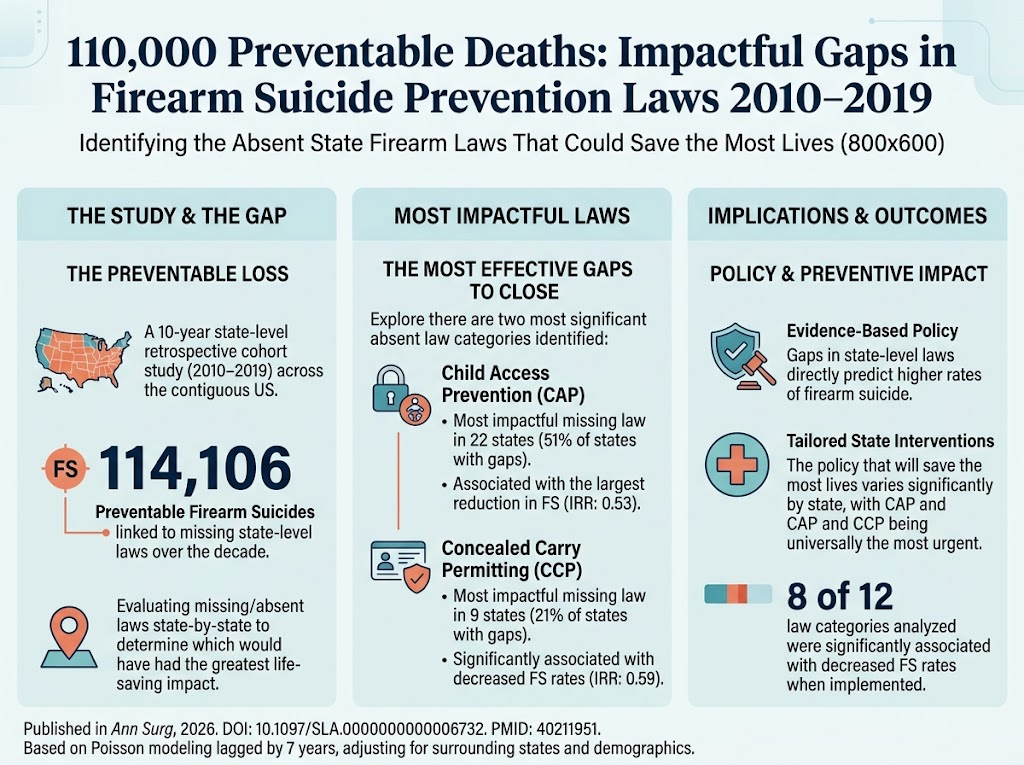
This comprehensive study identifies critical legislative gaps in firearm suicide prevention across U.S. states, pinpointing child access prevention (CAP) and concealed carry permitting (CCP) laws as the most impactful missing regulations. Implementing these laws could have prevented an estimated 114,106 firearm suicides from 2010 to 2019.
Study Background
Firearm suicide is a major public health crisis in the United States, representing a substantial proportion of the over 48,000 annual suicide deaths. Evidence suggests that states with stringent gun control laws generally report lower rates of firearm suicides. However, the efficacy of specific laws varies widely, and previous research has not sufficiently addressed how these laws’ impacts differ by state. Given the complex legal landscape and varying cultural contexts across the U.S., understanding which absent laws would most effectively reduce firearm suicides in individual states is essential for targeted policy interventions.
Study Design
This retrospective cohort study analyzed firearm suicide rates and firearm laws across the contiguous United States from 2010 through 2019. State-level firearm laws were categorized into 12 discrete types, including child access prevention (CAP) laws and concealed carry permitting (CCP). Poisson regression models assessed associations between firearm suicide incidence per 100,000 population and the presence or absence of these laws, using a seven-year lag period to account for delayed policy effects. The model also incorporated spatial weighting of firearm laws in neighboring states and adjusted for demographic variables. The goal was to estimate the potential reduction in firearm suicides attributable to implementing each absent law in each state, thereby identifying the most impactful missing law per state.
Key Findings
Out of the 12 law categories studied, eight demonstrated a significant association with decreased firearm suicide rates. Notably, child access prevention laws exhibited the strongest association with reduced firearm suicides (incidence rate ratio [IRR] 0.53, 95% confidence interval [CI] 0.48–0.59, P < 0.001), indicating a 47% reduction in firearm suicide rates where these laws were present. Concealed carry permitting laws also showed a significant protective effect (IRR 0.59; 95% CI 0.54–0.65; P < 0.001), corresponding to a 41% reduction.
Out of all states analyzed, five states had comprehensive implementation of all 12 firearm law categories during the study period. Among the remaining states, child access prevention laws were identified as the most impactful missing regulation in 22 states (51%), while concealed carry permitting laws held this distinction in nine states (21%). Modeling estimated that the absence of these most effective missing laws collectively accounted for approximately 114,106 preventable firearm suicides across the studied decade.
The study also controlled for neighboring states’ laws, acknowledging cross-border influences on firearm access and legislation effectiveness, and adjusted for state demographics including age distribution, socioeconomic status, and urbanization.
Expert Commentary
This study provides compelling, state-specific evidence to guide firearm suicide prevention policies. The robust association of CAP laws with decreased firearm suicides aligns with previous findings emphasizing the importance of restricting youth access to firearms. By requiring secure firearm storage or imposing liability for unsupervised access, CAP laws disrupt one of the most common means of impulsive firearm suicides in adolescents and adults alike.
The role of concealed carry permitting laws is more nuanced but suggests that regulatory oversight of firearm possession may reduce suicide risks, possibly through background checks, waiting periods, or training requirements that accompany permit issuance. However, further research is warranted to explore mechanistic pathways.
Despite its strengths, limitations include potential residual confounding inherent to ecological analyses, and the assumption that all laws uniformly affect diverse populations within a state. Moreover, cultural and enforcement differences may modulate law efficacy.
Conclusion
This study highlights that strategically closing legislative gaps through implementing child access prevention and concealed carry permitting laws represents a promising pathway to reducing firearm suicides in the U.S. Policymakers should prioritize enactment and enforcement of these laws, tailored to state-specific needs, to address over 110,000 preventable firearm deaths over the past decade. Ongoing research and surveillance will be critical to evaluate real-world policy impacts, inform nuanced legislation, and ultimately save lives.
Funding and ClinicalTrials.gov
The original study did not report specific funding sources or trial registry identifiers.
References
- Laudon AD, Franks JA, Davis ES, et al. 110,000 Preventable Deaths: The Most Impactful Gaps in Firearm Suicide Prevention Laws 2010-2019. Ann Surg. 2025 Apr 11;284(4):849-858. PMID: 40211951.
- Swanson JW, Easter MM, Alanis-Hirsch K, et al. Gun violence and firearm suicide among mental health patients in the United States. JAMA Psychiatry. 2017;74(11):1137-1145.
- Miller M, et al. Gun prevalence and suicide: Cross-national comparisons. Soc Sci Med. 2009;69(9):1411-1418.
- Wintemute GJ. Firearm availability and suicide: A critical review. Epidemiol Rev. 2015;37:131-140.