Introduction
The Smart Bedside Station (SBS) system is an innovative interactive digital terminal designed to provide hospitalized patients with easy access to health information and bedside services. As hospitals increasingly adopt these technologies, the goal is to improve patient engagement, autonomy, and quality of care. While the SBS system offers various functions such as educational videos, expense tracking, call features to nurses, and entertainment, actual patient adoption and sustained use remain variable. Understanding which factors encourage or inhibit use can help optimize these technologies in clinical settings.
Background and Rationale
With technological advancement in healthcare, digital tools at the patient’s bedside serve to bridge communication gaps and empower patients in their treatment process. The Unified Theory of Acceptance and Use of Technology (UTAUT) provides a useful framework to investigate why patients accept or reject novel technology. UTAUT highlights core constructs influencing technology use: performance expectancy, effort expectancy, social influence, and facilitating conditions.
Previous studies have focused on healthcare providers’ perspectives or technology design factors, but patient-centered insights remain limited. Given the diversity in patient demographics and clinical contexts, exploring real-world facilitators and barriers from the patients’ point of view is essential to tailor effective implementations.
Study Objectives
This qualitative descriptive study aimed to explore, through semi-structured interviews, the facilitators that promote and the barriers that inhibit the use of SBS systems among hospitalized patients, applying the UTAUT model to structure data collection and analysis.
Methods
Design and Participants: Conducted in September 2024, the study recruited 13 inpatients aged 22 to 73 years with prior experience using SBS systems at a tertiary hospital. Participants were selected purposively to capture diverse perspectives including gender and varied clinical conditions.
Data Collection: Interviews were guided by themes derived from UTAUT, focusing on experiences with system functionality, usability, perceived benefits, social encouragement, and contextual challenges.
Data Analysis: A hybrid thematic analysis approach was employed—incorporating both inductive coding and deductive mapping against UTAUT constructs—to identify key facilitators and barriers.
Results
Among the 13 participants (9 men, 4 women), most first learned about the SBS system from nursing staff, with only two discovering it independently. Usage durations were generally short-term; only about 15.4% used the system for more than 30 days.
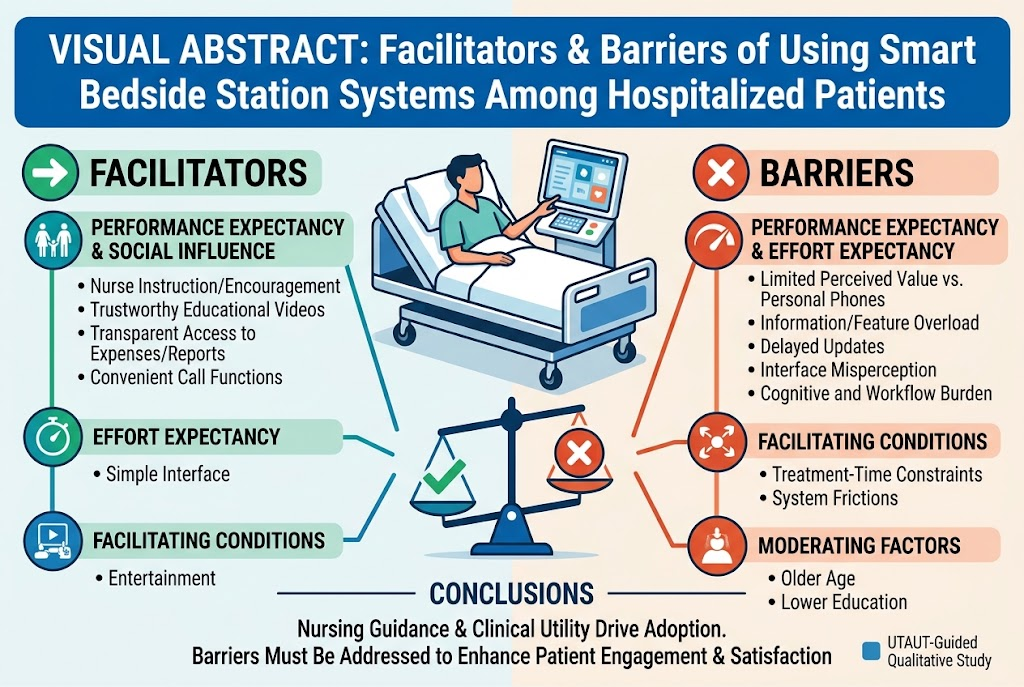
Facilitators: Key elements encouraging use included comprehensive nurse instruction and encouragement, trustworthy educational health videos, transparent and accessible cost and report information, convenient nurse call functions, and available entertainment options. These aspects aligned with UTAUT’s performance expectancy, social influence, and facilitating conditions. Additionally, a simple and intuitive system interface reduced effort expectancy, making usage easier and more appealing.
Barriers: Conversely, participants reported several obstacles. Many perceived that the SBS system lacked significant added value compared to their personal smartphones. Treatment-related time constraints and workflow demands limited opportunity to engage with the system. Information and feature overload sometimes caused confusion. Technical issues like delayed content updates or lagging interfaces diminished satisfaction. Misinterpretations of the user interface and fears about misoperation or unintended charges further discouraged use. Demographic factors such as older age and lower education levels were associated with challenges in navigating the system.
Discussion
The findings highlight nursing staff as critical facilitators who can motivate patients and demonstrate system benefits, particularly through guided education employing reliable video content. Educative and communicative support builds patient trust and perceived utility, encouraging adoption.
However, cognitive and workflow burdens—such as information overload or complex interfaces—and system friction points can quickly overwhelm patients, leading to abandonment or minimal use. Many patients preferred their familiar personal devices for information access and entertainment, signaling that SBS systems must offer distinctive and clear added value.
Addressing these barriers requires system refinement to simplify interfaces, streamline features, and optimize update responsiveness. Tailored support for older adults and those less digitally literate is also vital. Integrating patient feedback into system design and hospital workflows can improve usability and acceptance.
Conclusions
This study underscores the importance of comprehensive nursing guidance and clinically relevant video education to drive SBS system adoption in hospitals. To achieve sustained patient engagement and satisfaction, hospitals should focus on enhancing system usability, reducing cognitive burdens, and clearly differentiating system benefits from personal devices.
Improving these factors will support wider implementation of Smart Bedside Station systems, contributing to more patient-centered, technologically advanced care environments.
Implications for Practice
Healthcare institutions planning or currently implementing SBS solutions should:
- Invest in nurse training to deliver effective system introductions and ongoing encouragement.
- Develop high-quality, trustworthy educational content tailored to various patient needs.
- Focus on simplifying interface design and limiting feature overload.
- Provide targeted assistance for older and less digitally proficient patients.
- Ensure transparent information about costs and billing to alleviate fears of unintended charges.
- Optimize system responsiveness and update frequency to maintain content relevance.
By addressing these facilitators and barriers, hospitals can foster meaningful patient engagement with bedside technology, ultimately enhancing care quality and patient satisfaction.
Limitations and Future Research
This study was limited by a small sample size from a single medical center, which may affect generalizability. Further research involving larger, more diverse patient populations and multiple institutions would enrich understanding. Quantitative studies measuring the impact of specific facilitators and barriers on system usage are also recommended. Additionally, exploring integration with personal devices might provide insights to improve SBS system appeal.
References
Shi J, Li Z, Dai Y, Chen X, Yang L, Wang X, Ma P. Facilitators and Barriers of Using Smart Bedside Station Systems Among Hospitalized Patients: A Qualitative Study Based on UTAUT. Journal of General Internal Medicine. 2026 Sep 14. PMID: 42736529. Available from: https://pubmed.ncbi.nlm.nih.gov/42736529/