Highlight
- New-onset eating difficulty correlates with increased dementia risk, reflecting wider functional impairment rather than isolated oral health issues.
- Dental status, such as tooth loss or poor dental health, shows minimal independent association with cognitive decline after adjustment.
- Recurrent eating difficulties and concurrent functional limitations predict the largest risk differences for dementia indicators over six years.
- Eating difficulty in clinical settings should prompt comprehensive functional and cognitive evaluation instead of serving as a sole dementia screening tool.
Study Background
Aging populations face increasing cognitive decline and dementia-related burdens, which pose significant public health challenges globally. Early identification of risk markers is crucial for timely intervention and care planning. Oral health and eating ability impairments are prevalent in older adults and have been postulated as potential early signs or contributing factors to cognitive deterioration. However, the causal pathways and specificity of such associations remain unclear. This study addresses the gap by investigating whether eating difficulty or dental problems precede abrupt cognitive decline or rather signal broader functional vulnerabilities associated with dementia risk.Study Design
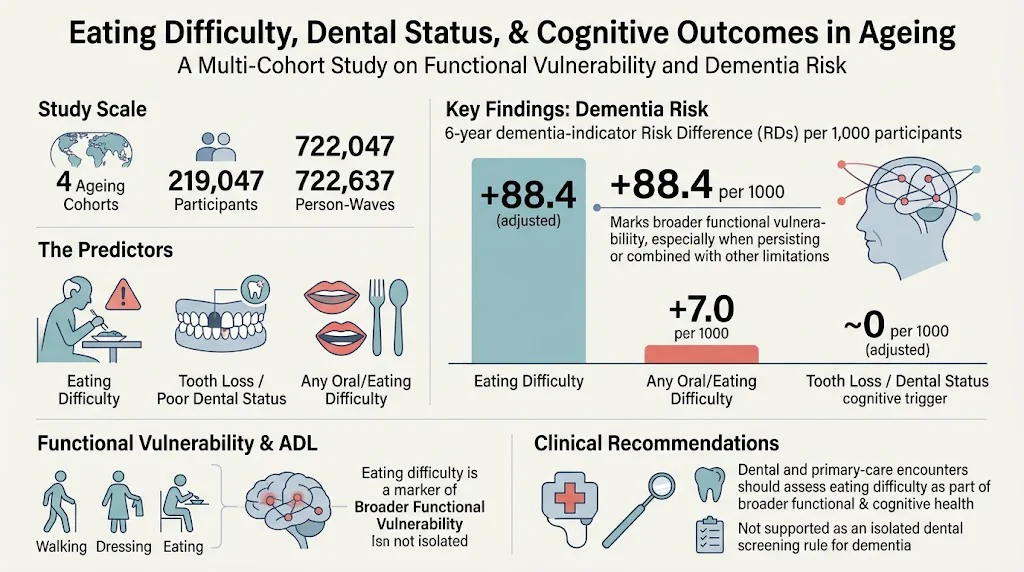
This large-scale epidemiological investigation harmonized data from four prominent ageing cohorts: the China Health and Retirement Longitudinal Study (CHARLS), English Longitudinal Study of Ageing (ELSA), Health and Retirement Study (HRS), and Survey of Health, Ageing and Retirement in Europe (SHARE). Combined, they included 219,047 participants and 722,637 person-waves, representing diverse geographical populations. The study employed a matched-cohort design, aligning initial reports of new eating difficulties, tooth loss, or poor dental health with corresponding observation waves in each cohort. Cognitive trajectories, dementia indicators over a fixed 6-year window, and functional measures (including both oral/eating and non-eating activities of daily living) were examined. Statistical models included risk differences (RDs) with 95% confidence intervals (CIs), adjusted analyses accounting for confounders, and event-time models to evaluate the time course and directionality between eating difficulty onset and cognitive decline.Key Findings
The main findings highlight eating difficulty as a robust marker of increased dementia risk and functional vulnerability: – The matched 6-year risk difference for dementia indicators was 91.5 per 1000 (95% CI: 42.4 to 140.6) for newly reported eating difficulty, which remained largely unchanged after adjustment (88.4 per 1000). – For any oral/eating difficulty combined, the unadjusted RD was 39.5 per 1000 (95% CI: -9.6 to 88.6) but declined to 7.0 per 1000 after adjustment, indicating confounding influences. – Tooth loss or poor dental health alone did not significantly predict dementia risk after adjustment (adjusted RD ~0 per 1000). – When eating difficulty co-occurred with other functional limitations, the dementia-related risk difference increased markedly to 105.1 per 1000, and persistence of eating difficulty across waves was associated with an even higher RD of 202.1 per 1000. – Event-time analyses showed no evidence of abrupt cognitive decline acceleration following reported eating difficulty. Instead, lower baseline cognitive status predicted future onset of eating difficulties, suggesting reverse causality or a bidirectional relationship. These findings collectively argue that eating difficulty is an indicator of broader functional and cognitive impairments rather than a discrete oral-mediated trigger of dementia.Expert Commentary
This study substantially advances understanding of swallowing and oral function within the context of ageing and cognition. The large, multinational cohorts and harmonized methodology enhance the reliability and generalizability of findings. The lack of significant association between dental status and cognitive outcomes after adjustment challenges assumptions that tooth loss directly precipitates cognitive decline. Instead, eating difficulty seems to represent an integrated marker capturing multiple dimensions of ageing vulnerability—including neuromuscular control, nutrition, and broader physical impairment. Recognizing eating difficulty as a red flag for functional decline rather than an isolated oral health problem has pragmatic implications. Dental and primary care professionals are well positioned to initiate comprehensive geriatric assessments when such difficulties arise, facilitating early multidisciplinary intervention. Limitations include reliance on self-reported or caregiver-reported oral and eating measures, which may be subject to bias or underreporting. Additionally, clinical dementia diagnosis was not available, restricting analyses to cognitive indicators and proxy measures. Future research should explore mechanistic pathways linking eating function with neurodegeneration and validate findings in more granular clinical cohorts.Conclusion
Eating difficulty is a clinically meaningful marker of broader functional vulnerability associated with increased risk for cognitive decline and dementia indicators. In contrast, dental health status such as tooth loss appears insufficient alone to predict these outcomes after accounting for confounders. This distinction underscores the importance of holistic functional evaluations in ageing populations reporting eating difficulties. Consequently, clinicians should incorporate screening for eating difficulties as a trigger for comprehensive cognitive and functional assessment rather than relying on it as a sole oral-specific dementia screening tool. Dental and primary care encounters offer valuable opportunities for early recognition of broader geriatric syndromes, informing tailored intervention strategies to improve outcomes in older adults.Funding and ClinicalTrials.gov
The study did not report specific funding sources or clinical trial registration numbers.References
1. Wei L, Liu T, Yang S, Chu Y, Han Y. Eating difficulty, dental status, and functional vulnerability in relation to cognitive outcomes across four ageing cohorts. J Dent. 2026 Oct 26;107129. PMID: 42933590. 2. Livingston G, Huntley J, Sommerlad A, et al. Dementia prevention, intervention, and care: 2020 report of the Lancet Commission. Lancet. 2020;396(10248):413-446. 3. Chen X, Mao G, Leng SX. Frailty syndrome: an overview. Clin Interv Aging. 2014;9:433-441. 4. Ikebe K, Ogawa H, Masui Y, et al. Oral frailty as a risk factor for physical frailty and mortality in community-dwelling elderly. J Am Geriatr Soc. 2018;66(10):1909-1916. 5. Peters LL, Bryan J, Freidel S, et al. Harmonization and standardization of cognitive and functional measures for global aging cohorts. Alzheimer’s Dement. 2021;17(6):961-973.Specialty calculators
For clinical reference; use professional judgment.