Highlight
The PANKU-Lung01 trial shows that izalontamab brengitecan (iza-bren), a bispecific antibody-drug conjugate targeting EGFR and HER3, offers a significant progression-free survival benefit over standard platinum-based chemotherapy in advanced EGFR-mutated non-squamous NSCLC following progression on third-generation EGFR TKIs. Despite higher rates of grade 3 or worse adverse events, the safety profile is manageable and supports iza-bren as a potential new treatment option in this difficult-to-treat population.
Study Background
Non-small-cell lung cancer (NSCLC) harboring activating epidermal growth factor receptor (EGFR) mutations represents a significant subset of lung cancers, particularly in Asian populations. Targeted therapies using EGFR tyrosine kinase inhibitors (TKIs), including third-generation agents like osimertinib, have dramatically improved outcomes. However, resistance inevitably develops, and treatment options post third-generation TKI progression remain limited. Platinum-based chemotherapy remains standard of care, but with modest benefit and notable toxicity. Innovative therapies addressing this unmet need are urgently required.
Izalontamab brengitecan is a first-in-class bispecific antibody-drug conjugate designed to simultaneously target EGFR and human epidermal growth factor receptor 3 (HER3), delivering a cytotoxic payload selectively into tumor cells. Preclinical and early clinical studies demonstrated promising antitumor activity in EGFR-mutated NSCLC. The PANKU-Lung01 trial aimed to evaluate the efficacy and safety of iza-bren compared to platinum doublet chemotherapy in patients with advanced non-squamous NSCLC with EGFR mutations after failure of third-generation EGFR TKIs.
Study Design
PANKU-Lung01 is a multicenter, randomized, open-label, phase 3 trial conducted at 73 centers across China. Eligible participants had histologically confirmed EGFR-mutated locally advanced or metastatic non-squamous NSCLC with disease progression after third-generation EGFR TKIs and had not received prior chemotherapy for advanced disease.
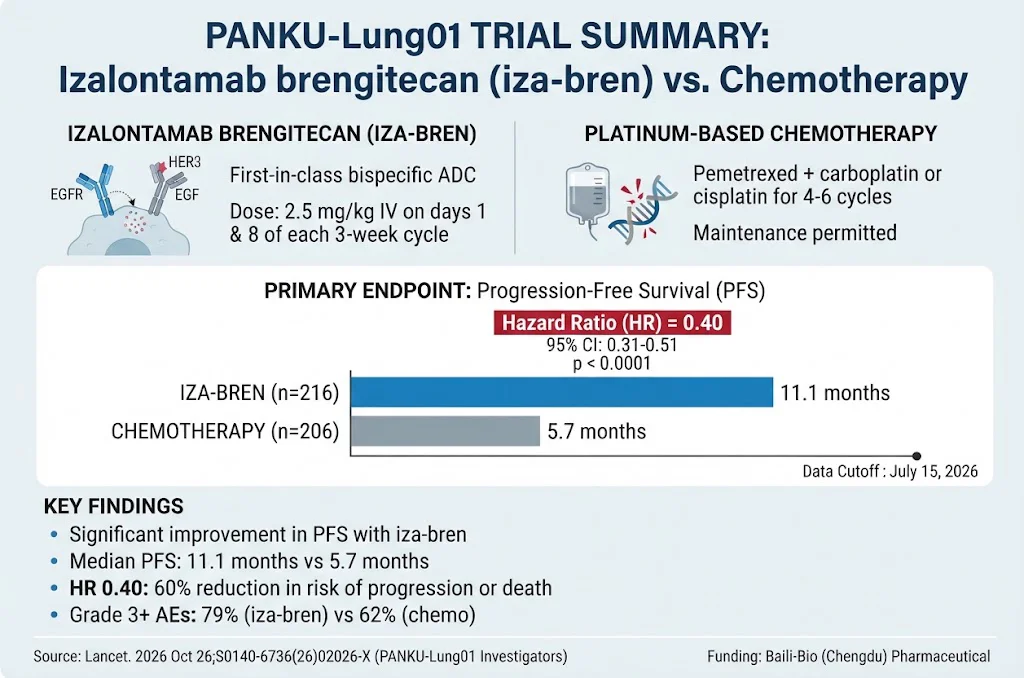
Participants were randomized 1:1 to receive either izalontamab brengitecan (2.5 mg/kg intravenously on days 1 and 8 every 3 weeks) or platinum-based chemotherapy consisting of pemetrexed plus carboplatin or cisplatin for 4 to 6 cycles, with option for pemetrexed maintenance in the chemotherapy arm.
The primary endpoint was progression-free survival (PFS) assessed by blinded independent central review (BICR). Secondary endpoints included overall survival (OS), safety, and tolerability. Analysis was based on the modified intention-to-treat population—patients who received at least one dose of study treatment.
Key Findings
Between May 2024 and September 2025, 654 participants were screened; after excluding 222 patients, 432 were randomized (217 to iza-bren, 215 to chemotherapy). Of these, 422 patients received treatment and were included in the modified intention-to-treat analysis (216 in the iza-bren group and 206 in chemotherapy).
At data cutoff (July 15, 2026), median follow-up was 14.6 months (95% CI 12.9–16.7) in the iza-bren arm and 15.2 months (11.2–18.2) in chemotherapy. Median PFS assessed by BICR was significantly longer with iza-bren at 11.1 months (95% CI 9.2–12.7) compared with 5.7 months (5.5–5.9) for chemotherapy, corresponding to a hazard ratio of 0.40 (95% CI 0.31–0.51; p<0.0001 one-sided), indicating a 60% reduction in risk of progression or death.
Interim analyses of overall survival are ongoing but not yet mature for definitive conclusions.
Regarding safety, grade 3 or higher treatment-related adverse events occurred more frequently in the iza-bren group (79%) versus chemotherapy (62%). These were predominantly hematologic, consistent with known toxicities of antibody-drug conjugates and chemotherapy. Notably, treatment-related interstitial lung disease (ILD) occurred in 1% of iza-bren patients and none in chemotherapy. Permanent treatment discontinuation due to adverse events was similar (2% in each group), and there was one treatment-related death per group.
Expert Commentary
The PANKU-Lung01 trial provides the first robust phase 3 evidence supporting a bispecific antibody-drug conjugate’s use in EGFR-mutated NSCLC after third-generation EGFR TKI failure. The dual targeting of EGFR and HER3 may overcome heterogeneous resistance mechanisms that limit single-target therapies. The substantial PFS advantage reflects meaningful clinical benefit, potentially translating to improved survival pending mature data.
While adverse events were more common with iza-bren, they remained manageable with low discontinuation rates, suggesting a favorable risk-benefit balance. However, vigilance for ILD is required, given its association with EGFR-targeting agents.
Limitations include open-label design and exclusively Chinese patient population, which may affect generalizability. Further studies across diverse populations and longer follow-up are necessary to assess impact on overall survival and quality of life.
Conclusion
For patients with advanced EGFR-mutated non-squamous NSCLC progressing after third-generation EGFR TKIs, izalontamab brengitecan significantly extends progression-free survival compared with platinum-based chemotherapy. This represents a promising new therapeutic avenue addressing a critical unmet need. Careful patient selection and monitoring remain essential given the elevated toxicity profile. These results may shift the standard of care in this setting and pave the way for bispecific antibody-drug conjugates in lung cancer treatment paradigms.
Funding and ClinicalTrials.gov
This investigator-initiated PANKU-Lung01 trial was funded by Baili-Bio (Chengdu) Pharmaceutical. Registered with ClinicalTrials.gov, identifier NCT06382116.
References
Hong S, Zhou T, Hou X, et al. Izalontamab brengitecan versus platinum-based chemotherapy in EGFR-mutated advanced non-squamous non-small-cell lung cancer after progression on third-generation EGFR tyrosine kinase inhibitors (PANKU-Lung01): a multicentre, randomised, open-label, phase 3 trial in China. Lancet. 2026 Oct 26. PMID: 42933461.
Soria JC, Ohe Y, Vansteenkiste J, et al. Osimertinib in untreated EGFR-mutated advanced non-small-cell lung cancer. N Engl J Med. 2018;378(2):113-125.
Li BT, Smit EF, Goto Y, et al. Trastuzumab Deruxtecan in HER2-Mutant Non–Small-Cell Lung Cancer. N Engl J Med. 2022;386(3):241-251.
Specialty calculators
For clinical reference; use professional judgment.