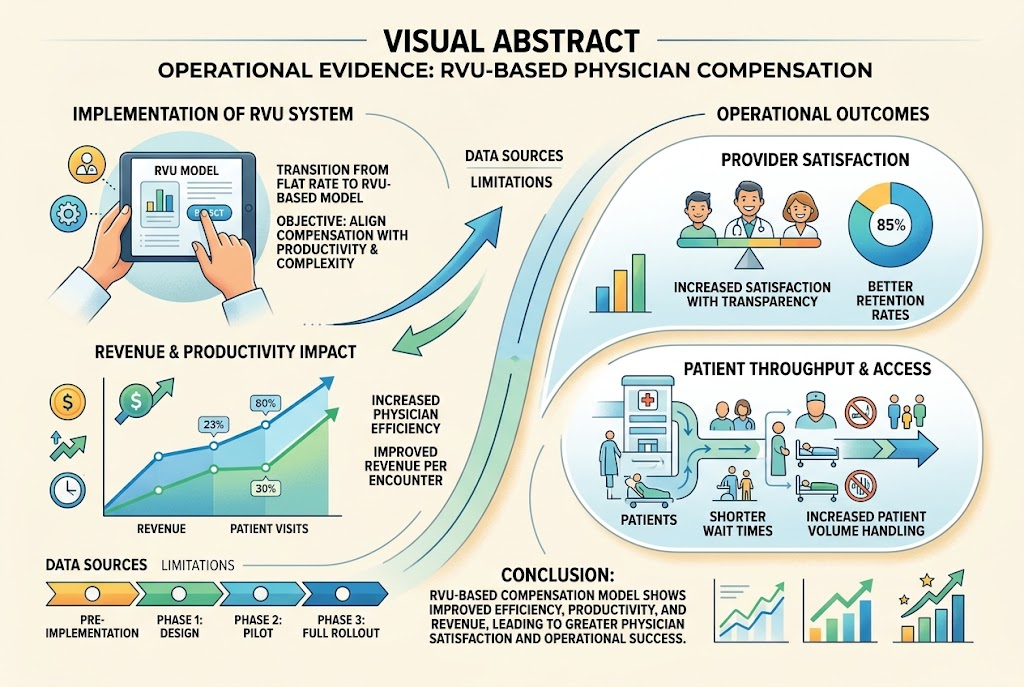
Highlight
- Transitioning from hourly to RVU-based compensation does not significantly affect emergency department productivity or billing intensity.
- No appreciable change was observed in key operational outcomes such as patient left without being seen rates or length of stay.
- Advanced practice provider hours increased relative to physician hours in some models after transitioning to RVU compensation.
- Clinician satisfaction and safety indicators, including clinician attrition and 72-hour return admissions, remained stable across compensation models.
Study Background
Emergency departments (EDs) face ongoing challenges balancing productivity, quality care, and operational efficiency. Physician compensation models within EDs traditionally rely on hourly wages but increasing interest surrounds relative value unit (RVU)-based systems, which tie pay to the volume and complexity of billed services. RVU-based compensation aims to incentivize physician productivity and more accurately reflect physician workload, potentially impacting clinical practices, billing intensity, and patient care outcomes. However, empirical data evaluating this transition’s operational impact in emergency medicine remains limited. Understanding how compensation influences physician behavior and system metrics is crucial for ED leaders considering payment reforms to optimize both resource use and care quality.
Study Design
This observational study examined data from 167 general EDs across the United States between January 2019 and December 2024, encompassing 2,191 site-quarters of operational metrics. The primary intervention was the change from an hourly-based to an RVU-based physician compensation model at select sites. Comparator sites continued hourly compensation. Primary outcomes included site-level relative value units per patient (RVUs/patient), patients per hour (PPH), and left without being seen (LWBS) rates. Secondary outcomes inspected staffing patterns (hours worked by physicians and advanced practice providers [APPs]), operational efficiency metrics (length of stay for discharged patients, admission rates), clinician satisfaction measures (net promoter score, clinician attrition rates), patient safety indicators (72-hour return rates with subsequent admission), use of computed tomography (CT) imaging, and critical care billing percentages.
Analyses used two-way fixed effects and staggered difference-in-difference statistical models controlling for confounders such as patient acuity, boarding hours, ED volume, and payer mix. This robust methodology allowed assessment of within-site changes over time, adjusting for secular trends and contemporaneous differences.
Key Findings
The primary finding was a lack of statistically significant differences attributable to the switch to RVU-based compensation:
- RVUs per Patient: No meaningful increase or decrease in RVUs generated per patient was detected, indicating billing intensity remained stable.
- Patients per Hour (PPH): Physician productivity, as measured by patient throughput, was unaffected by compensation model changes.
- Left Without Being Seen (LWBS) Rates: Patient abandonment rates did not change significantly, suggesting patient flow and satisfaction were not compromised.
Among secondary outcomes:
- Some models showed increased APP hours relative to physician hours, which may indicate staffing adjustments post-implementation, though causality is unclear.
- No significant changes emerged in length of stay, admission rates, clinician satisfaction, clinician attrition, or patient safety as measured by 72-hour return admissions.
- Use of CT imaging and critical care billing percentages remained consistent, indicating no detected shifts in diagnostic intensity or critical care coding practices.
These findings held across multiple analytic approaches and after adjustment for site-specific and temporal confounders, supporting the robustness of the null effects observed.
Expert Commentary
This investigation provides important real-world evidence that transitioning compensation models in emergency medicine settings may not inherently drive changes in physician behavior or operational metrics. Theoretically, RVU-based pay could incentivize increased service intensity or volume; however, this study suggests that physician practices and ED workflows may be influenced more by systemic factors such as departmental policies, patient complexity, and resource availability than by compensation model alone.
The increase in APP hours highlights that staffing strategies might adapt during such transitions, potentially to buffer physician workload or optimize team dynamics. It remains to be clarified whether these adjustments improve care quality or efficiency.
Limitations include potential unmeasured confounders, heterogeneity in site characteristics, and the observational design, which cannot establish causality definitively. Also, implementation nuances (such as specific RVU valuation methods or bonus structures) were not detailed and could moderate effects.
This study complements prior literature emphasizing the need for multifaceted approaches—including workflow optimization, patient triage, and resource alignment—to achieve meaningful gains in ED operational performance and care quality.
Conclusion
The national data on transitioning from hourly to RVU-based emergency physician compensation demonstrate no significant impact on billing intensity, productivity, patient flow, or secondary operational and safety measures. While RVU-based models might intuitively foster greater output, their influence appears limited in complex ED environments where multiple factors dictate clinical and operational behaviors.
Emergency medicine stakeholders should consider that compensation restructuring alone is unlikely to yield substantial improvements without concurrent system-level interventions. Future research should explore how compensation models interact with other organizational strategies and impact long-term clinician satisfaction, financial sustainability, and patient-centered outcomes.
Funding and ClinicalTrials.gov
The publication does not specify external funding sources or clinical trial registration numbers. Further inquiries may refer to the US Acute Care Solutions Research Group for ancillary study details.
References
1. Kachman MM, Zocchi MS, Nikolla DA, et al. Implementation of Relative Value Unit-Based Physician Compensation in Emergency Physicians: Operational Evidence From a National Group. Ann Emerg Med. 2026 Sep 11. PMID: 42730744.
2. Hall MK, Lee H, Pines JM. Emergency Department Physician Compensation Models and Emergency Care Delivery. Ann Emerg Med. 2021;78(5):628-636.
3. Jena AB, Prasad V. Performance Incentives and Physician Behavior in Emergency Medicine: An Evidence Review. Health Serv Res. 2020;55 Suppl 3:834-847.
4. Wilcox R et al. The Role of Advanced Practice Providers in Emergency Medicine: A Review of Staffing Trends and Outcomes. J Emerg Med. 2022;63(4):451-459.